Booking Holdings Inc 市场表现:Booking 如何赢得在线旅游5年,又如何赢得AI旅游?
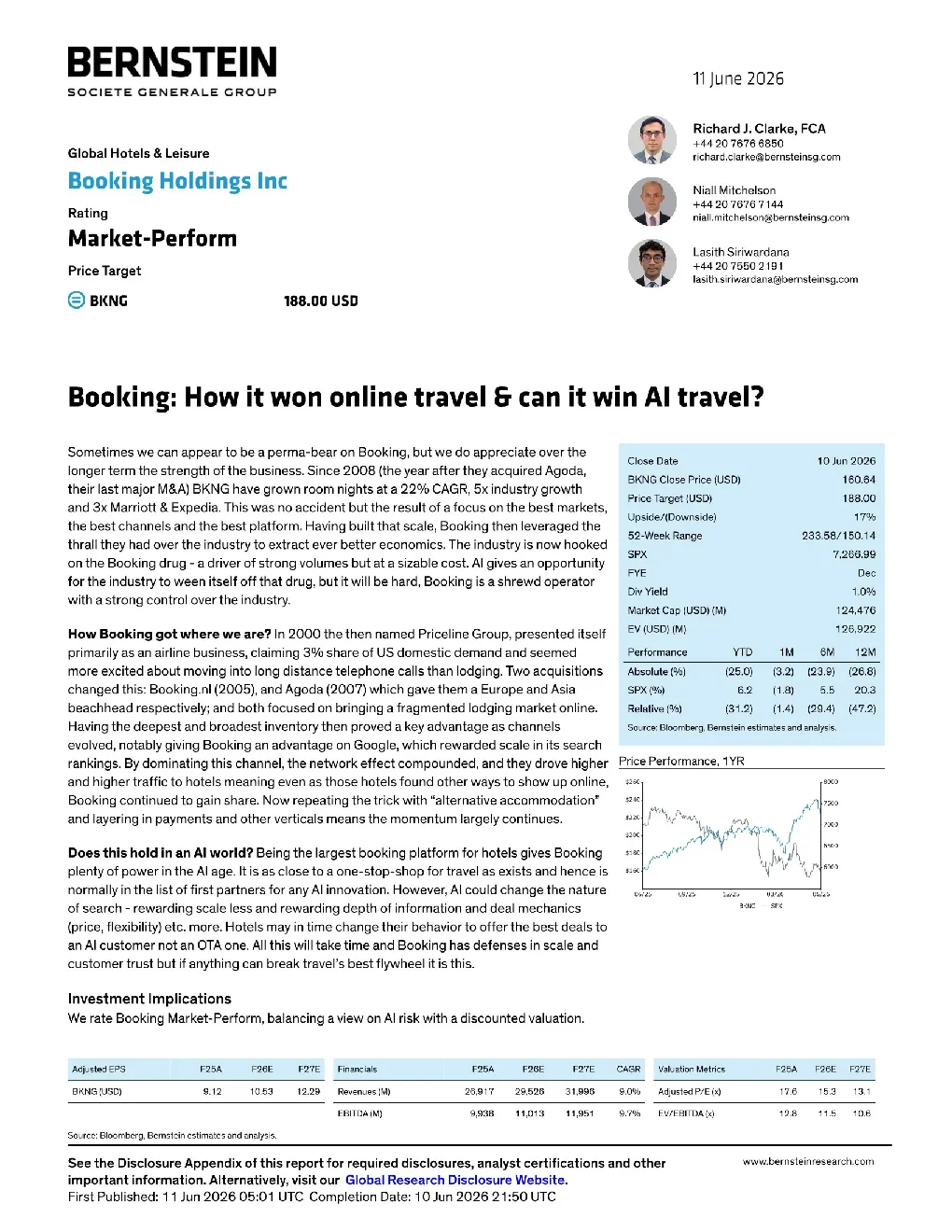
+44 20 76766850richard.clarke@bernsteinsg.com +44 20 7676 7144niall.mitchelson@bernsteinsg.com Market-PerformPrice Target +44 20 7550 2191lasith.siriwardana@bernsteinsg.com Booking: How it won online travel & can it win Al travel? longer term the strengthof the business.Since 2008 (the year after they acquired Agoda,their last major M&A) BKNG have grown room nights at a 22% CAGR, 5x industry growthand 3x Marriott & Expedia.This was no accidentbutthe result of afocus on the best markets,the best channels and the best platform. Having built that scale, Booking then leveraged thethrall they had over the industryto extract ever better economics. The industry is now hookedon the Booking drug-a driver of strong volumes but at a sizable cost. Al gives an opportunityfor the industry to ween itself off that drug, but it will be hard, Booking is a shrewd operatorwith a strong control overthe industry. How Booking got where we are? In 2000 the then named Priceline Group,presented itselfprimarilyasan airline business,claiming3% share of US domestic demandand seemedmore excited about moving into long distance telephone calls than lodging. Two acquisitionschanged this: Booking.nl (2005), and Agoda (2007) which gave them a Europe and Asiabeachhead respectively; and both focused on bringing a fragmented lodging market online.Having the deepest and broadest inventorythen proved akey advantageas channelsevolved, notably giving Booking an advantage on Google, which rewarded scale in its searchrankings. By dominating this channel, the network effect compounded, and they drove higherand higher traffic to hotels meaning evenasthose hotels found other ways to show up online,Booking continued to gain share.Now repeating the trick with“alternative accommodation"and layering in payments and other verticals means the momentum largely continues. Does this hold in an Al world? Being the largest booking platform for hotels gives Bookingplenty of power in the Alage. It is as close to a one-stop-shop for travelas exists and hence isnormally in the list of first partners for any Al innovation. However, Al could change the natureof search -rewarding scale less and rewarding depth of information and deal mechanics(price, flexibility) etc. more. Hotels may in time change their behavior to offer the best deals toan Al customer notan OTA one.All this will taketime and Booking has defenses in scale andcustomer trust but if anything can break travel's best flywheel it is this. InvestmentImplications We rate Booking Market-Perform,balancing a view on Al risk witha discounted valuation. Stage1-build thebiggest, broadest supplybaseStage 2 - leverage that scale advantage in thenew funnel..7Stage3-suppliersbecamedependent onbooking..12Stage 4 -use that leverage to get better quality supply...12Stage 5-use all the above to convince the customer to come direct and stay loyal....18Stage 6-wrap it all in great execution andmaniacal attention to detail -andperpetuate.21What Booking's moat is not...23What could break the flywheel?.....24Could anything disrupt Booking if Al didn't exist?..26Does the flywheel hold in an Al funnel?....26What does hold?....29What does Booking actually do today?...301. The "classifieds for hotels"...302. Three-sided value propositionAppendix 1: Where does supply come from?...341. Direct supply......342.Channelmanager/PMS/CRSconnectivity..343.Wholesale/Bedbank supply...364. Other Distribution Intermediaries (GDS and Aggregators).36Appendix 2: Company History..37 Booking's Self-Reinforcing Flywheel "There is no suchthing [as a dominantposition] in travel.Everyday,you're justa click awayfrom gettinga better price." - Glenn Fogel at the Skift Global Forum in 2025. This may be true, but Booking.com has got as close to that dominantposition as anyone. We set out the flywheel that got them there Booking and Expedia's growth from pre-2016 very strongly correlates with the pace that they onboarded hotels (Exhibit 4). How did Booking do this? tend to favor the agency model, as it allows them to retain control over pricing,payments,and customer relationships, whileleveraging Bookingfor distribution.Bycontrast,smaller orless sophisticatedproperties aremore likelyto rely on merchant-style solutions (often facilitated via Booking's payments infrastructure),effectively outsourcing payments and aligning moreclosely with Booking's commercial framework in exchange for demand and simplicity. and Expedia) operated primarily under the merchant model,focusing on larger, chain hotels.These arrangements involvedcomplexcommercial structures suchas negotiatednetrates,allotments,ratefences,andpackagingrequirements,whichnecessitatedmoreadvancedrevenuemanagementcapabilitiesandbackendsystems.Asa result,thesemodelswerebestsuitedtolarge hotel groups with established infrastructure(e.g.PMS,CRS,channelmanagement systems),while smallerindependent properties were largely excluded dueto the cost andcomplexity of participation. Atthe sametime,there