电力价格上行周期为时尚早
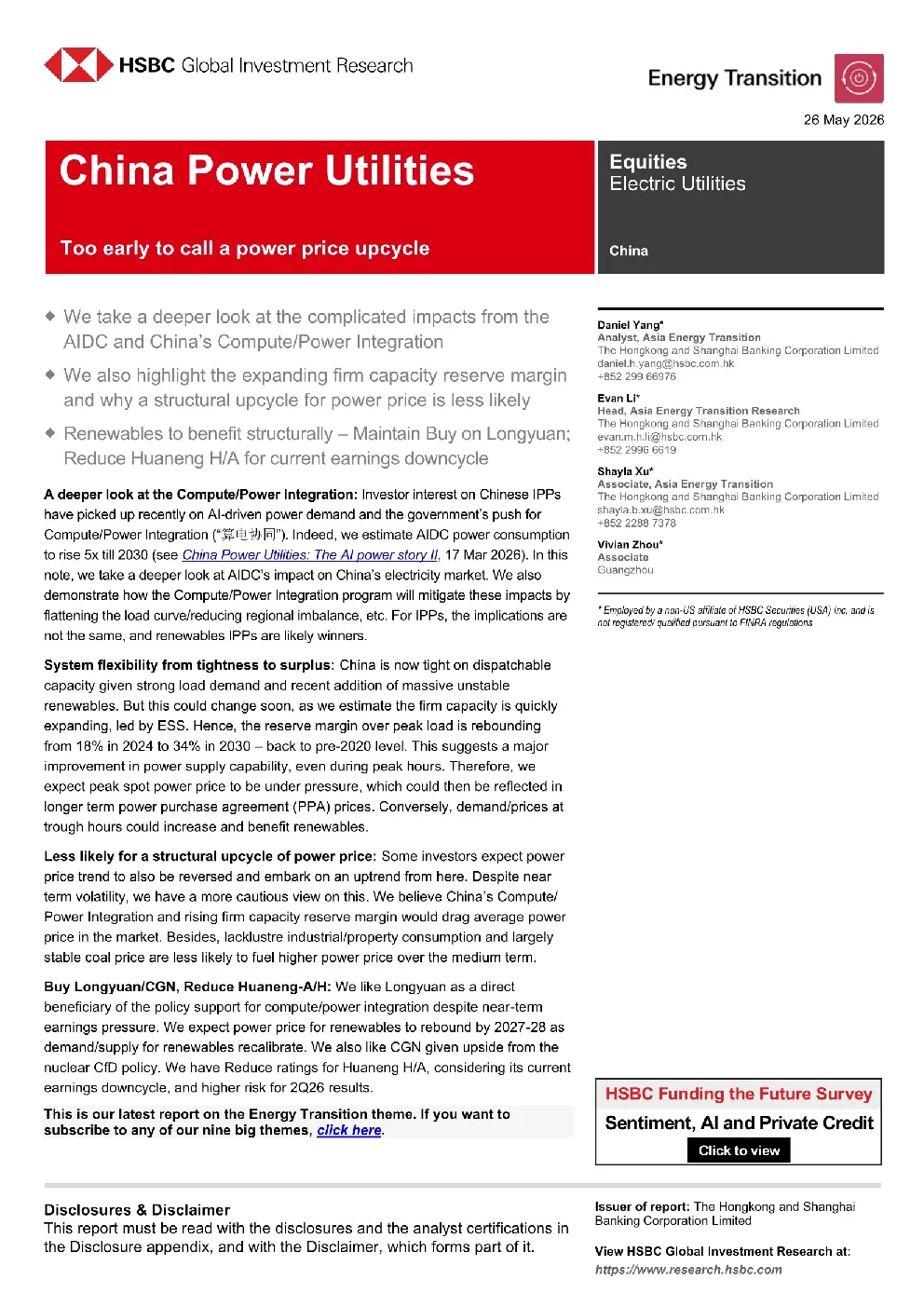
Electric Utilities AIDC and China's Compute/Power Integration Analyst, Asia Energy TransitionThe Hongkong and Shanghai Banking Corporation Limiteddaniel.h.yang@hsbc.com.hk+85229966976Evan Li* + We also highlight the expanding firm capacity reserve marginandwhyastructural upcycleforpowerpriceisless likely Head, Asia Energy Transition ResearchThe Hongkong and Shanghai Banking Corporation Limitedevan.m.h.li@hsbc.com.hk+85229966619Shayla Xu* +Renewables to benefit structurally-Maintain Buy on Longyuan;ReduceHuaneng H/Aforcurrent earningsdowncycle Associate,Asia EnergyTransitionThe Hongkong and Shanghai Banking Corporation Limitedshayla.b.xu@hsbc.com.hk+8522288 7378Vivian Zhou* Adeeperlookat theCompute/PowerIntegration: Investor interest on ChineseIPPshave picked up recently on Al-driven power demand and the government's push forCompute/PowerIntegration(算电协同").Indeed,weestimateAIDCpowerconsumptiontorise5xtill2030(seeChinaPowerUtilities:TheA/powerstoryll,17Mar2026).Inthisnote, we take a deeper look at AIDC's impact on China's electricity market. We alsodemonstrate howthe Compute/Power Integration program will mitigate these impacts byflatteningtheload curve/reducingregional imbalance,etc.ForIPPs,the implications arenot the same, and renewables IPPs are likely winners. AssociateGuangzhou not registered/qualifedpursuant toFINRAregulations System flexibility from tightness to surplus: China is now tight on dispatchablecapacitygiven strongloaddemandand recent additionof massiveunstablerenewables.But this could change soon,as we estimate the firm capacity is quicklyexpanding,led by Ess.Hence, the reserve margin over peak load is reboundingfrom 18% in 2024 to 34% in 2030 -back to pre-2020 level. This suggests a majorimprovement in power supply capability,even during peak hours.Therefore,weexpect peak spot power price to be underpressure, which could then be reflected intrough hours could increase and benefit renewables. Less likelyforastructuralupcycleofpowerprice:Some investors expectpowerprice trend to also be reversed and embark on an uptrend from here.Despite nearterm volatility,we have a more cautious view on this.Webelieve China's Compute/price in the market. Besides, lacklustre industrial/property consumption and largelystablecoalpricearelesslikelytofuelhigherpowerpriceoverthemediumterm. Buy Longyuan/CGN, Reduce Huaneng-A/H: We like Longyuan as a directbeneficiary of the policy support for compute/power integration despite near-termearnings pressure.We expect power price for renewables to rebound by2027-28 asdemand/supplyforrenewablesrecalibrate.Wealso like CGN givenupsidefromthenuclear CfD policy. We have Reduce ratings for Huaneng H/A, considering its currentearnings downcycle, and higher risk for 2Q26 results HSBC Funding the Future Survey This is ourlatest report on the EnergyTransition theme.If you want tosubscribe to any of our nine big themes, click here. Sentiment, Al and Private Credit Click to view Issuer of report: The Hongkong and ShanghaiBanking Corporation Limited Disclosures&Disclaimer This report must be read with the disclosures and the analyst certifications inthe Disclosure appendix, and with the Disclaimer, which forms part of it. ViewHSBCGlobal InvestmentResearchat:https://www.research.hsbc.com Key charts China's Compute/PowerIntegration program could turn AiDC from a challenge toadispatchable resourcefor demand load Mitigating AlDCs'impact AiDCs can cause complicated impacts to the electricity market, i.e.more load volatility and regional imbalance...+...China's Compute/PowerIntegrationcouldmitigate these impactsthroughmeasureslikeco-location,on-sitegenerationandVPPsRenewablesbenefitthemostfromdemandupsideandbetterloadflexibility, nuclear has potential but needs regulatory clarity to scale AiDC powerdemand beyond theheadline:volatility,flexibility andwinners Frompower demand uplift to load-shaping potentialsPreviously,weestimated thatpowerconsumptionatAiDCswould jump5xbetweennowand 2030, reaching over 1,000bn kwh or 9% of China's total power demand, with further upsidecoming fromnewAlagents andusage surgeforChineseAlmodelsfrom overseas (seeChinaPower Utilities: The Al power story ll, 17 Mar 2026). In this report, we look beyond the headlineAiDCpowerdemandtounderstand itsgridloadprofilesandthe scopeforloadflexibility,whichremain less discussed by investors. OurkeythesisChallenges: Rising power demand from AlDCs will likely increase grid-load volatility and lift peak load,given less predictable computing workloads versus traditional data centres. Compute/Power Integration: We believe China's ambitious Compute/Power Integrationprogramme can effectively mitigate these impacts by flattening the load curve/reducingregional imbalance, etc. Winners: Renewables should be favoured, supported by mandatory green electricityrequirements for AIDCs and improving demand flexibility.By contrast, AIDC's incrementalimpact on thermal generation looks less compelling in China. Whi