您的浏览器禁用了JavaScript(一种计算机语言,用以实现您与网页的交互),请解除该禁用,或者联系我们。 [印度品牌价值基金会]:印度的小型商用车:实现最后一英里的机动性和城市物流 - 发现报告

印度的小型商用车:实现最后一英里的机动性和城市物流

报告封面

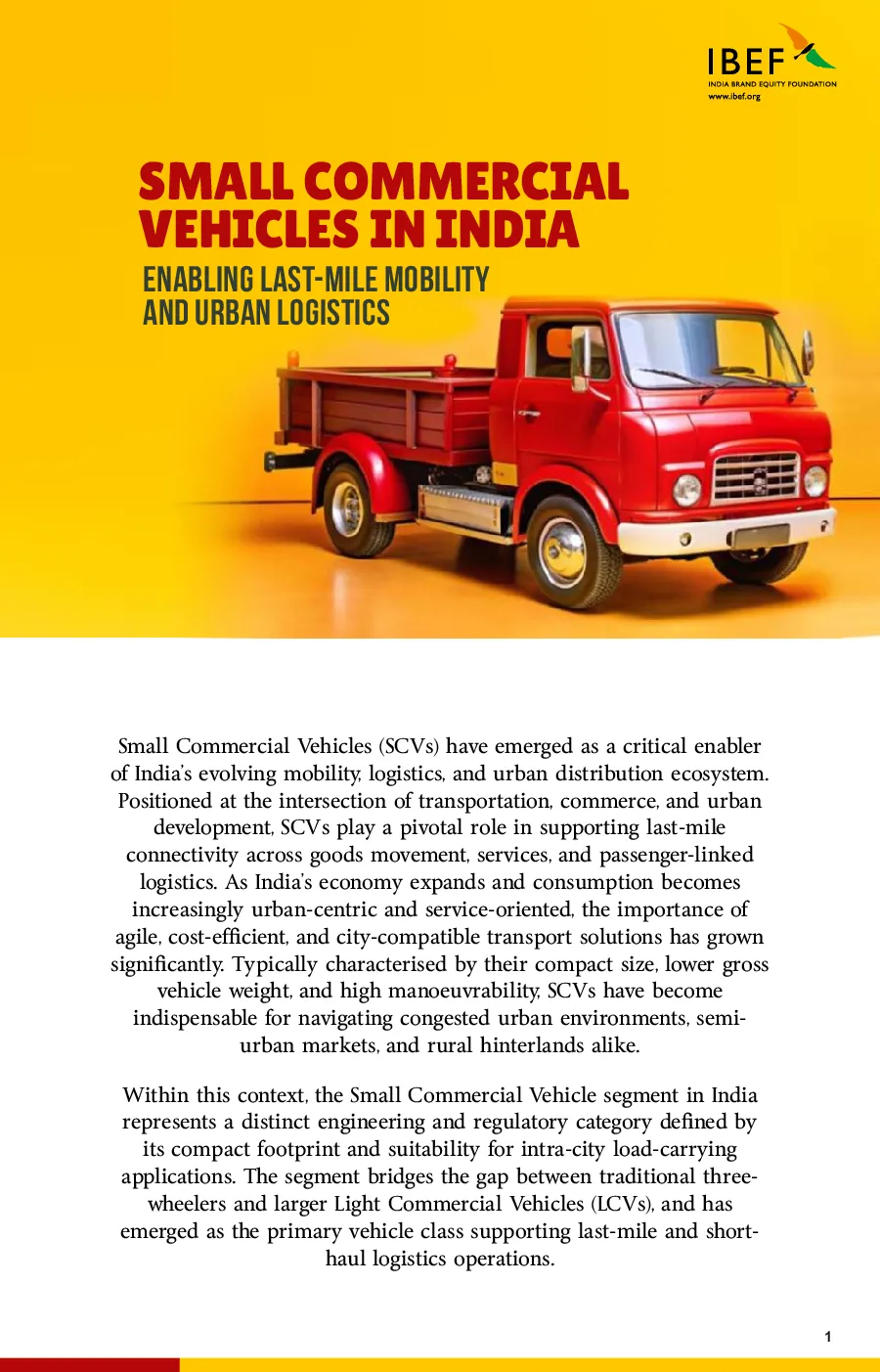
ENABLING LAST-MILE MOBILITYAND URBAN LOGISTICS Small Commercial Vehicles (SCVs) have emerged as a critical enablerof India’s evolving mobility, logistics, and urban distribution ecosystem.Positioned at the intersection of transportation, commerce, and urbandevelopment, SCVs play a pivotal role in supporting last-mileconnectivity across goods movement, services, and passenger-linkedlogistics. As India’s economy expands and consumption becomesincreasingly urban-centric and service-oriented, the importance ofagile, cost-efficient, and city-compatible transport solutions has grownsignificantly. Typically characterised by their compact size, lower grossvehicle weight, and high manoeuvrability, SCVs have becomeindispensable for navigating congested urban environments, semi-urban markets, and rural hinterlands alike. Within this context, the Small Commercial Vehicle segment in Indiarepresents a distinct engineering and regulatory category defined byits compact footprint and suitability for intra-city load-carryingapplications. The segment bridges the gap between traditional three-wheelers and larger Light Commercial Vehicles (LCVs), and hasemerged as the primary vehicle class supporting last-mile and short-haul logistics operations. needs,SCVs are optimised for high-frequency,short-distance deliveryoperations. Their operational flexibility,c o m p l i a n c ew i t h u r b a n t r a f fi cregulations, and relatively lower total costofownership have made them thepreferredchoice for small businesses,self-employed operators, fleet owners, andlogisticsservice providers.In addition,SCVs have contributed meaningfully tolivelihood generation by enabling first-t i m ev e h i c l e o w n e r s h i p a n dentrepreneurialactivity,particularlyacross Tier II, Tier III, and rural markets. In the Indian regulatory and industrialframework, SCVs are generally classifiedas goods-carrying vehicles with a GrossVehicle Weight (GVW) of up to 3.5 tonnes(3,500kg).The GVW includes theunladen weight of the vehicle, maximumpermissible payload, fuel, and occupants.From a legal standpoint, these vehiclestypicallyfall under the N1 category,coveringmotor vehicles used for thecarriage of goods with a maximum massnot exceeding 3.5 tonnes. The segment isfurtherstructured into multiple sub-nichesto address varied logisticalrequirements, including mini-trucks witha GVW of up to 2 tonnes and pickuptrucksin the 2–3.5 tonne range.Theprimary value proposition of SCVs lies intheir ability to provide efficient door-to-door delivery in dense urban areas wherelargercommercial vehicles face access,size, or regulatory constraints. Urbanisation, rising disposable incomes,andthe formalisation of trade havefurtherstrengthened the structuralrelevance of SCVs in India. Governmentinitiativesfocused on infrastructuredevelopment,urban mobility,andlogistics efficiency alongside regulatoryshiftsrelated to emissions,safety,andelectrification are reshaping the segment’stechnological and competitive landscape.Atthe same time,evolving customerexpectations around reliability, payloadoptimisation, fuel efficiency, and access tofinancingare influencing productdevelopment and go-to-market strategiesacross the SCV ecosystem. Therapid growth of e-commerce,o r g a n i s e dr e t a i l ,f o o d d e l i v e r y,constructionsupport services,andMSME-ledtrade has reshaped demandpatterns within the commercial vehiclemarket.Unlike medium and heavycommercialvehicles,which primarilyserve long-haul and bulk transportation TheIndian Small Commercial Vehicle(SCV)market has demonstrated strongstructural growth over the past five years,despiteshort-term volume moderationobserved in recent fiscal years. Accordingtothe data by Society of IndianAutomobileManufacturers(SIAM)domesticSCV sales expanded fromapproximately 0.37 million units in FY21to a peak of over 0.52 million units inFY23, reflecting a robust post-pandemicrecoverydriven by the revival ofeconomic activity, accelerated growth in e-commerce,and heightened demand forlast-milelogistics soluions.The strongdouble-digit growth recorded in FY22 andFY23 underscores the segment’s sensitivityto improvements in consumption, tradeflows, and urban mobility requirements. While aggregate SCV volumes moderatedin FY24 and FY25, the decline has beenrelatively contained at around 6% year-on-yearin each of these years.Thismoderationshould be viewed in thecontext of a high base effect following thesharp rebound in FY22–FY23, as well asbroader macroeconomic factors such asinflationarypressures,higher interestrates, and cautious capital expenditure bysmallfleet operators and self-employedbuyers. Importantly, volumes in FY24 andFY25remain significantly higher thanpre-recoverylevels,indicating that themarkethas stabilised at a structurallyelevatedbase rather than reverting toearlier demand conditions. ratereduction for commercial vehiclesa nde a s i n g fi n a n c i n g c o s t s .T h i sperformancehighlights a return togrowthtrajectory for the SCV ma