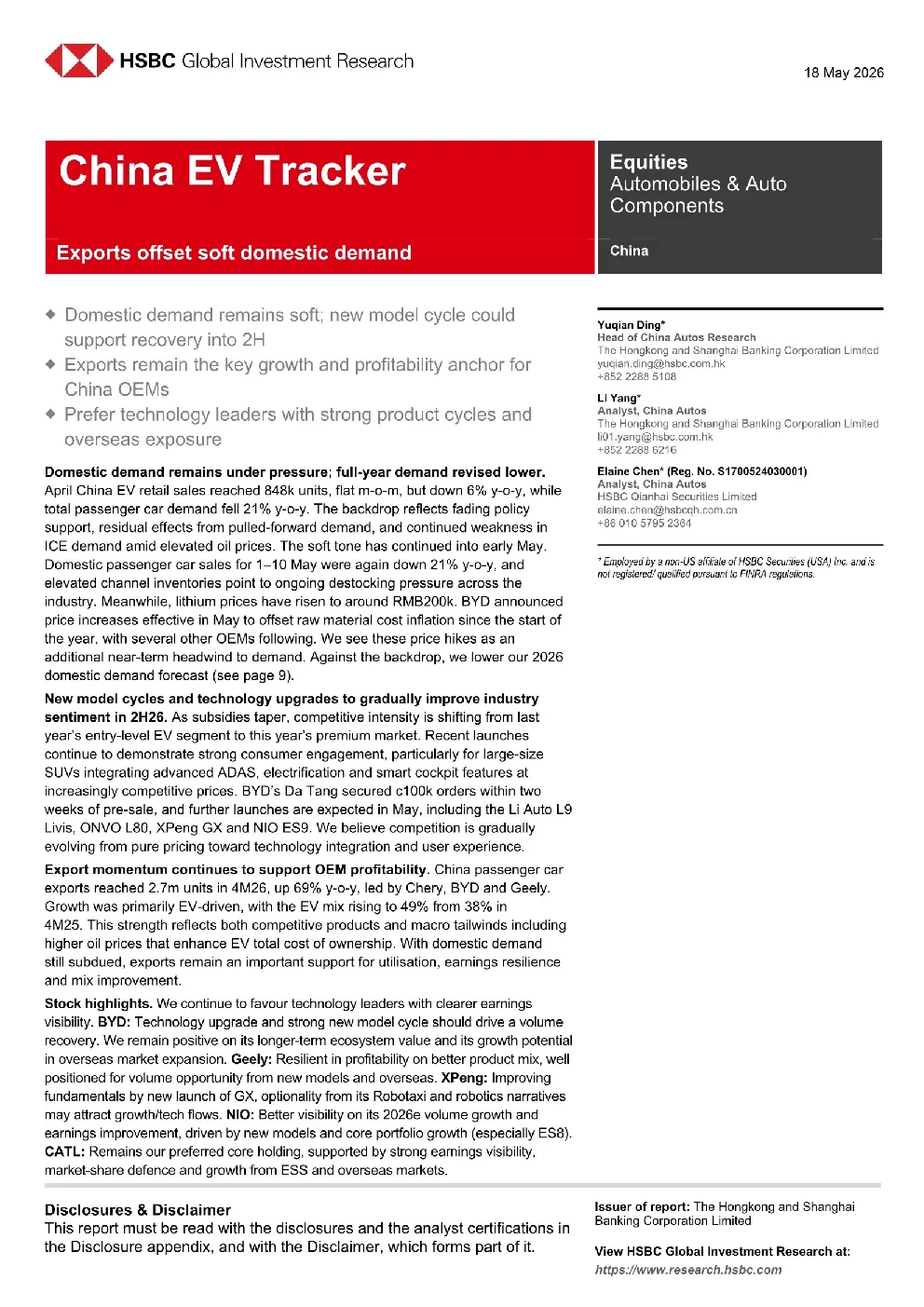
Automobiles & AutoComponents support recovery into 2H+ Exports remain the key growth and profitability anchor forChina OEMs+Prefertechnologyleaderswithstrongproductcyclesandoverseas exposure Head of China Autos ResearchThe Hongkong and Shanghai Banking Corporation Limitedyuqian.ding@hsbc.com.hk+85222885108Li Yang* Analyst, China AutosThe Hongkong and Shanghai Banking Corporation Limitedli01.yang@hsbc.com.hk+85222886216Elaine Chen*(Reg. No. S1700524030001) Analyst,ChinaAutosHSBC Qianhai Securities Limitedelaine.chen@hsbcqh.com.cn+8601057952364 April China EV retail sales reached 848k units, flat m-0-m, but down 6% y-0-y, while total passenger car demandfell 21% y-o-y.The backdrop reflects fading policysupport, residual effects from pulled-forward demand, and continued weakness inICE demand amid elevated oil prices.The soft tone has continued into early May.industry.Meanwhile, lithium prices have risen to around RMB200k.BYD announcedprice increases effective in May to offset raw material cost inflation since the start ofthe year, with several other OEMs following. We see these price hikes as anadditional near-term headwind to demand.Against the backdrop,we lower our 2026domestic demand forecast (see page 9).Newmodel cycles and technologyupgrades tograduallyimprove industry *Employed by a non-US affliate of HSBC Securities (USA) Inc, and isnot registered/qualfied pursuant toFINRA regulations. sentiment in 2H26.As subsidies taper, competitive intensity is shifting from lastyear's entry-level EV segment to this year's premium market.Recent launchesSUVs integrating advanced ADAS,electrification and smart cockpit features atincreasingly competitive prices.BYD's Da Tang secured c10Ok orders within twoweeks of pre-sale, and furtherlaunches are expected in May, including the Li Auto L9Livis,ONvOL80,XPengGX andNIOES9.Webelievecompetition is graduallyevolving from pure pricing toward technology integration and user experience. ExportmomentumcontinuestosupportOEMprofitability.Chinapassengercarexports reached 2.7m units in 4M26, up 69% y-0-y, led by Chery, BYD and Geely.Growth was primarily EV-driven, with the EV mix rising to 49% from 38% in4M25. This strength reflects both competitive products and macro tailwinds includinghigheroilpricesthatenhanceEVtotal costofownership.Withdomesticdemandand mix improvement. Stock highlights. We continue to favour technology leaders with clearer earningsvisibility. BYD: Technology upgrade and strong new model cycle should drive a volumerecovery.We remain positive on its longer-term ecosystem value and its growth potentialin overseas market expansion. Geely: Resilient in profitability on better product mix, wellpositioned for volume opportunity from new models and overseas. xPeng: Improvingfundamentals by newlaunch of Gx,optionalityfrom its Robotaxi and robotics narrativesmay attract growth/tech flows.NIO: Better visibility on its 2026e volume growth andearningsimprovement,drivenbynewmodelsandcoreportfoliogrowth(especiallyEs8)CATL: Remains our preferred core holding, supported by strong earnings visibility,market-share defence and growth from EsS and overseas markets. Issuer of report: The Hongkong and ShanghaiBankingCorporation Limited Disclosures&Disclaimer This report must be read with thedisclosures and the analyst certifications inthe Disclosure appendix, and with the Disclaimer, which forms part of it. View HSBC Global Investment Research at:https://www.research.hsbc.com Sector highlights Mostfrequentlydiscussedchartsofthemonth Exhibit 6. Chery,BYD and Geely leadChina'spassengercarexportvolumein4M26 Source: CADA, HSBC Exhibit 24.CATL:40% share of China'sLFPEVbatterymarketin4M26 Source: CABIA, HSBC fading policy support, residual effects from demand pulled forward, and continued weakness inICE demand amid elevated oil prices. We still expect some pull-forward into late 2026, driven bythe anticipated phase-out of replacement subsidies.As a result,we alsolower our 2027demand growth forecast to -2% (from 0%).WehavealsotrimmedourEVpenetration assumptionsfollowingweaker-than-expected EV sales growth in 4M26.Our revised EV penetration forecasts for 2026-28 are 62%, 70% and77%, respectively.Despite the near-term adjustment, we expect EVs to continue gaining shareversus IcE,particularly if oil prices remain elevated.We nowforecast 2030 EV penetration at88% (from 83%). Downside risks for the A- and H-shares: (1) weaker-than- We use a sum-of-the-parts (SOTP) approach to value BYD's expected EV demand growth; (2) stronger-than-expectedcompetition from peers in the EV and EV battery space,which could hurt BYD's pricing and margin; (3) potentialincrease in global trade uncertainties or unfavourableoverseas policies, which might extend the company'soverseas expansion execution timeline and cost. 20.0x (EV battery maker peers past two-year average 12-monthforward PE multiple; unchanged), which we apply to our 2028divisional earnings estimate of RMB23.8bn (unchanged). We