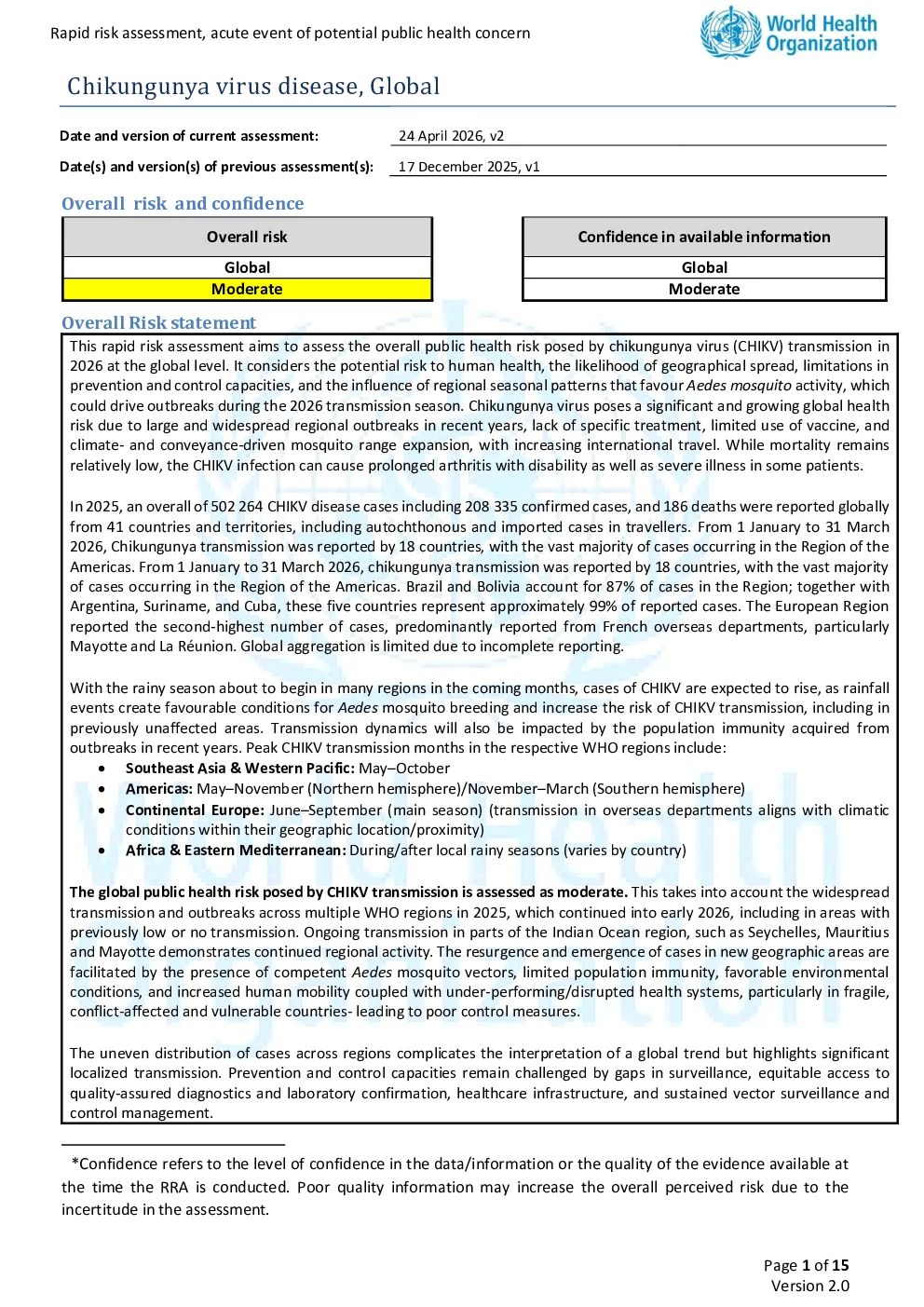
Dateandversionof current assessment: Date(s)and version(s)of previous assessment(s): Overall Risk statement Thisrapid risk assessment aims toassess the overall public health risk posed by chikungunya virus (CHIKV) transmissionin2026 at the global level. Itconsidersthe potential risk to human health, the likelihood of geographical spread, limitations inprevention andcontrol capacities, and the influence of regional seasonal patterns that favourAedes mosquitoactivity, whichcoulddrive outbreaks during the 2026 transmission season.Chikungunya virus poses a significant and growing global healthrisk due to large and widespread regional outbreaks in recent years,lack ofspecifictreatment, limited use ofvaccine, and In2025, an overall of 502264 CHIKV disease cases including 208335 confirmed cases, and 186 deaths were reported globallyfrom 41 countries and territories, including autochthonous and imported cases in travellers.From 1 January to 31 March2026,Chikungunyatransmission was reported by 18 countries, with the vast majority of cases occurring in the Region of theAmericas.From 1 January to 31 March 2026, chikungunya transmission was reported by 18 countries, with the vast majorityof cases occurring in the Region of the Americas.Brazil and Bolivia account for 87% ofcases in the Region; together with With the rainy season about to begin in many regions in the coming months, cases ofCHIKVareexpected torise,as rainfallevents createfavourableconditions forAedesmosquito breeding and increasethe risk of CHIKV transmission, includinginpreviously unaffected areas.Transmissiondynamicswill also be impacted by the population immunity acquiredfrom •Southeast Asia & Western Pacific:May–October•Americas:May–November (Northernhemisphere)/November–March (Southern hemisphere)•ContinentalEurope:June–September(main season)(transmission in overseas departments aligns withclimatic The global public health risk posed by CHIKV transmission is assessed asmoderate.Thistakes into account thewidespreadtransmission andoutbreaks across multiple WHO regionsin2025,which continuedintoearly 2026,includinginareas withpreviously low or no transmission.Ongoing transmission in parts of the Indian Ocean region, such as Seychelles, Mauritiusand Mayottedemonstrates continued regional activity.The resurgence and emergence of cases in new geographic areas arefacilitated by the presence of competentAedesmosquito vectors, limited population immunity, favorable environmental The uneven distribution of casesacross regionscomplicatestheinterpretation ofaglobaltrend buthighlights significantlocalized transmission.Prevention andcontrol capacities remain challenged by gaps in surveillance,equitable access to Rapid risk assessment, acute event of potential public health concern Immediate actionsWHO country offices (WCOs) to: •Continue supporting public health response.•Continue supporting national authorities’ efforts to strengthen gaps in surveillance, case detection andreporting, laboratory confirmation of cases, case management, infection prevention and control.•Continue supporting strengthening of community awareness on the ongoing outbreaks as well as preventionmeasures. WHO Regional Offices (RO) to support WCOs with:•Advocacy efforts for timely information sharing. •Regional partners coordination for a coordinated and efficient response.•Monitoring of chikungunya case trends across the Regions, and in-depth risk analytics to identify high-risk areasand guide targeted interventions.•Provide technical assistance, as appropriate, to support disease control and outbreak response activities. WHO HQ will support WCOs and ROs as needed, including: •Support with vaccine recommendations, once the available evidence for the two available CHIKV vaccines hasbeen reviewed by the chikungunya vaccine working group for the Strategic Advisory Group of Experts in Supporting information Hazard assessment Chikungunya is anAedes-borne viral disease caused by the CHIKV, an RNA virus in thealphavirusgenus of thefamilyTogaviridae.CHIKV is transmitted by infected female mosquitoes, most commonlyAedesaegyptiandAedesalbopictus, which can also transmit dengue and Zika viruses. These mosquitoes bite primarily during daylight hours When anuninfected mosquitofromAedesspeciesfeeds on a person who has CHIKV circulating in their bloodstream,the mosquito can ingest the virus. Over a period of about 10 days (range: 7-12 days), the virus replicates intothemosquito and enters its salivary glands. Once this occurs, the mosquito becomes capable of transmitting the virus to a Rapid risk assessment, acute event of potential public health concern Transmission efficiency byAedes albopictuscan be enhanced for certain CHIKV lineages harboring the E1-A226V In symptomatic patients,illnessonset is typically 4–8 days (range 2–12 days) after the bite of aCHIKV-infected mosquito.Disease is characterized by an abrupt onset of fever, frequently accompanied by severe joint pain. The joint