您的浏览器禁用了JavaScript(一种计算机语言,用以实现您与网页的交互),请解除该禁用,或者联系我们。[世界卫生组织]:世界卫生组织快速风险评估-基孔肯雅病毒,全球第1版 - 发现报告

世界卫生组织快速风险评估-基孔肯雅病毒,全球第1版

AI智能总结
查看更多
世界卫生组织快速风险评估-基孔肯雅病毒,全球第1版

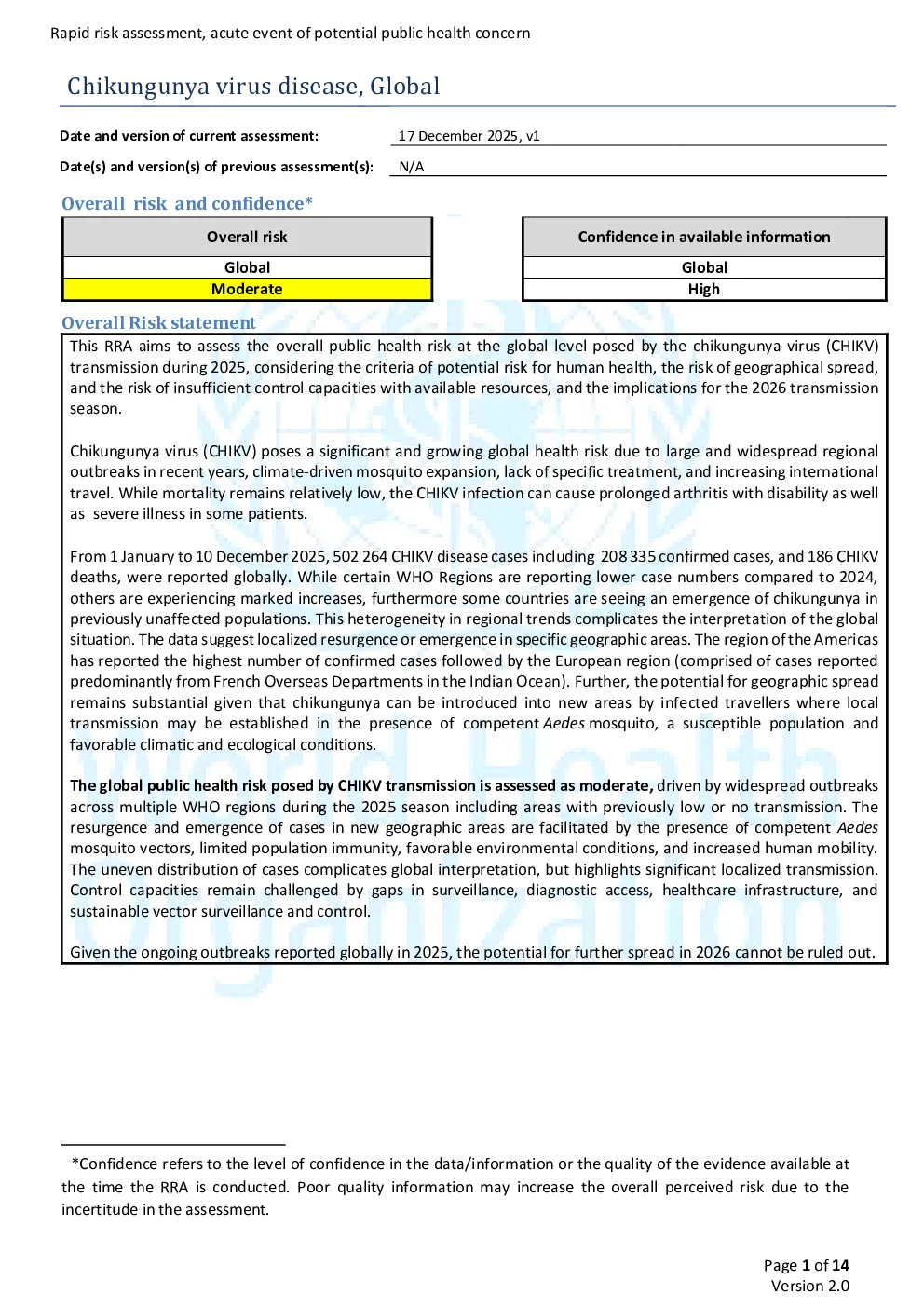
Dateandversionof current assessment:Date(s)and version(s)of previous assessment(s): Overall riskandconfidence* Overall Risk statement This RRA aims to assess the overall public health risk at the global level posed by thechikungunyavirus(CHIKV)transmission during 2025,consideringthe criteriaofpotentialriskfor humanhealth,the risk of geographical spread, Chikungunya virus (CHIKV) poses a significant and growing global health risk due tolarge andwidespreadregionaloutbreaksin recent years, climate-driven mosquito expansion, lack of specific treatment, and increasing internationaltravel. While mortality remains relatively low, theCHIKV infectioncancauseprolonged arthritiswith disabilityaswell From1January to10December2025,502264CHIKV disease casesincluding208335confirmedcases, and186CHIKVdeaths,werereported globally. While certain WHO Regions are reporting lower case numbers compared to 2024,others are experiencing marked increases, furthermore some countries are seeing an emergence of chikungunya inpreviously unaffected populations. This heterogeneity in regional trends complicates the interpretation oftheglobalsituation.The data suggest localized resurgence or emergence in specific geographic areas. The region of the Americashas reported the highest number ofconfirmedcases followed by the European region (comprised of cases reported The global public health risk posed by CHIKV transmission is assessed asmoderate,driven by widespread outbreaksacross multiple WHO regionsduringthe2025 seasonincluding areas with previously low or no transmission. Theresurgence and emergence of cases in new geographic areas are facilitated by the presence of competentAedes mosquito vectors, limited population immunity, favorable environmental conditions, and increased human mobility.The uneven distribution of cases complicates global interpretation,but highlights significant localized transmission. Given the ongoing outbreaks reported globally in 2025, the potential for further spreadin 2026cannot be ruled out. Immediate actionsWHO country offices(WCOs)to: •Continue supporting public health response.•Continue supporting national authorities’ efforts to strengthen gaps in surveillance, case detection andreporting, laboratory confirmation of cases, case management, infection prevention and control. WHORegional Offices(RO)to support WCOs with: •Advocacy efforts for timely information sharing.•Regional partners coordination for a coordinated and efficient response. WHOHQ will support WCOs andROsas needed, including: •Supportwith vaccine recommendations,once theavailableevidencefor the two availableCHIKVvaccineshas been reviewed by thechikungunya vaccine working group for theStrategic Advisory Group of Experts Supporting information Hazard assessment Chikungunya is anAedes-borne viral disease caused by the CHIKV, an RNA virus in thealphavirusgenus of thefamilyTogaviridae.CHIKV is transmitted by infected femalemosquitoes, most commonlyAedesaegyptiandAedesalbopictus, which can also transmit dengue and Zika viruses. These mosquitoes bite primarily during daylight hoursandAedes aegyptifeeds both indoors and outdoors, whereasAedes albopictusfeeds primarily outdoors. They lay When an uninfectedAedessppmosquito feeds on a person who has CHIKV circulating in their bloodstream, themosquito can ingest the virus. Over a period of about 10 days (range: 7-12 days), the virus replicates in themosquito and enters its salivary glands. Once this occurs, the mosquito becomes capable of transmitting the virus In symptomatic patients,illnessonset is typically 4–8 days (range 2–12 days) after the bite of aCHIKV-infectedmosquito. Disease is characterized by an abrupt onset of fever, frequently accompanied by severe joint pain. Thejoint pain is often debilitating and usually lasts for a few days but may be prolonged, lasting for weeks, months oreven years. Othercommon signs and symptoms include joint swelling, muscle pain, headache, nausea, fatigue andrash.Since these symptoms overlap with other infections,including those with dengue and Zika viruses, cases canbe misdiagnosed. In the absence of significant joint pain, symptoms in infected individuals are usually mild and theinfection may go unrecognized. Most patients recover fully from the infection; however, occasionalocular,cardiac,dermatologicaland neurologicaldiseasemanifestation andshockhave been reported with CHIKV infections.Patients at extremes of the age spectrum are at higher risk for severe disease including newborns infected during Clinical management includes managing fever and joint pain with anti-pyretic, analgesics, maintaining adequatehydration by consuming sufficient fluids and ensuring general rest.There is no specific antiviral drug treatment forCHIKV infections. Paracetamol(acetaminophen)isrecommended for pain relief and reducing fever until dengue There are currently two chikungunya vaccines that have received regulatory approvals and/or have beenrecommended for us