AI智能总结
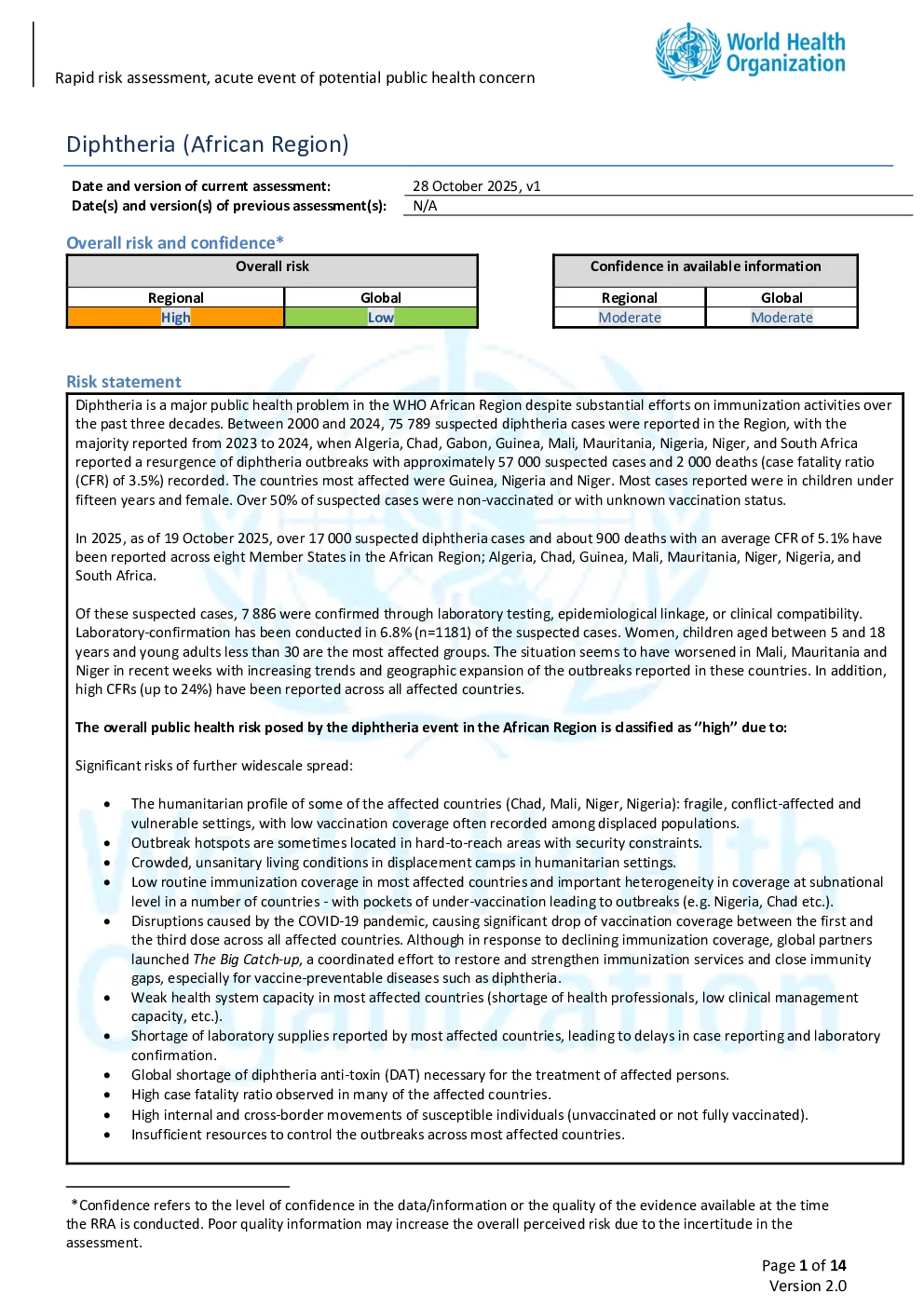
Dateandversionof current assessment:Date(s)and version(s)of previous assessment(s): Risk statement Diphtheria is a major public health problem in theWHOAfricanRegion despitesubstantialefforts on immunizationactivitiesoverthe past three decades. Between 2000 and 2024, 75 789suspecteddiphtheria cases were reported in the Region, with themajority reportedfrom 2023 to 2024,whenAlgeria, Chad, Gabon, Guinea, Mali, Mauritania, Nigeria, Niger, and South Africareportedaresurgence of diphtheriaoutbreakswithapproximately57 000 suspectedcases and 2 000 deaths (case fatality ratio(CFR)of 3.5%) recorded. The countries most affected wereGuinea,Nigeriaand Niger. Most cases reported wereinchildren under In2025,as of 19October 2025, over 17000suspecteddiphtheria casesand about900deaths withan averageCFR of 5.1%havebeen reportedacross eight Member States in the African Region;Algeria, Chad,Guinea, Mali, Mauritania, Niger, Nigeria, and Of these suspected cases,7 886wereconfirmed through laboratory testing, epidemiological linkage, or clinical compatibility.Laboratory-confirmation has been conducted in6.8% (n=1181) of the suspected cases.Women, children aged between 5 and 18years and young adultsless than 30are the most affectedgroups.The situation seems to have worsened inMali,Mauritaniaand The overallpublic healthriskposed by the diphtheria eventintheAfrican Regionis classified as ‘’high’’due to: Significant risks of further widescalespread: •Thehumanitarianprofile of some of the affected countries(Chad, Mali, Niger, Nigeria):fragile, conflict-affected andvulnerablesettings, with low vaccination coverage often recorded among displaced populations.•Outbreakhotspots aresometimeslocated in hard-to-reach areas with security constraints.•Crowded, unsanitary living conditions in displacement camps inhumanitarian settings.•Low routine immunization coverage in most affected countriesandimportant heterogeneity in coverage at subnationallevel in a number of countries-with pockets of under-vaccination leading to outbreaks (e.g. Nigeria, Chadetc.).•Disruptions caused by the COVID-19 pandemic, causing significant dropofvaccination coverage between the first andthe third dose across all affected countries.Althoughin response to declining immunization coverage, global partners Page1of14Version 2.0 The overallpublic healthriskposed by thediphtheria eventat the global levelis classified as ‘’low’’ due to: Theglobalrisk of diphtheria outbreaksfrom the ongoing multi-country diphtheriaoutbreak in the AfricanRegion is assessed aslow, giventheexistence ofroutineimmunization programsinmost countries.Nonetheless, the risk posed byinternational travel Major actionsrecommendedby the risk assessment teamAction ☐Refer the event forreview by IHR Emergency Committee forconsiderationas aPHEICby DG (Art 12, IHR)☒Immediate activation ofWHO response mechanism as urgent public health response is required☒Recommend setting up WHO grading call☐Immediate support to response,but no WHO grading recommended at this point in time☐Rapidly seek further information and repeat RRA (including field risk assessment)☒Support Member State to undertake preparedness measures☒Continue to closely monitor WHOImmediate actionsat the three levelsWCOstocontinuesupportingnational authorities in: •Coordination of partnersforanefficientpublichealth response.•Development of vaccine requests for supplementary immunization activities where necessary toaddress immunity gaps. AFRO to support WCOs with: •Advocacy efforts for timely information sharing.•Regional partners coordination for a coordinated and efficient response.•Monitoring of diphtheria case trends across the Region, andin-depth risk analytics to identify high-riskareas and guide targeted interventions. •Support for the procurement of DAT for the affected countriesand maintaining global stockpile of DATincluding at the logisticshub in Dubai as a global resource,for country allocation based on needs. Supporting information Hazard assessment Diphtheria is an infectious disease caused by the bacteriumCorynebacterium diphtheria, which primarily infectsthe throat and upper airways, and produces a toxin affecting other organs. The diseasecan spread person to personfrombreathing in the aerosolized secretions from coughs or sneezes ofinfected individuals. Although transmission from respiratory cases via droplets is the most common mode ofinfection, cutaneous carriage ofC. diphtheriaeshould also be considered as it is an important source of person-to-person transmission of the pathogen, particularly in communities where vaccination coverage is low and/or The incubation period istypicallyfrom 2 to 5 days.The illness has an acute onset,andcommon symptoms includea sore throat,fever, swelling of the neck glandsand weakness.Within 2–3 days from infection,thediphtheriatoxin causes a membrane of dead tissue to build upin the respiratory tract, forming a thick, greyish-whitecoatingthat can covertissues in the nose, tonsils a