您的浏览器禁用了JavaScript(一种计算机语言,用以实现您与网页的交互),请解除该禁用,或者联系我们。[世界卫生组织]:世界卫生组织快速风险评估-奥罗普病毒病,美洲地区第1版 - 发现报告

世界卫生组织快速风险评估-奥罗普病毒病,美洲地区第1版

世界卫生组织快速风险评估-奥罗普病毒病,美洲地区第1版

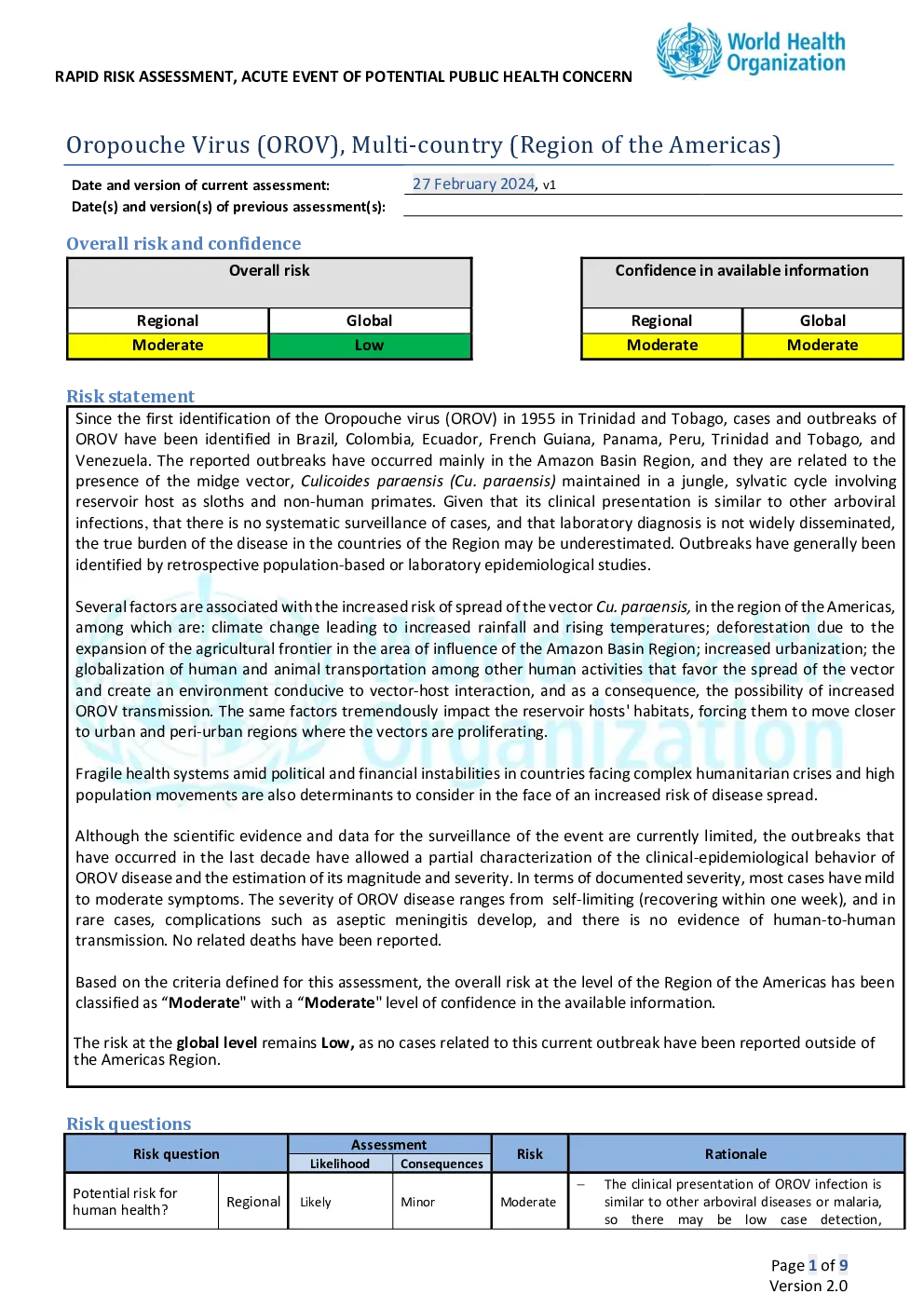
Oropouche Virus (OROV), Multi-country (Region of the Americas) 27 February 2024,v1 Dateandversionof current assessment:Date(s)and version(s)of previous assessment(s): Overallriskand confidence Risk statement Since the first identification oftheOropouche virus(OROV)in 1955 in Trinidad and Tobago,casesand outbreaks ofOROV have been identified in Brazil, Colombia, Ecuador, French Guiana, Panama, Peru, Trinidad and Tobago, andVenezuela. The reported outbreaks have occurred mainly in the Amazon BasinRegion,andtheyare related to thepresence of themidgevector,Culicoides paraensis (Cu. paraensis)maintained in a jungle,sylvaticcycle involvingreservoir host assloths andnon-human primates. Given thatits clinical presentation is similar to other arboviralinfections,that there is no systematic surveillance of cases, and that laboratory diagnosis is not widely disseminated,the true burden of the disease in the countries of the Region may beunderestimated. Outbreaks have generally beenidentified by retrospective population-based or laboratory epidemiological studies. Several factors are associated with the increased risk of spread of the vectorCu. paraensis,in the regionof theAmericas,among which are: climate change leading to increased rainfall and rising temperatures; deforestation due to theexpansion of the agricultural frontier in the area of influence of the Amazon Basin Region; increased urbanization;theglobalization of human and animal transportationamong other human activities that favor the spread of the vectorand create an environment conducive to vector-host interaction, and as a consequence, the possibility of increasedOROV transmission.The same factorstremendouslyimpactthereservoir hosts' habitats, forcingthemtomove closerto urban and peri-urban regions where the vectors are proliferating. Fragile health systems amid political and financial instabilities in countries facing complex humanitarian crises and highpopulation movements are also determinants to consider in the face of an increased risk of disease spread. Although the scientific evidence and data for the surveillance of the event are currently limited, the outbreaks thathave occurred in the last decade have allowed a partial characterization of the clinical-epidemiological behavior ofOROVdiseaseandthe estimation of its magnitude and severity. In terms of documented severity, most cases have mildto moderate symptoms.The severity ofOROVdiseaseranges fromself-limiting(recoveringwithinone week), andinrare cases,complications such as aseptic meningitis develop,and there is no evidence of human-to-humantransmission. No related deaths have been reported. Based on the criteria defined for this assessment, the overall risk at the level of the Region of the Americas has beenclassified as “Moderate" with a “Moderate" level of confidence in the available information. The risk at theglobal levelremainsLow,as no cases related to this current outbreak have been reported outside ofthe Americas Region. Risk questions Page1of9Version 2.0 Major actionsrecommendedby the risk assessment teamAction Supporting information Hazard assessment Oropouche fever (ICD-10 A93.0) is amidge-borneviraldiseasecausedby Oropouche virus (OROV), a segmentedsingle-stranded RNA virus that is part of the genusOrthobunyavirusof thePeribunyaviridaefamily.It istransmitted to humans mainly by the bite ofCulicoides paraensis (C. paraensis).The disease manifests withsymptoms resemblingmalaria,dengue (with no warning signs), chikungunya, and other arboviral diseases. It hasan incubation period of 4 to 8 days (range between 3 and 12 days). The onset issudden, usually with fever,headache, arthralgia, myalgia, chills, and sometimes persistent nausea and vomiting for up to 5 to 7 days.Occasionally, aseptic meningitis may occur. Most cases recover within 7 days, however, in some patients,convalescence can take weeks. The circulation of the Oropouche virus is suspected to include both epidemicurbantransmissioncycles,andsylvaticcycles. In thesylvaticcycle,vertebrate hosts includenon-humanprimates, sloths, andwildbirds, althoughno definitive arthropod vector has been identified. In the urban epidemic cycle, humans are the amplifying host.The virusis transmitted mainly through the bite of theCulicoides paraensisthat is present in the region, as wellas themosquitospeciesCulex quinquefasciatuswhichhavebeen reported to be likelyvectorin the sylvatic cycle.Other species of hematophagous mosquitoes such asCoquillettidia venezuelensis, andAedes (Ochlerotatus)serratushave the potential to reproduce and could be naturally infected by the virus. These two species areclassified as secondary vectors of the virus and are commonly found in dense populations within sylvatichabitats. OROV is an emerging virus and was first isolated in 1955 from an infected individual in Vega de Oropouche,Trinidad and Tobago. In most of these outbreaks, people of both sexes and of all ages were affected. Inpopulations with