AI智能总结
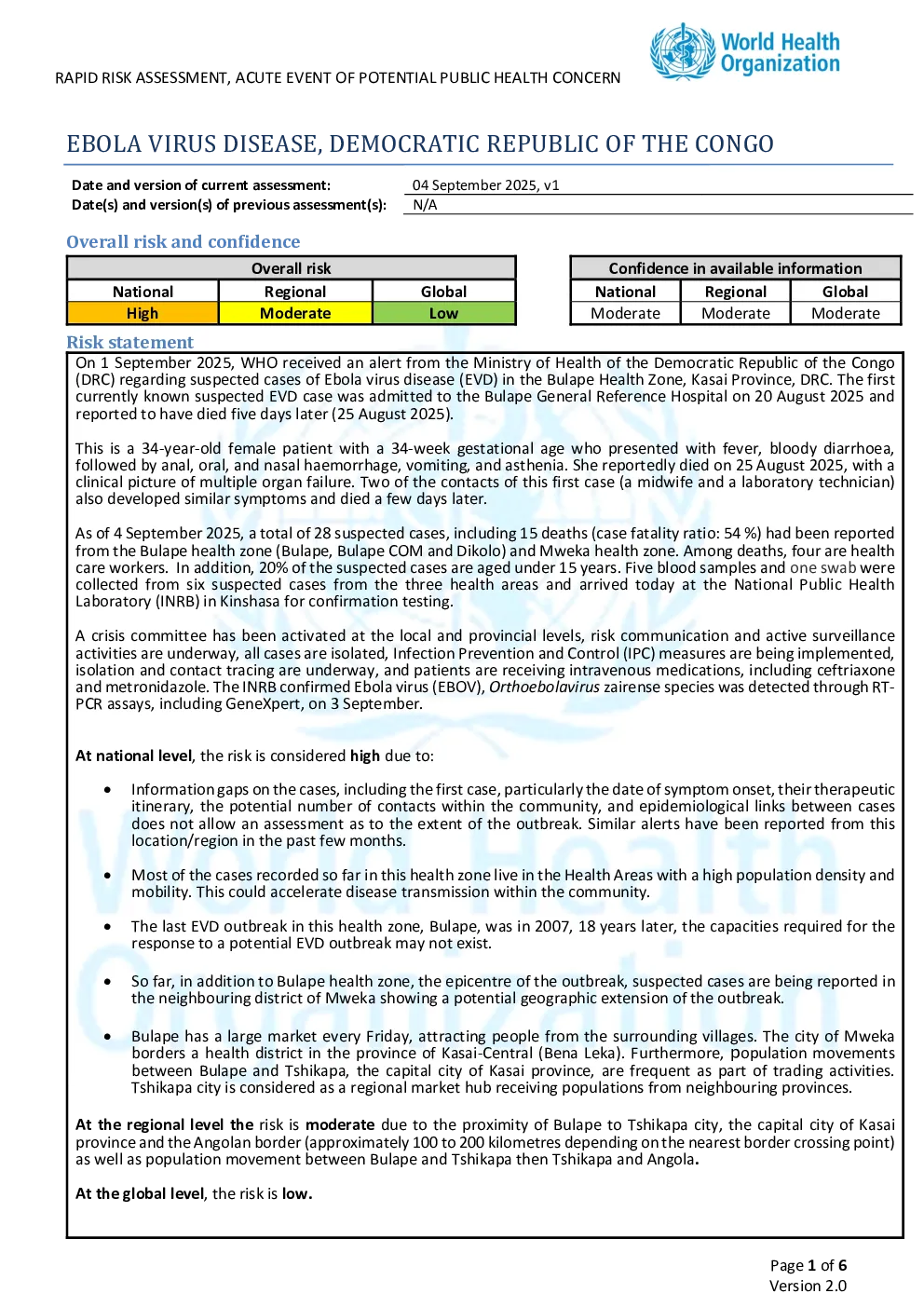
Dateandversionof current assessment:04 September 2025,v1Date(s)and version(s)of previous assessment(s):N/A Overallriskand confidence Risk statementOn 1 September 2025, WHO received an alert from the Ministry of Health of the Democratic Republic of the Congo (DRC) regarding suspected cases of Ebola virus disease (EVD) in the Bulape Health Zone, Kasai Province, DRC. The firstcurrently known suspectedEVD case was admitted to the Bulape General Reference Hospital on 20 August 2025 andreported to have died five days later (25 August 2025). This is a 34-year-old female patient with a 34-week gestational age who presented with fever, bloody diarrhoea,followed by anal, oral, and nasal haemorrhage, vomiting, and asthenia. She reportedly died on 25 August 2025, with aclinical picture of multiple organ failure. Two of the contacts of this first case (a midwife and a laboratory technician)also developed similar symptoms and died a few days later. As of 4 September 2025, a total of 28 suspected cases, including 15 deaths (case fatality ratio: 54 %) hadbeen reportedfrom the Bulape health zone (Bulape, Bulape COM and Dikolo) and Mweka health zone. Among deaths, four are healthcare workers. In addition, 20% of the suspected cases are aged under 15 years. Five blood samples andone swabwerecollected from six suspected cases from the three health areas and arrived today at the National Public HealthLaboratory (INRB) in Kinshasa for confirmation testing. A crisis committee has been activated at the local and provincial levels, risk communication and active surveillanceactivities are underway, all cases are isolated,Infection Prevention and Control (IPC)measures are being implemented,isolation and contact tracing are underway, and patients are receiving intravenous medications, including ceftriaxoneand metronidazole.The INRB confirmed Ebola virus(EBOV),Orthoebolaviruszairensespecieswas detected through RT-PCR assays, including GeneXpert, on3September. At national level, the risk is consideredhighdue to: •Information gaps on the cases, including the first case, particularly the date of symptom onset, their therapeuticitinerary, the potential number of contacts within the community, and epidemiological links between casesdoes not allow an assessment as tothe extent of the outbreak. Similar alerts have been reported from thislocation/region in the past few months. •Most of the cases recordedso farin this health zone live in the Health Areas with a high population density andmobility. Thiscouldaccelerate diseasetransmissionwithin the community. •The last EVD outbreak in thishealth zone,Bulape,was in2007, 18 years later, the capacitiesrequired for theresponse to apotentialEVD outbreakmay notexist. •So far, in addition to Bulape health zone, the epicentre of the outbreak, suspected cases are being reported inthe neighbouring district of Mweka showingapotentialgeographic extension of theoutbreak. •Bulape has a large market every Friday, attracting people from the surrounding villages. The city of Mwekaborders a health district intheprovince of Kasai-Central (Bena Leka).Furthermore,population movementsbetween Bulape and Tshikapa, the capital city of Kasai province, are frequent as part of trading activities.Tshikapa city is considered as a regional market hub receiving populations from neighbouring provinces. At the regionallevel therisk ismoderatedue tothe proximity ofBulape toTshikapacity,the capitalcityofKasaiprovince and the Angolan border (approximately 100 to 200 kilometres depending on the nearest border crossing point)as well as populationmovementbetween Bulape and Tshikapa then Tshikapa and Angola. At the global level, the risk islow. Page1of6Version 2.0 Risk questions Major actionsrecommendedby the risk assessment team Supporting information Hazard assessmentEbola virus disease (EVD) is a serious, often fatal illness in humans. The virus is transmitted to humans through close contact with the blood or secretions of infected wildlife and then spreads through human-to-humantransmissionvia contact with bodily fluids.The average case fatalityratiois 50%; case fatality ranging from 25%to 90%hasbeen reported in previous outbreaks. The incubation periodvaries from 2 to 21 days. Symptoms canappear suddenly and include fever, fatigue, muscle aches, headache, and sore throat. These are followed byvomiting, diarrhea, a rash, symptoms of kidney and liver failure, andonlyin some cases, internal and externalbleeding (e.g., bleeding gums, blood in the stool). Effectiveoutbreakcontrol relies on the application of a set of interventions, namely clinical case managementincluding rapid therapeutic access,IPC & WASH,surveillance and contact tracing, good laboratory service, safeand dignified burials, community engagement, and social mobilization. Ebola virus can persist in some body fluidsof people who have recovered from EVD. In a limited number of cases, secondarytransmissions resulting fromexposure to the body fluids of p