黄金需求趋势:美国关注2026年第一季度
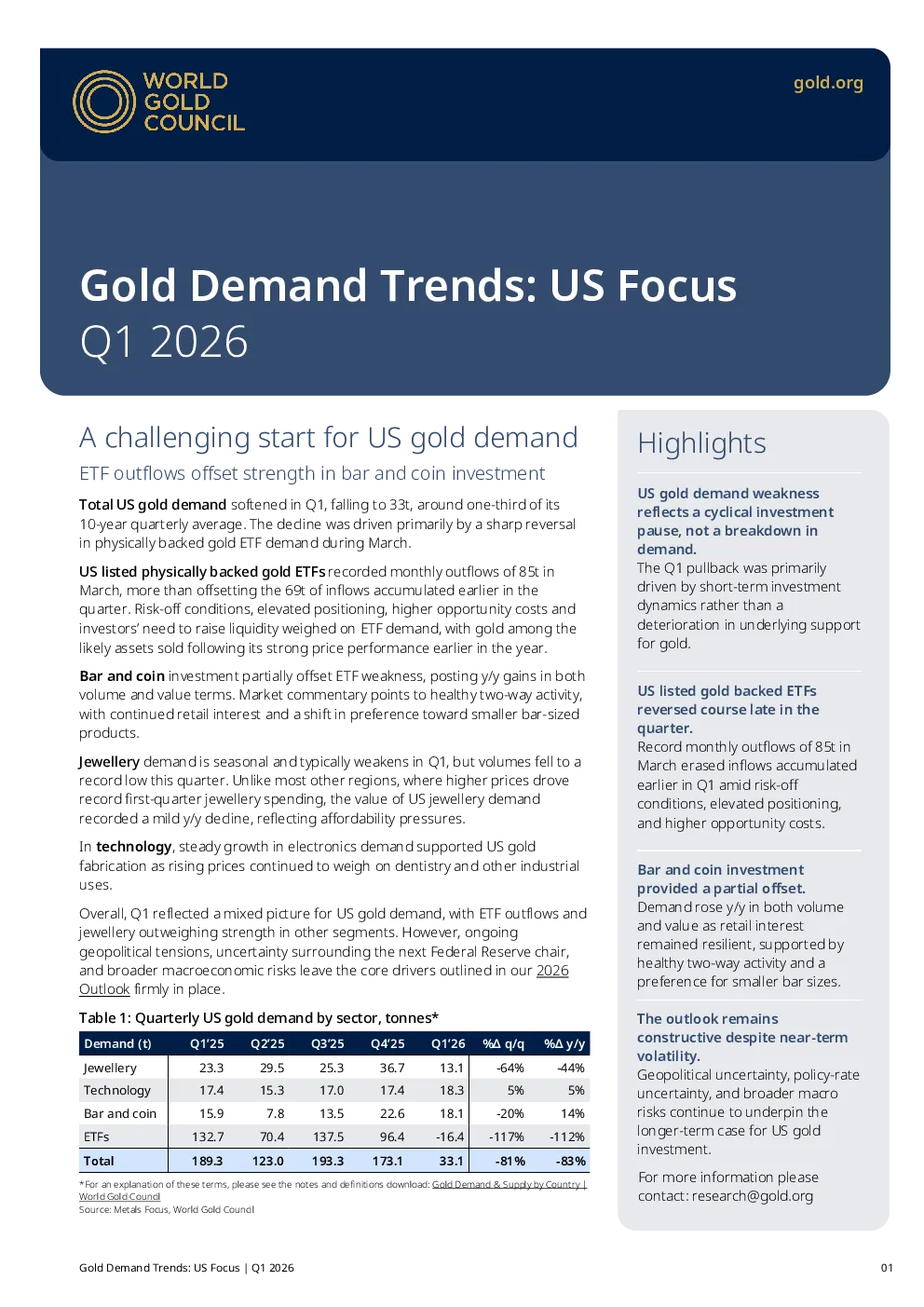
A challenging start for US gold demand Highlights ETF outflows offset strength in bar and coin investment US gold demand weaknessreflects a cyclical investment Total US gold demandsoftened in Q1, falling to 33t, around one‑third of its10‑year quarterly average. The decline was driven primarily by a sharp reversal The Q1 pullback wasprimarilydriven by short‑term investment US listed physically backed gold ETFsrecorded monthly outflows of 85t inMarch, more than offsetting the 69t of inflows accumulated earlier in thequarter. Risk‑off conditions, elevated positioning, higher opportunity costs and Bar and coininvestment partially offset ETF weakness, posting y/ygains in bothvolume and value terms. Market commentary points to healthy two‑way activity, USlistedgoldbacked ETFsreversed course late in the Record monthly outflows of 85t inMarch erased inflows accumulatedearlier in Q1 amid risk‑offconditions, elevated positioning, Jewellerydemand is seasonal andtypically weakens in Q1, but volumes fell to arecord low this quarter. Unlike most other regions, where higher prices droverecord first‑quarter jewellery spending, the value of US jewellery demand Intechnology, steady growth in electronics demand supported US goldfabricationas rising prices continued to weigh on dentistry and other industrial Bar and coin investmentprovided a partial offset. Demand rosey/yin both volumeand value as retail interestremained resilient, supported byhealthy two‑way activity and a Overall, Q1 reflected a mixed picture for US gold demand, with ETF outflowsandjewelleryoutweighing strength in other segments. However, ongoinggeopolitical tensions, uncertainty surrounding the next Federal Reserve chair, The outlookremainsconstructivedespite near-term Geopolitical uncertainty, policy‑rateuncertainty, and broader macrorisks continue to underpin the For more information pleasecontact:research@gold.org Several drivers that had previously supported ETF demandwere put on hold late in the quarter and became key ETF demand reverses course in March Investment via ETFs over the past ten years has, on average,represented around 38% of quarterly net US gold demand,but strong gold price performance resulted in six •Risk-off selling:Operation Epic Fury1triggered broad de-risking, likely prompting US investors to raise liquidity by As a result, last year was the strongest year ofUS$ inflows onrecord and the second highest in tonnage terms, with ETFsaveraging 73% of total net demand. This trend temporarily •Elevated CTA pressure:Commodity Trading Advisors(CTAs) entered mid‑March withelevatedlong positioningand appear to have amplified downside price momentum, •Higher opportunity costs:a stronger dollar, higherrates, and delayedratecut expectations weighed on gold However, a single-month reduction in demand does notsuggest thatthe gold ETF bull market has come to an end. It is important to put recent developments into perspectiveand recognise that US ETFs had reported positive demandfor six consecutive quarters (and nine consecutive months). Furthermore, the only other instance of at least sixconsecutive quarters of positive demand, outside of theinitial conditions phase,2occurred during the seven quartersleading up to and including the Global Financial Crisis The key significance here is not only gold’s performance orETF demand in a single month, quarter, or even year, but Key US funds snapshot As a reminder, there have been two prolongedglobal goldETF bull runs since their appearance in 2003, lasting 221 and253 weeks and adding 1,823t and 2,341t, respectively. Themost recent run for gold ETFs began in May 2024; 99 weeksin, holdings are up 1,035t. Compared with prior cycles, this North American retail investment Below are key takeaways from recent conversations withNorth American dealerson current market trends: •Retail demand integrity remains intact, though two‑wayflows and operational stress continue to shapeavailability, •Bar-size polarisation is emerging in US retail demand.There has been strong demand for small-format bars (1g,5g, 10g), despite elevated premiumscompared to largerformats. Some retailers attribute this to retail clients •Retailer marketing and sales conversations areincreasingly framed aroundthe longer-term narratives of •Large, recurring orders from mass retailers (e.g. Costco)represent a structural expansion of US retail demand,not World GoldCouncil Research We are a membership organisation that champions the rolegold plays as a strategic asset, shaping the future of aresponsible and accessible gold supply chain. Our team of Jeremy De Pessemier, CFAAsset Allocation Strategist Johan PalmbergSenior Quantitative Analyst Kavita ChackoResearch Head, India Krishan GopaulSenior Analyst, EMEALouise StreetSenior Markets Analyst We drive industry progress, shaping policy and setting the Lead Author Marissa SalimSenior Research Lead, APAC Ray JiaResearch Head, APAC ex-India & Taylor BurnetteRese