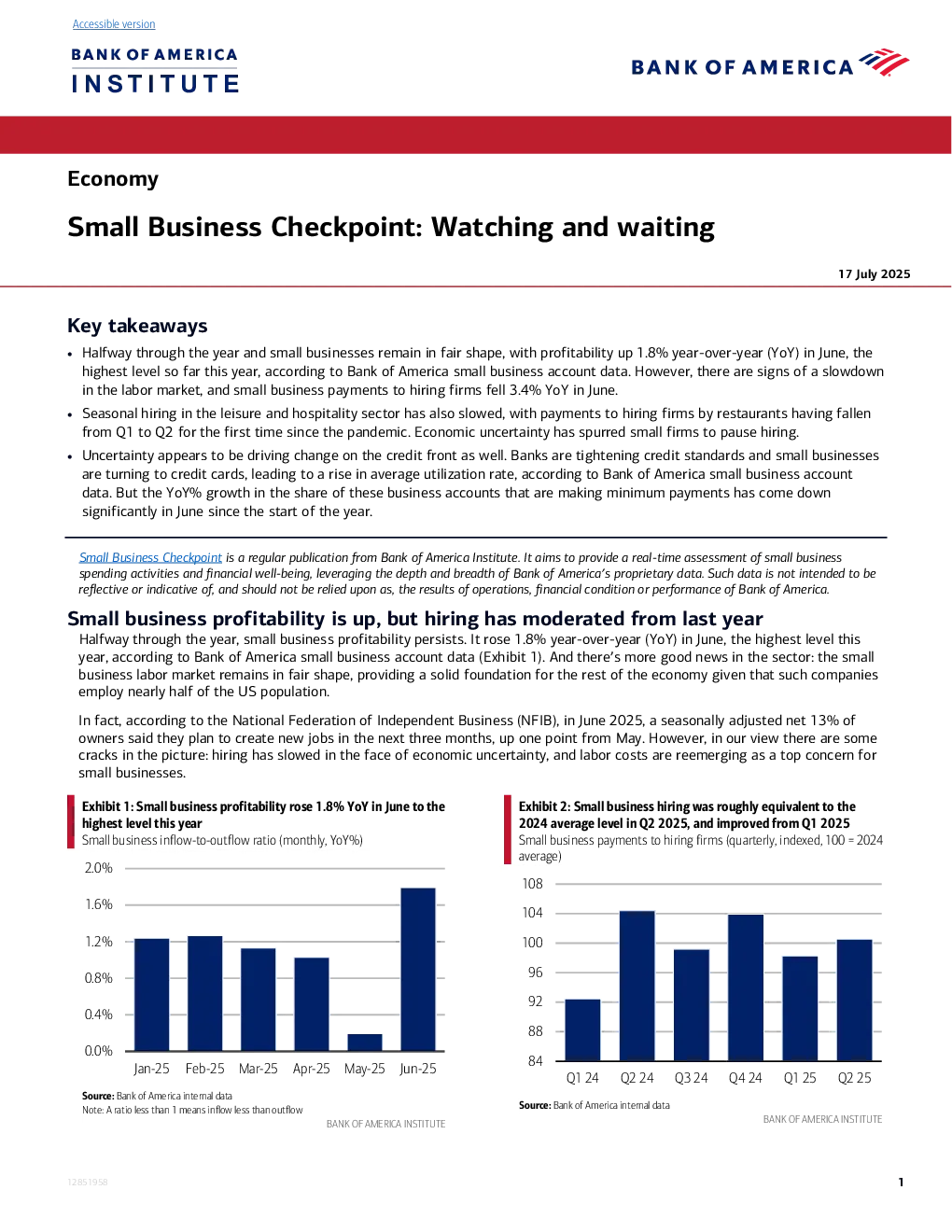
Small Business Checkpoint: Watching and waiting 17 July 2025 Key takeaways •Halfway through the year and small businesses remain in fair shape, with profitability up 1.8% year-over-year (YoY) in June, thehighest level so far this year, according to Bank of America small business account data. However, there are signs of a slowdownin the labor market, and small business payments to hiring firms fell 3.4% YoY in June. Seasonal hiring in the leisure and hospitality sector has also slowed, with payments to hiring firms by restaurants having fallenfrom Q1 to Q2 for the first time since the pandemic. Economic uncertainty has spurred small firms to pause hiring. •Uncertainty appears to be driving change on the credit front as well. Banks are tightening credit standards and small businessesare turning to credit cards, leading to a rise in average utilization rate, according to Bank of America small business accountdata. But the YoY% growth in the share of these business accounts that are making minimum payments has come downsignificantly in June since the start of the year. Small Business Checkpointis a regular publication from Bank of America Institute. It aims to provide a real-time assessment of small businessspending activities and financial well-being, leveraging the depth and breadth of Bank of America’s proprietary data. Such data is not intended to bereflective or indicative of, and should not be relied upon as, the results of operations, financial condition or performance of Bank of America. Small business profitability is up, but hiring has moderated from last yearHalfway through the year, small business profitability persists. It rose 1.8% year-over-year (YoY) in June, the highest level this year, according to Bank of America small business account data (Exhibit 1). And there’s more good news in the sector: the smallbusiness labor market remains in fair shape, providing a solid foundation for the rest of the economy given that such companiesemploy nearly half of the US population. In fact, according to the National Federation of Independent Business (NFIB), in June 2025, a seasonally adjusted net 13% ofowners said they plan to create new jobs in the next three months, up one point from May. However, in our view there are somecracks in the picture: hiring has slowed in the face of economic uncertainty, and labor costs are reemerging as a top concern forsmall businesses. Exhibit2:Small business hiring was roughly equivalent to the2024 average level in Q2 2025, and improved from Q1 2025Small business payments to hiring firms (quarterly, indexed, 100 = 2024 Exhibit1:Small business profitabilityrose1.8%YoYin Juneto thehighest level this yearSmall business inflow-to-outflow ratio (monthly, YoY%) average) Small business payments to hiring firms were down 3.4% YoY in June on a three-month moving average, though remainrelatively equal to the 2024 average level (Exhibit 2). However, on a month-over-month (MoM) basis, in June, such payments rose2.2% from May on a three-month moving average. Searching for a summer job isn’t so hot right nowFor seasonal workers, summer is a peak hiring period at small firms, particularly those in the leisure and hospitality sector.1This is especially true for young people, though recently, evidence is emerging that they’re struggling on the job front. Teenagers areprojected to fill one million jobs in May, June and July, the lowest tally since 2010, according to estimates by outplacement firmChallenger, Gray & Christmas.2 Notably, the restaurant industry is typically the nation’s second-largest creator of seasonal jobs during the summer months,ranking only behind the construction industry.3Using Bank of America small business payments data, we find small businesspayments to hiring firms by restaurants fell from Q1 to Q2 for the first time since the pandemic (Exhibit 3). Small business payments to hiring firmsby restaurants (quarter-over-quarter, %, annual) There are several reasons this might be happening. For one, small business owners are having difficulty hiring workers. Aseasonally adjusted 36% of all such owners said they had job openings they could not fill in June, an increase of two points fromMay, according to the NFIB. And of the 58% of owners hiring or trying to hire in June, 86% reported few or no qualifiedapplicants, suggesting lack of qualified labor could be plaguing the restaurant industry as well. Another reason: These businesses are freezing or cutting seasonal positions over concerns about ebbing consumer confidenceand fears that consumer spending could slow further in the face of tariffs (read more about these concerns in ourJuneConsumer Checkpointand ourJuly Consumer Checkpoint). However, it is possible hiring will increase later in the summer. Employment typically rises for 16- to 19-year-olds during June,July, and August with food preparation and serving occupations4becoming prevalent during that period. But if the ever-changingtimeline of t