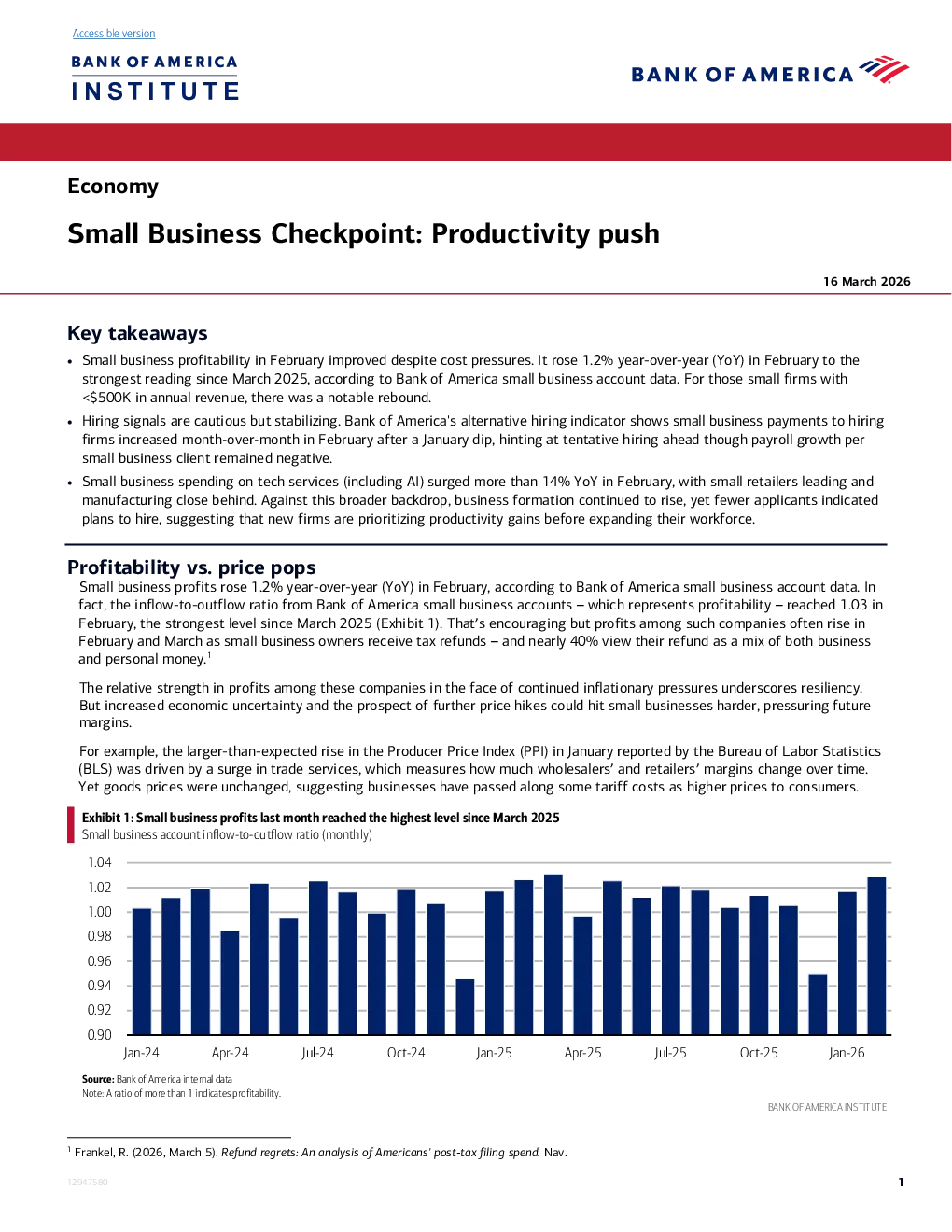
Small Business Checkpoint: Productivity push Key takeaways Small business profitability in February improved despite cost pressures. It rose 1.2% year-over-year (YoY) in February to thestrongest reading since March 2025, according to Bank of America small business account data. For those small firms with •Hiring signals are cautious but stabilizing. Bank of America's alternative hiring indicator shows small business payments to hiringfirms increased month‑over‑month in February after a January dip, hinting at tentative hiring ahead though payroll growth per Small business spending on tech services (including AI) surged more than 14% YoY in February, with small retailers leading andmanufacturing close behind. Against this broader backdrop, business formation continued to rise, yet fewer applicants indicated Profitability vs. price popsSmall business profits rose 1.2% year-over-year (YoY) in February, according to Bank of America small business account data. In fact, the inflow-to-outflow ratio from Bank of America small business accounts–which represents profitability–reached 1.03 inFebruary, the strongest level since March 2025 (Exhibit 1). That’s encouraging but profits among such companies often rise in The relative strength in profits among these companies in the face of continued inflationary pressures underscores resiliency.But increased economic uncertainty and the prospect of further price hikes could hit small businesses harder, pressuring future For example, the larger-than-expected rise in the Producer Price Index (PPI) in January reported by the Bureau of Labor Statistics(BLS) was driven by a surge in trade services, which measures how much wholesalers’and retailers’margins change over time. Microbusinesses operate on the thinnest marginsFor those businesses with lower annual revenues (<$500K and $500K-$1M), February profitability growth rebounded (Exhibit 2). Notably, for firms with annual revenues of <$500K, profitability growth was the strongest since April 2025. One of the largest costs for small firms is labor. According to Bank of America small business payments data, payroll paymentsper client were nearly 5% below the 2024 average in February, although they did increase slightly from the January low (Exhibit3). Comparatively, small businesses with higher revenue tiers were just below or above the 2024 average. For small businesses, Exhibit2:In February, across all revenue tiers, small businessprofitability growth was positive Exhibit3:Payroll payments for small firms with <$500K in annualrevenue remained below 2024 average levels, but ticked up in FebPayroll payments per small business client by revenue tier (monthly, 3-month moving average, indexed, 2024 avg = 100) Small business account inflow-to-outflow ratio by revenue tier (monthly,YoY%, 3-month moving average) Small business labor outlook remains cautiousYet, small business hiring has been uneven, and February marked a softer month for job gains, according to the latest BLS Employment Report. At the same time, Bank of America small business account data shows that payments to hiring firms rose Survey data from the National Federation of Independent Business (NFIB) reinforces this picture: the small business labormarket remains tight by historical standards, with job openings and compensation pressures still elevated. Yet conditions aregradually easing as fewer firms report severe labor shortages compared to late 2025, according to the NFIB. Across sectors, small wholesalers were the only group to see an increase in payroll growth per small business client on athree‑month moving average through February (Exhibit 4). Still, with the exception of retail, payroll levels across most sectorsremain below their 2024 average, based on Bank of America small business payments data. Overall, the data point to a labor Exhibit4:Small wholesalers were the only group to see an increase in payroll growth per small business client through FebruaryPayroll payments per small business client in February by industry (YoY%, 3-month moving average) Small businesses scale up AI spendingWhile the hiring landscape remains relatively depressed, companies appear to be ramping up their spending on AI. In fact, according to Bank of America small business payments data, spending on tech services–which includes AI–grew more than This might be linked to a productivity push. In fact, productivity is showing signs of accelerating relative to the pre-pandemicaverage, likely because of increased business formation and pandemic efficiencies, according to federal data. While the numberof high-propensity business applications was up 15.1% YoY in January, applications with planned wages fell 4.4% and the Exhibit5:The number of businessapplications with planned wagesimproved slightly in January, but remains depressed compared to Exhibit6: Small business spending growth on tech services and AIreached the strongest pace in our series to date Payments to