您的浏览器禁用了JavaScript(一种计算机语言,用以实现您与网页的交互),请解除该禁用,或者联系我们。[美国银行]:小企业检查点:为意外做好计划 - 发现报告

小企业检查点:为意外做好计划

AI智能总结
查看更多
小企业检查点:为意外做好计划

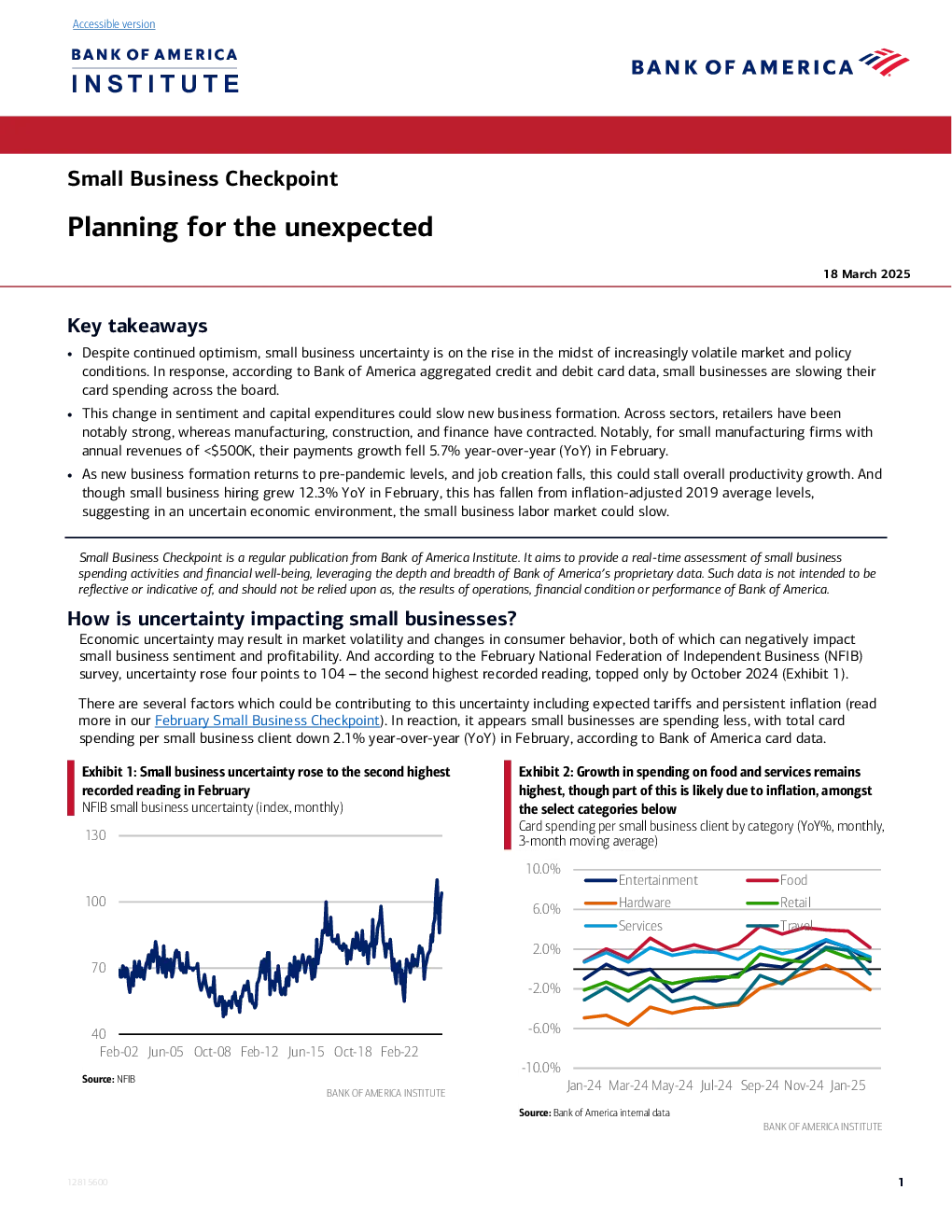
Planning for the unexpected Key takeaways •Despite continued optimism, small business uncertainty is on the rise in the midst of increasingly volatile market and policyconditions. In response, according to Bank of America aggregated credit and debit card data, small businesses are slowing theircard spending across the board. •This change in sentiment and capital expenditures could slow new business formation. Across sectors, retailers have beennotably strong, whereas manufacturing, construction, and finance have contracted. Notably, for small manufacturing firms withannual revenues of <$500K, their payments growth fell 5.7% year-over-year (YoY) in February. •As new business formation returns to pre-pandemic levels, and job creation falls, this could stall overall productivity growth. Andthough small business hiring grew 12.3% YoY in February, this has fallen from inflation-adjusted 2019 average levels,suggesting in an uncertain economic environment, the small business labor market could slow. Small Business Checkpoint is a regular publication from Bank of America Institute. It aims to provide a real-time assessment of small businessspending activities and financial well-being, leveraging the depth and breadth of Bank of America’s proprietary data. Such data is not intended to bereflective or indicative of, and should not be relied upon as, the results of operations, financial condition or performance of Bank of America. How is uncertainty impacting small businesses?Economic uncertainty may result in market volatility and changes in consumer behavior, both of which can negatively impact small business sentiment and profitability. And according to the February National Federation of Independent Business (NFIB)survey, uncertainty rose four points to 104–the second highest recorded reading, topped only by October 2024 (Exhibit 1). There are several factors which could be contributing to this uncertainty including expected tariffs and persistent inflation (readmore in ourFebruary Small Business Checkpoint). In reaction, it appears small businesses are spending less, with total cardspending per small business client down 2.1% year-over-year (YoY) in February, according to Bank of America card data. Exhibit1:Small business uncertainty rose to the second highestrecorded reading in FebruaryNFIB small business uncertainty (index, monthly) Exhibit2:Growth in spending on food and services remainshighest, though part of this is likely due to inflation, amongstthe select categories belowCard spending per small business client by category (YoY%, monthly, 3-month moving average) Some of that decline reflected the extra leap day in February 2024, which boosted spending last year and depressed the YoYgrowth rate for February 2025. Additionally, total payments per small business client remained positive on a 3-month movingaverage, up 3.7% YoY in February, so spending on non-card is still in reasonable shape. Looking across spending categories, food spending growth was modest, and part of this growth is likely due to inflation withinthese categories (see ourMarch Consumer Checkpointfor more) (Exhibit 2).. However, travel and hardware had a sharpdeterioration in the past month, possibly as business looked to cut costs amid weakening demand and growing uncertainty.Cutting back on business travel could be indicativeof slowing demand. Additionally, this could be a reflection that fewer smallbusinesses that are interested in expanding or improving their existing business models. A shaky outlook could suppress new business formation and productivityIn fact, the NFIB found that the number of small businesses reporting“now is a good time to expand”fell in February from December’s five-year high, although the level was above the average for the past four years. Plus, compared to the peak duringCovid, the number of high-propensity business applications is down 16.7% in February. However, high-propensity business applications, which include all businesses that are more likely to become employers, were still35% higher than the average level in 2019. As Exhibit 3 shows, business applications are currently being driven by retail. Exhibit3: Retail, healthcare and social assistance, and entertainment drove positive total business formation growth in FebruaryHigh-propensity business applications by industry in February (YoY%, 3-month moving average) Why is retail all the rage?As of February, retail exhibited the strongest YoY% growth in high-propensity business applications, whereas manufacturing was weakest. What is driving strength in retail growth amongst new business formation? In February, the Fiserv Small Business Indexfound growth in small businesses was broad, but the strongest month-to-month increase in spending occurred in restaurants,sporting goods, auto parts, furniture and clothing; conversely, service-oriented spending declined in the areas of professionalservices and hotels1. This is somewhat supported by Ban