您的浏览器禁用了JavaScript(一种计算机语言,用以实现您与网页的交互),请解除该禁用,或者联系我们。 [美国银行]:小企业检查点:费用加起来 - 发现报告

小企业检查点:费用加起来

医药生物 2026-02-01 美国银行 Elise
报告封面

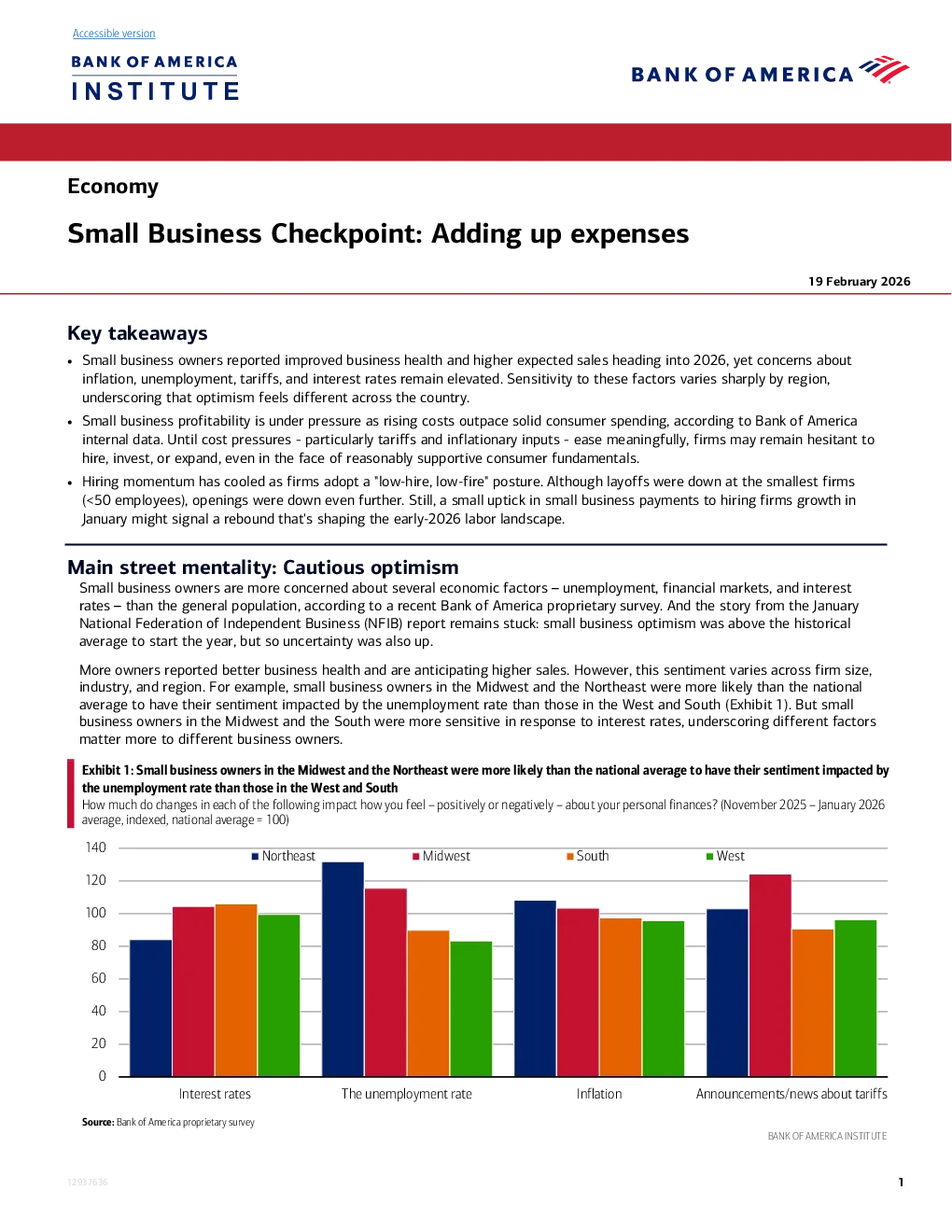
Small Business Checkpoint: Adding up expenses 19 February 2026 Key takeaways •Small business owners reported improved business health and higher expected sales heading into 2026, yet concerns aboutinflation, unemployment, tariffs, and interest rates remain elevated. Sensitivity to these factors varies sharply by region,underscoring that optimism feels different across the country. •Small business profitability is under pressure as rising costs outpace solid consumer spending, according to Bank of Americainternal data. Until cost pressures - particularly tariffs and inflationary inputs - ease meaningfully, firms may remain hesitant tohire, invest, or expand, even in the face of reasonably supportive consumer fundamentals. •Hiring momentum has cooled as firms adopt a "low‑hire, low‑fire" posture. Although layoffs were down at the smallest firms(<50 employees), openings were down even further. Still, a small uptick in small business payments to hiring firms growth inJanuary might signal a rebound that's shaping the early‑2026 labor landscape. Main street mentality: Cautious optimismSmall business owners are more concerned about several economic factors–unemployment, financial markets, and interest rates–than the general population, according to a recent Bank of America proprietary survey. And the story from the JanuaryNational Federation of Independent Business (NFIB) report remains stuck: small business optimism was above the historicalaverage to start the year, but so uncertainty was also up. More owners reported better business health and are anticipating higher sales. However, this sentiment varies across firm size,industry, and region. For example, small business owners in the Midwest and the Northeast were more likely than the nationalaverage to have their sentiment impacted by the unemployment rate than those in the West and South (Exhibit 1). But smallbusiness owners in the Midwest and the South were more sensitive in response to interest rates, underscoring different factorsmatter more to different business owners. Exhibit1:Small business owners in the Midwest and the Northeast were more likely than the national average to have their sentiment impacted bythe unemployment rate than those in the West and SouthHow much do changes in each of the following impact how you feel – positively or negatively – about your personal finances? (November 2025 – January 2026 average, indexed, national average = 100) Small business profits threatened by rising costs despite consumer spending strengthThe primary driver in the uptick in small business optimism originated from an increase in expected real sales. According to Bank of America aggregated credit and debit card data, consumer spending grew 2.6% year-over-year (YoY) in January–the strongestpace in nearly two years (read more on this in theFebruary Consumer Checkpoint). Yet, some small business owners have found it difficult to raise prices and have reported being negatively impacted by all theincreased demands on their clients’income.1And in fact, despite consumer discretionary spending growth increasing in thesecond half of 2025, small business profitability growth continued to moderate, signaling a mismatch between spending andrevenue gains (Exhibit 2). If increased revenue isn’t driving growth, small firms must be faced with higher costs. Although only a small subset of clientspays Customs and Border Protection (CBP) directly, tariff payments per small business client were up 142% YoY in January on a3-month moving average (mma) (Exhibit 3). And a recent analysis from the NY Fed found that US import prices for goods subjectto the average tariff increased by 11% more than those for goods not subject to tariffs–underscoring that US firms andconsumers continue to bear the economic impact of the high tariffs imposed in 2025.2 Exhibit2:Consumer discretionary spending growth has deviatedfrom small business (SB) profitability growthAggregated credit and debit card discretionary spending growth (monthly, 3-mma, seasonally adjusted, YoY%) and small business accountinflow-to-outflow ratio (monthly, 3-mma, YoY%) Rising insurance costs weigh on small firmsBeyond tariffs, inflationary pressures remain. For example, in January, 13% of business owners reported the cost or availability of insurance as their single most important problem, up 4 points from December, according to the NFIB. The last time insurancereached this percentage was December 2018. There are two reasons as to why insurance could be top of mind: 1) tenants’insurance in the Consumer Price Index was up 8.4%YoY in January on a 3-mma–the highest print on record–and 2) expiring American Care Act (ACA) subsidies will impact manysmall businesses. For now, insurance payments (including healthcare) were down 1.2% YoY in January (Exhibit 4). Interestingly, lending‑relatedautomated clearing house (ACH) payments per small business client have picked up at the start of 2026, while tax paymentshave e