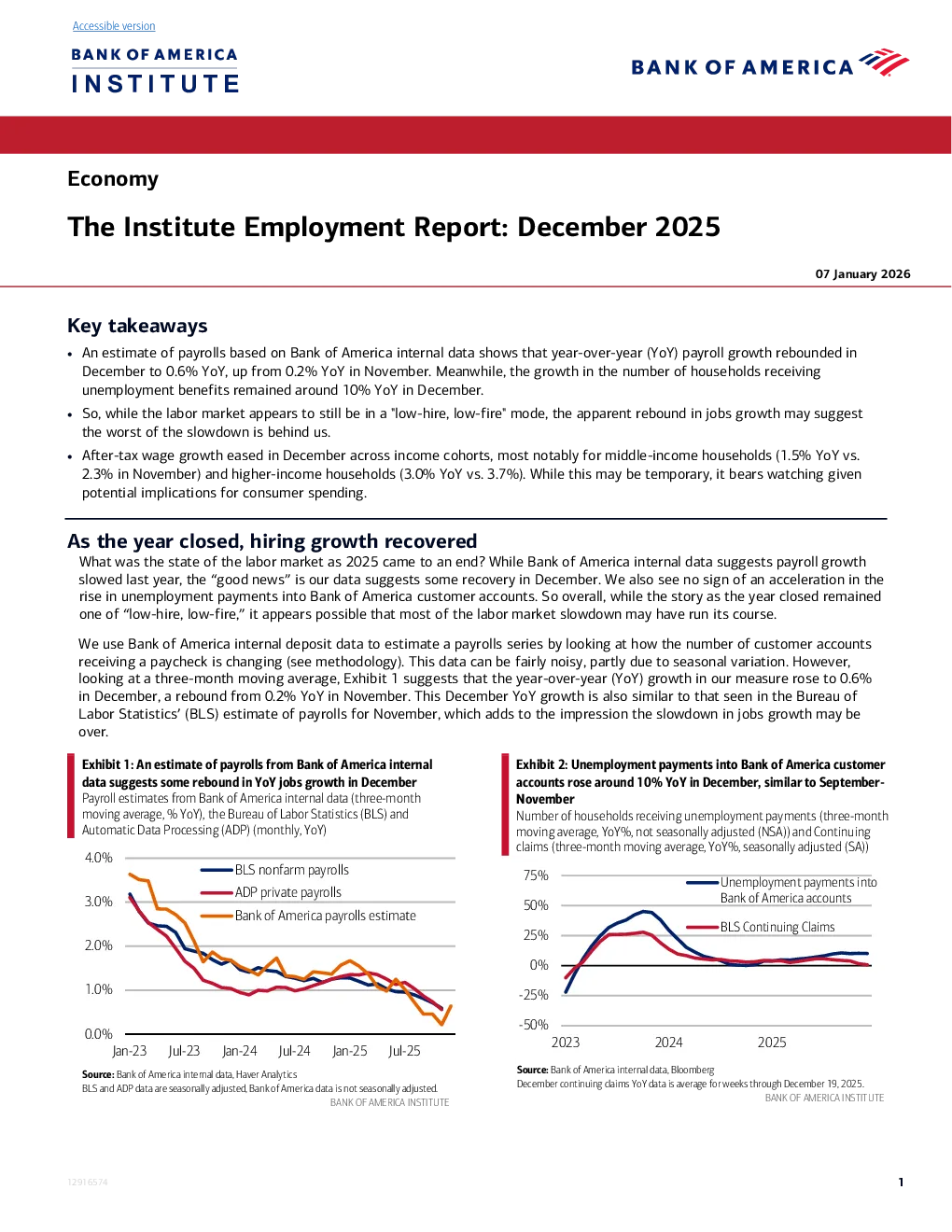
The Institute Employment Report: December 2025 07 January 2026 Key takeaways •An estimate of payrolls based on Bank of America internal data shows that year-over-year (YoY) payroll growth rebounded inDecember to 0.6% YoY, up from 0.2% YoY in November. Meanwhile, the growth in the number of households receivingunemployment benefits remained around 10% YoY in December. So, while the labor market appears to still be in a "low-hire, low-fire" mode, the apparent rebound in jobs growth may suggestthe worst of the slowdown is behind us. •After-tax wage growth eased in December across income cohorts, most notably for middle-income households (1.5% YoY vs.2.3% in November) and higher-income households (3.0% YoY vs. 3.7%). While this may be temporary, it bears watching givenpotential implications for consumer spending. As the year closed, hiring growth recoveredWhat was the state of the labor market as 2025 came to an end? While Bank of America internal data suggests payroll growth slowed last year, the“good news”is our data suggests some recovery in December. We also see no sign of an acceleration in therise in unemployment payments into Bank of America customer accounts. So overall, while the story as the year closed remainedone of“low-hire, low-fire,”it appears possible that most of the labor market slowdown may have run its course. We use Bank of America internal deposit data to estimate a payrolls series by looking at how the number of customer accountsreceiving a paycheck is changing (see methodology). This data can be fairly noisy, partly due to seasonal variation. However,looking at a three-month moving average,Exhibit 1suggests that the year-over-year (YoY) growth in our measure rose to 0.6%in December, a rebound from 0.2% YoY in November. This December YoY growth is also similar to that seen in the Bureau ofLabor Statistics’(BLS) estimate of payrolls for November, which adds to the impression the slowdown in jobs growth may beover. Exhibit1:An estimate of payrolls from Bank of America internaldata suggests some rebound in YoY jobs growth in DecemberPayroll estimates from Bank of America internal data (three-month Exhibit2: Unemployment payments into Bank of Americacustomeraccounts rose around 10% YoY in December, similar to September-November moving average, % YoY), the Bureau of Labor Statistics (BLS) andAutomatic Data Processing (ADP) (monthly, YoY) Number of households receiving unemployment payments (three-monthmoving average, YoY%, not seasonally adjusted (NSA)) and Continuingclaims (three-month moving average, YoY%, seasonally adjusted (SA)) We also do not see signs of an acceleration in the rise in unemployment payments into Bank of America customer accounts.Exhibit 2shows that in December, growth in unemployment payments into Bank of America customer accounts held steady ataround 10% YoY, consistent with the rate of growth observed from September through November. But higher- and middle-income households’ wage growth cooled in DecemberOver 2025 there was notable slowdown in lower-income households’after-tax wage and salary growth, while higher-income households appeared to see an acceleration (Exhibit 3). This produced a pronounced gap in the wage growth experience betweenlower- and higher-income households. Looking at developments in December, Bank of America deposit data indicates lower-income households’after-tax wage andsalary growth eased back to 1.1% YoY, from 1.4% in November. But the“good news”is that the overall deceleration in lower-income households’wage growth over 2025 appears to have largely leveled out. There was, however, a larger pullback in wage growth for both middle- and higher-income households in December. Middle-income households’wage growth eased to 1.5% YoY in December, from 2.3% in November–the lowest growth rate since May2024. And higher-income households also saw an easing in wage growth to 3.0% YoY, from 3.7% in November. In our view, some of these declines in wage growth may prove temporary rather than a more underlying deterioration, thoughthis clearly bears watching. If maintained, it could have negative implications for consumer spending momentum in 2026–butfor now, it is too early to judge. Exhibit3: InDecember,lower-income households’ after-tax wage growthwas1.1% YoY, while higher-income households’ wage growthwas 3.0% YoY After-tax wage and salary growth by household income terciles, based on Bank of America aggregated consumer deposit data (3-month movingaverage, YoY%, SA) MethodologySelected Bank of America transaction data is used to inform the macroeconomic views expressed in this report and should be considered in the context of other economic indicators and publicly available information. In certain instances, the data mayprovide directional and/or predictive value. The data used is not comprehensive; it is based onaggregated and anonymizedselections of Bank of America data and may reflect a degree of selection bias and limitations on t