您的浏览器禁用了JavaScript(一种计算机语言,用以实现您与网页的交互),请解除该禁用,或者联系我们。 [美国银行]:研究所就业报告:2025年10月 - 发现报告

研究所就业报告:2025年10月

信息技术 2025-11-01 美国银行 章嘉艺
报告封面

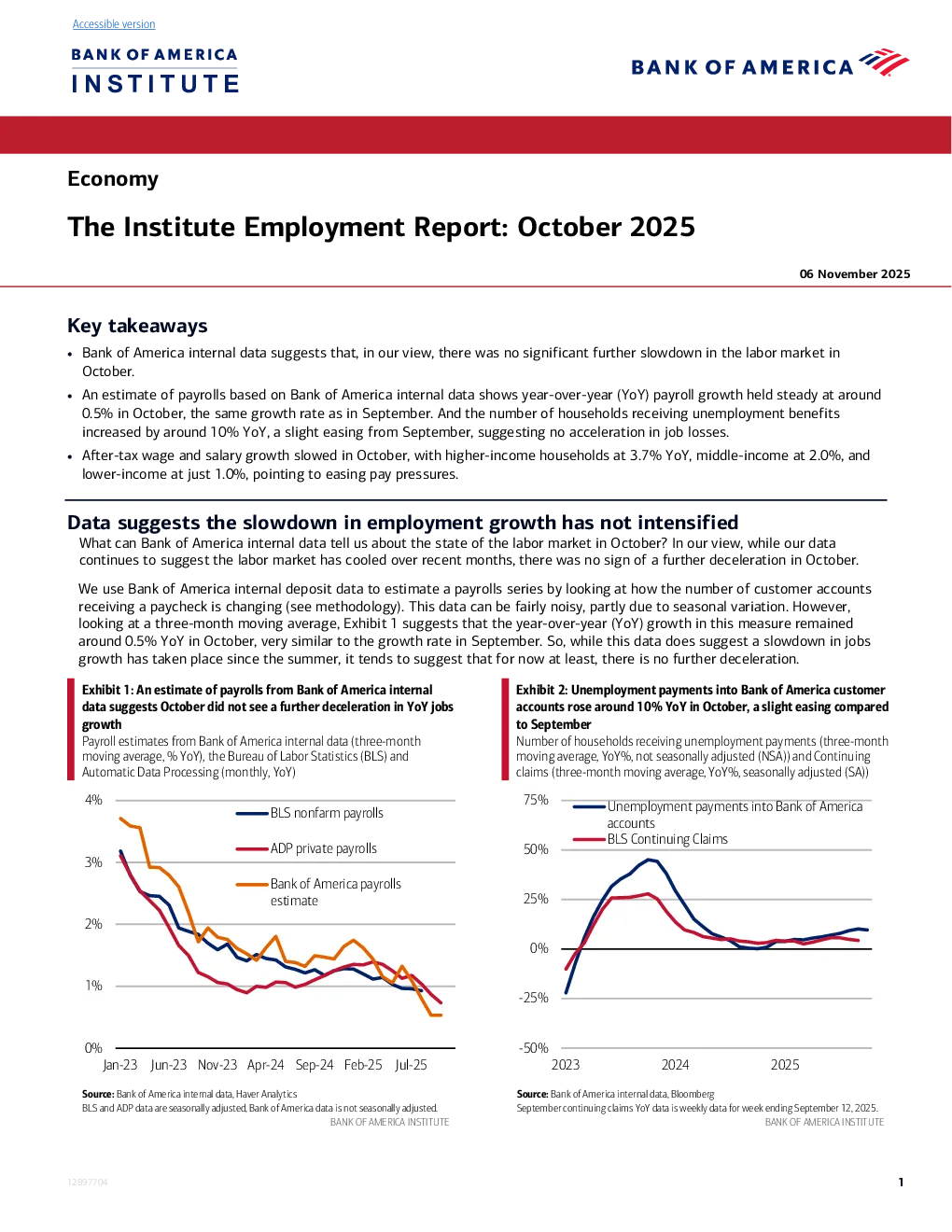
The Institute Employment Report: October 2025 06 November 2025 Key takeaways •Bank of America internal data suggests that, in our view, there was no significant further slowdown in the labor market inOctober. •An estimate of payrolls based on Bank of America internal data shows year-over-year (YoY) payroll growth held steady at around0.5% in October, the same growth rate as in September. And the number of households receiving unemployment benefitsincreased by around 10% YoY, a slight easing from September, suggesting no acceleration in job losses. •After-tax wage and salary growth slowed in October, with higher-income households at 3.7% YoY, middle-income at 2.0%, andlower-income at just 1.0%, pointing to easing pay pressures. Data suggests the slowdown in employment growth has not intensifiedWhat can Bank of America internal data tell us about the state of the labor market in October? In our view, while our data continues to suggest the labor market has cooled over recent months, there was no sign of a further deceleration in October. We use Bank of America internal deposit data to estimate a payrolls series by looking at how the number of customer accountsreceiving a paycheck is changing (see methodology). This data can be fairly noisy, partly due to seasonal variation. However,looking at a three-month moving average,Exhibit 1suggests that the year-over-year (YoY) growth in this measure remainedaround 0.5% YoY in October, very similar to the growth rate in September. So, while this data does suggest a slowdown in jobsgrowth has taken place since the summer, it tends to suggest that for now at least, there is no further deceleration. Exhibit1:An estimate of payrolls from Bank of America internaldata suggests October did not see a further deceleration in YoY jobsgrowth Exhibit2: Unemployment payments into Bank of Americacustomeraccounts rose around 10% YoY in October, a slight easing comparedto September Payroll estimates from Bank of America internal data (three-monthmoving average, % YoY), the Bureau of Labor Statistics (BLS) andAutomatic Data Processing (monthly, YoY) Number of households receiving unemployment payments (three-monthmoving average, YoY%, not seasonally adjusted (NSA)) and Continuingclaims (three-month moving average, YoY%, seasonally adjusted (SA)) Unemployment payments are rising, but they are not acceleratingWe can also look at unemployment payments into Bank of America customer accounts as a guide to continuing unemployment claims.Exhibit 2shows that in October unemployment payments increased around 10% YoY, a slight easing from the increase inSeptember. The YoY growth rate in this data was running ahead of the growth rate of continuing claims from the Bureau ofLabor Statistics (BLS) as of September 12, but even so, our October data suggests upward momentum in unemployment has notintensified. The mixed picture on pay continuesFinally, we consider pay growth. In October, Bank of America deposit data suggests some easing in after-tax wage and salary growth. Higher-income households’after-tax wage and salary growth was 3.7% YoY in October, while for middle-incomehouseholds it was 2.0% YoY and for lower-income households it was up 1.0% YoY. Although these changes are relatively smallcompared to September, they could suggest some easing in pay pressure, in our view. The gap between the after-tax wage and salary growth of higher-income households and that of lower-income householdsremains significant. At 2.7 percentage points (pp) in October, it is tied with August 2025 for the highest level since the start ofthis series in March 2016. Exhibit3: InOctober,lower-income households’ after-tax wage growthdropped back to1.0% YoY, while higher-income households’ wage growtheased to 3.7% YoYAfter-tax wage and salary growth by household income terciles, based on Bank of America aggregated consumer deposit data (3-month moving average, YoY%, SA) Overall, the data suggests a cooling, but not collapsing, labor marketOverall, in our view, Bank of America internal data remains consistent with a cooling of the labor market, but the October data tends to suggest this slowdown has not significantly intensified. YoY employment growth appears similar between Septemberand October, as does the rise in unemployment payments, while there are signs of modestly softer wage pressure. MethodologySelected Bank of America transaction data is used to inform the macroeconomic views expressed in this report and should be considered in the context of other economic indicators and publicly available information. In certain instances, the data mayprovide directional and/or predictive value. The data used is not comprehensive; it is based onaggregated and anonymizedselections of Bank of America data and may reflect a degree of selection bias and limitations on the data available. Any payments data represents aggregated spend from US Retail, Preferred, Small Business and Wealth Management clients witha