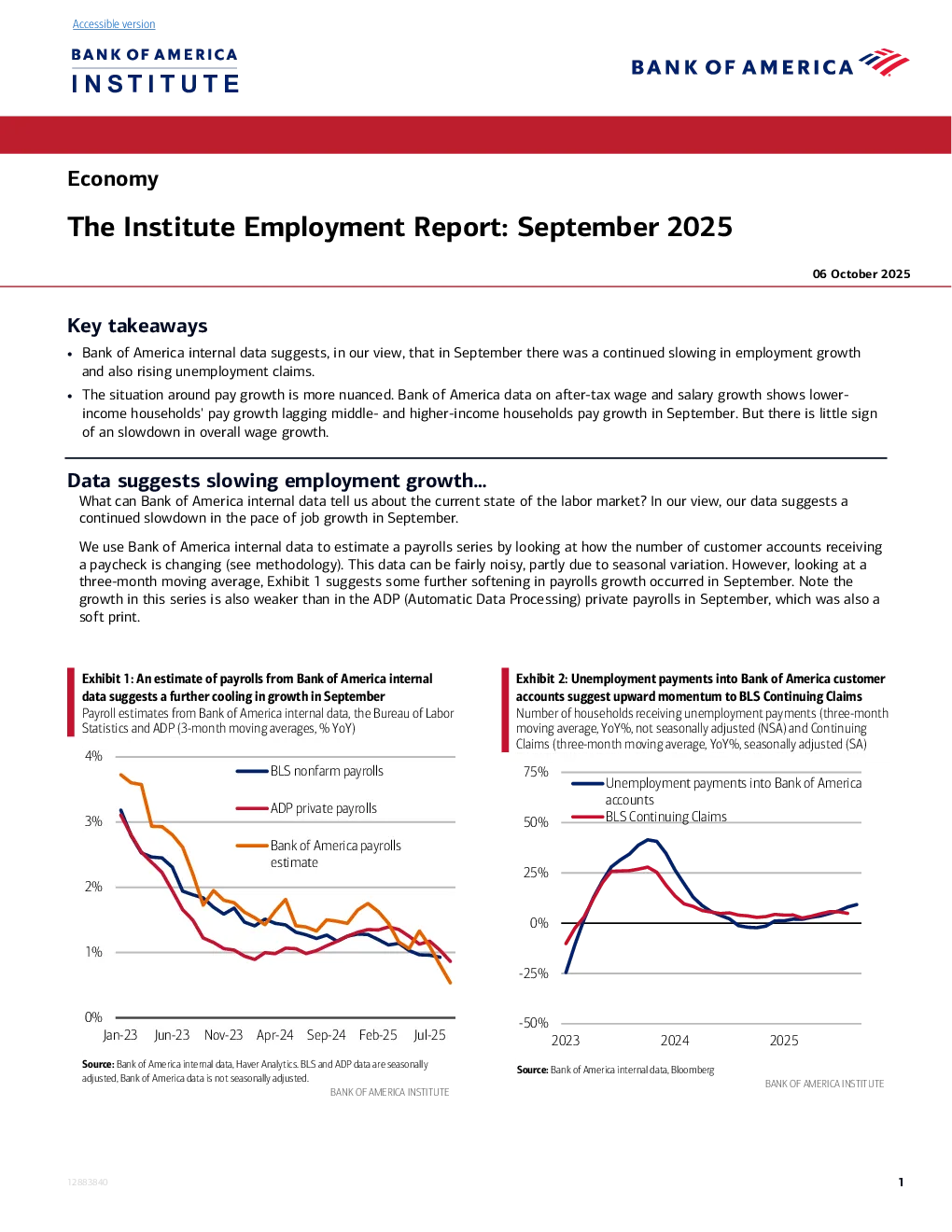
The Institute Employment Report: September 2025 06 October 2025 Key takeaways •Bank of America internal data suggests, in our view, that in September there was a continued slowing in employment growthand also rising unemployment claims. •The situation around pay growth is more nuanced. Bank of America data on after-tax wage and salary growth shows lower-income households' pay growth lagging middle- and higher-income households pay growth in September. But there is little signof an slowdown in overall wage growth. Data suggests slowing employment growth…What can Bank of America internal data tell us about the current state of the labor market? In our view, our data suggests a continued slowdown in the pace of job growth in September. We use Bank of America internal data to estimate a payrolls series by looking at how the number of customer accounts receivinga paycheck is changing (see methodology). This data can be fairly noisy, partly due to seasonal variation. However, looking at athree-month moving average,Exhibit 1suggests some further softening in payrolls growth occurred in September. Note thegrowth in this series is also weaker than in the ADP (Automatic Data Processing) private payrolls in September, which was also asoft print. Exhibit2: Unemployment payments into Bank of Americacustomeraccounts suggest upward momentum to BLS Continuing ClaimsNumber of households receiving unemployment payments (three-month Exhibit1:An estimate of payrolls from Bank of America internaldata suggests a further cooling in growth in SeptemberPayroll estimates from Bank of America internal data, the Bureau of Labor moving average, YoY%, not seasonally adjusted (NSA) and ContinuingClaims (three-month moving average, YoY%, seasonally adjusted (SA) Statistics and ADP (3-month moving averages, % YoY) ….and rising unemployment…Next up, we look at unemployment and unemployment insurance claims, in particular. Using unemployment payments into Bank of America customer accounts as a guide to continuing unemployment claims,Exhibit 2shows that in October the year-over-year (YoY) percentage rise in unemployment payments was around 10%, compared to a 5% YoY rise in BLS continuing claims inAugust. In our view, this suggests some upward momentum to unemployment. …with a mixed picture on payFinally, we consider pay growth. In September, Bank of America deposit data showed after-tax wage and salary payments increased 4.0% YoY for higher-income households, 2.4% YoY for middle-income households and 1.4% YoY for lower-incomehouseholds. While this reflects an acceleration for all three cohorts, the data continues to show a large divergence between thepay growth of middle- and higher- income households compared to that of lower-income households (Exhibit 3). Though, inSeptember, this did not widen further. Exhibit3: InSeptember,higher-incomehouseholdwage growth rose to4.0% YoY, whilefor lower-income households it ticked up to 1.4% YoYAfter-tax wage and salary growth by household income terciles, based on Bank of America aggregated consumer deposit data (3-month moving average, YoY%,SA) Overall, the data suggests continued labor market coolingOverall, in our view, Bank of America internal data is consistent with some continued cooling of the labor market: in particular, that employment growth slowed and unemployment claims rose in September. However, the data on pay growth appears morenuanced. After-tax wage and salary growth accelerated across income cohorts in September. But lower-income households’paygrowth remains significantly weaker than other income groups. MethodologySelected Bank of America transaction data is used to inform the macroeconomic views expressed in this report and should be considered in the context of other economic indicators and publicly available information. In certain instances, the data mayprovide directional and/or predictive value. The data used is not comprehensive; it is based onaggregated and anonymizedselections of Bank of America data and may reflect a degree of selection bias and limitations on the data available. Any payments data represents aggregated spend from US Retail, Preferred, Small Business and Wealth Management clients witha deposit account or credit card. Aggregated spend include total credit card, debit card, ACH, wires, bill pay, business/peer-to-peer, cash, and checks. AnySmall Businesspayments data represents aggregate spend from Small Business clients with a deposit account or a SmallBusiness credit card. Payroll payments data include channels such as ACH (automated clearing house), bill pay, checks and wire.Bank of America per Small Business client data represents activity spending from active Small Business clients with a depositaccount or a Small Business credit card and at least one transaction in each month. Small businesses in this report includebusiness clients within Bank of America and generally defined as under $5mm in annual sales revenue. Unless otherwise s