2009年欧洲旅游业——趋势与前景(2009年第四季度)
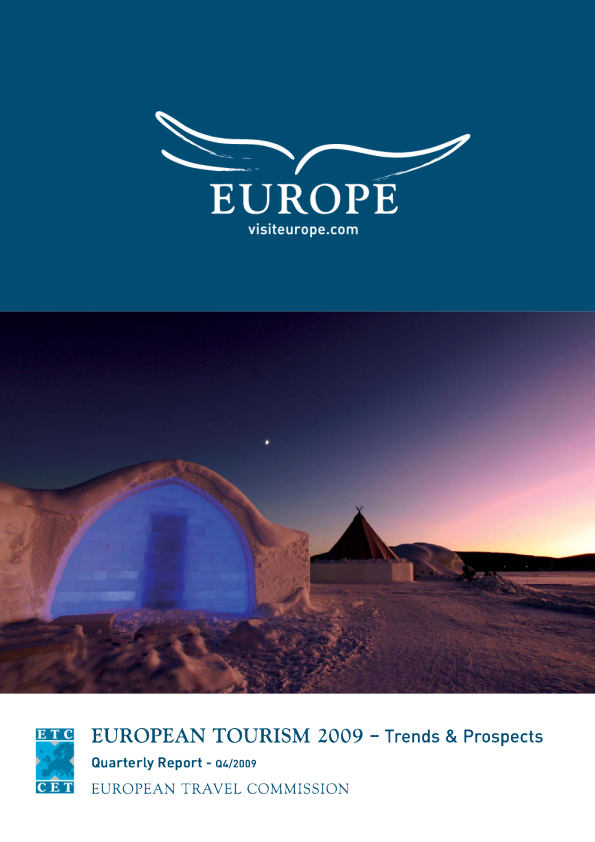
Q4/2009 EUROPEAN TOURISM IN 2009: Quarterly Report (Q4/2009) A quarterly insights report produced for the Market Intelligence Groupof theEuropean Travel Commission (ETC)byTourism Economics (an Oxford Economics Company)andThe Travel Business Partnership Copyright © 2010 European Travel Commission European Tourism in 2009: Trends & Prospects (Q4/2009) All rights reserved. The contents of this report may be quoted, provided thesource is given accurately and clearly. Distribution or reproduction in full ispermitted for own or internal use only. While we encourage distribution via The designations employed and the presentation of material in this publication ISBN No: 978-92-990050-9-5 This report was compiled and edited by:The Travel Business Partnership Photo: Entrance to Icehotel with Arctic sunset, Jukkasjärvi, Sweden.© iStockphoto.com / Daniel Rosenbaum Foreword A muted economic recovery along with weak consumer sentiment and anextended period of high unemployment will dampen the recovery in travel Rob FranklinExecutive Director Leslie VellaChairman Economic Trends and Implications The global economic recovery, which was becoming evident in the third quarterof 2009, became more widespread and more entrenched in the fourth. Indeed,the vigour of the recovery is almost as astonishing as the speed and extent ofthe collapse in Q4 2008 – although it is of course much less dramatic in However, as these graphs show, although it is widespread, the recovery isunevenly distributed, and much slower in Europe than in the rest of the world.In China, India and the rest of 'emerging Asia', the ground lost in the first half of2009 was almost fully recovered in the second half, and growth in 2010 isexpected to be even higher than it was in 2008.In the USA (and in much ofthe rest of the world), while the recovery is slower, forecasts for the outcomes … but remains slower Nevertheless,Oxford Economics has revised its 2010 forecasts for theEuropean Union upwards since October, from 0.6% to 1.1%.Its forecast forthe eurozone has similarly been revised upwards, from 0.5% to 1.1%, withincreases from 1.0% to 1.6% for Germany, 0.9% to 1.3% for France, and 0.3% There is still much uncertainty about the prospects for 2010.Some of theemploymentand economic support programmes(such as car scrappageschemes) come to an end soon.What will be the effect of this?TheInternational Monetary Fund (IMF) has been warning of the possibility of a While GDP in Europe has at least stabilised, the prospects for consumerconfidenceand consumer spending are still poor in some countries anduncertain in others.Generally, consumer credit conditions remain tight andproperty markets weak. In some countries (notably in Eastern Europe) there isa general awareness of the extent of the structural difficulties faced by their Unemployment is Perhaps the most powerful factor will be fears about unemployment, whichreached 10.0% in the eurozone in November.It has recently been rising moreslowly than had been expected, and much less steeply than in the USA, but itis nevertheless forecast to continue rising gradually to 10.5-11.0% some time The IMF and others have also been warning of the need to 'rebalance' theworld economy.One aspect of this is to reduce the large current accountdeficits of the USA and reduce the surpluses of China and the Asian 'tigers',which would involve a cheaper US dollar.For the moment, however, Chinahas effectively re-fixed the yuan/renminbi to the US dollar, and in doing so has Exchange rates The strength of the euro is affecting relative international prices.It is inparticularsupporting outbound long-haul travel from the eurozone todestinations with weaker currencies (counterbalancing, in part, the tendency to Within Europe, similar pressures are being generated by the weakness of theUK and Swedish currencies, encouraging inbound travel from the eurozoneand discouraging outbound travel to the zone.In Eastern Europe, somecountries have currencies fixed to the euro while their neighbours do not,creating flows of travellers to those with weak currencies and reducing the The strong euro is also helping to keep inflation low in Europe.It is insulatingthe local tourism industry from the rise in international oil prices.In 2009inflation averaged 0.3% in the eurozone and 0.8% in the EU as a whole, and Inflation remains subdued However, international commodity prices (including food and oil) have beenrising, and given the strength of demand in Asia and the developing world Among the developed world's Central Banks, only Australia has yet made amove to raise its key interest rates from their abnormally low levels.TheEuropean Central Bank's (ECB's) remains at 1.0% and the Bank of England'sat 0.5%.However, on 3 December the ECB announced that its liquidityfinancing operations would be scaled back in 2010: long-term refinancing Interest rates remain What practical effect this will have on industry, including the travel and tou