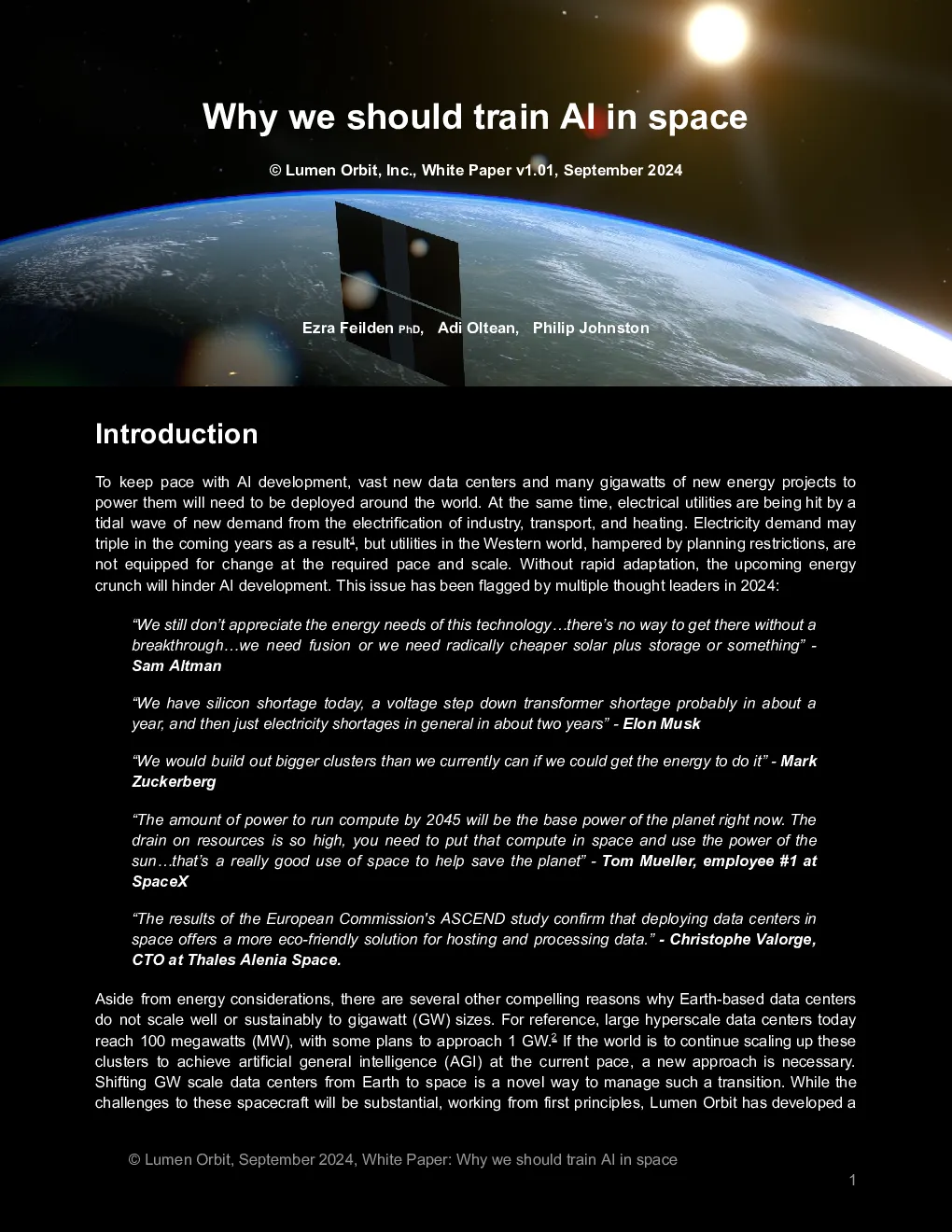
© Lumen Orbit, Inc., White Paper v1.01, September 2024 Introduction To keep pace with AI development, vast new data centers and many gigawatts of new energy projects topower them will need to be deployed around the world. At the same time, electrical utilities are being hit by atidal wave of new demand from the electrification of industry, transport, and heating. Electricity demand maytriple in the coming years as a result1, but utilities in the Western world, hampered by planning restrictions, arenot equipped for change at the required pace and scale. Without rapid adaptation, the upcoming energycrunch will hinder AI development. This issue has been flagged by multiple thought leaders in 2024: “We still don’t appreciate the energy needs of this technology…there’s no way to get there without abreakthrough…we need fusion or we need radically cheaper solar plus storage or something” -Sam Altman “We have silicon shortage today, a voltage step down transformer shortage probably in about ayear, and then just electricity shortages in general in about two years” -Elon Musk “We would build out bigger clusters than we currently can if we could get the energy to do it” -MarkZuckerberg “The amount of power to run compute by 2045 will be the base power of the planet right now. Thedrain on resources is so high, you need to put that compute in space and use the power of thesun…that’s a really good use of space to help save the planet” -Tom Mueller, employee #1 atSpaceX “The results of the European Commission's ASCEND study confirm that deploying data centers inspace offers a more eco-friendly solution for hosting and processing data.”- Christophe Valorge,CTO at Thales Alenia Space. Aside from energy considerations, there are several other compelling reasons why Earth-based data centersdo not scale well or sustainably to gigawatt (GW) sizes. For reference, large hyperscale data centers todayreach 100 megawatts (MW), with some plans to approach 1 GW.2If the world is to continue scaling up theseclusters to achieve artificial general intelligence (AGI) at the current pace, a new approach is necessary.Shifting GW scale data centers from Earth to space is a novel way to manage such a transition. While thechallenges to these spacecraft will be substantial, working from first principles, Lumen Orbit has developed a © Lumen Orbit, September 2024, White Paper: Why we should train AI in space range of concept designs and has not found any insurmountable obstacles. With new, reusable, cost-effectiveheavy-lift launch vehicles set to enter service, combined with the proliferation of in-orbit networking, the timingfor this opportunity is ideal. Lumen Orbit, Inc. is at the forefront of this development as the first company topursue orbital data centers of this scale. Our high-level vision is outlined below. Why Data Centers in Space? Orbital data centers offer several fundamental benefits compared to their terrestrial counterparts, especiallywhen scaled to GW sizes. Significant operational cost savings can be achieved by using inexpensive solarenergy without the limitations of terrestrial solar farms discussed below. Orbital data centers can leveragelower cooling costs using passive radiative cooling in space to directly achieve low coolant temperatures.Perhaps most importantly, they can be scaled almost indefinitely without the physical or permitting constraintsfaced on Earth, using modularity to deploy them rapidly. All of this will have a net benefit on the environment -a recent study by the European Commission concluded that orbital data centers will significantly reducegreenhouse gas emissions from grid electricity and eliminate fresh water usage for cooling.3 Eachof these benefits is detailed below and considered against the challenges and additional costsassociated with deploying and operating this infrastructure in space. Reduced Operating Expenses Data centers in space can utilize high-intensity 24/7 solar power unhindered by day/night cycles, weather, andatmospheric losses (attenuation). This enables orders of magnitude lower marginal energy costs, resulting indrastic operating cost savings versus their terrestrial counterparts. The performance of power plants are compared by their peak output and their “capacity factor” as follows: Terrestrial solar farms in the US achieve a median capacity factor of just 24%ref, while solar projects intemperate regions such as northern Europe typically achieve capacity factors under 10%. The majority ofterrestrial solar farms' generating potential is reduced by suboptimal sun position and losses due to theatmosphere and weather. A capacity factor >50% is impossible on Earth due to the day/night cycle alone. Bycontrast, the capacity factor of our proposed space-based solar array is greater than 95%, with no day/nightcycle, optimal panel orientation perpendicular to the sun’s rays, and no effects from seasons or weather.Additionally, the peak power generation will be ~40% high