财政规则:欧洲对中华人民共和国的观察(英)
 AI智能总结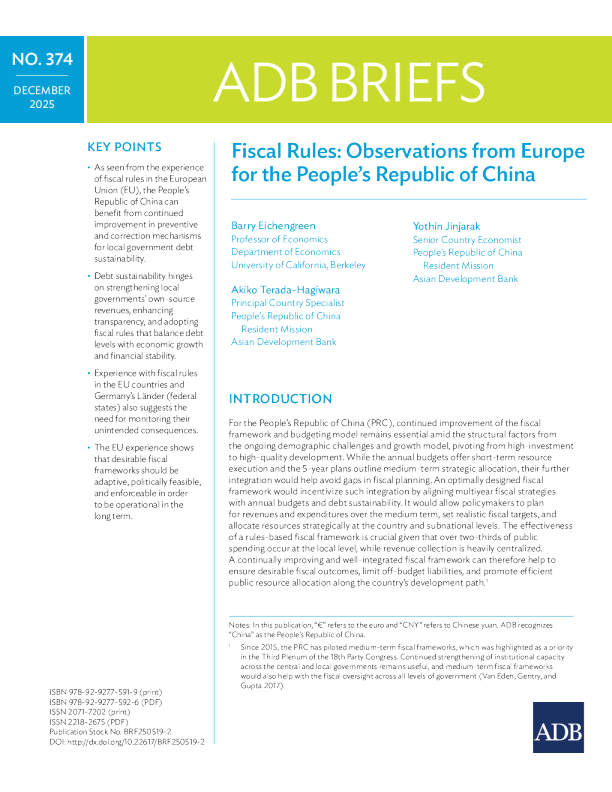
Fiscal Rules: Observations from Europefor the People’s Republic of China KEY POINTS •As seen from the experienceof fiscal rules in the EuropeanUnion (EU), the People’sRepublic of China canbenefit from continued Barry EichengreenProfessor of EconomicsDepartment of Economics Yothin JinjarakSenior Country EconomistPeople’s Republic of ChinaResident MissionAsian Development Bank Debt sustainability hingeson strengthening localgovernments’ own-sourcerevenues, enhancingtransparency, and adopting Akiko Terada-HagiwaraPrincipal Country SpecialistPeople’s Republic of ChinaResident Mission Experience with fiscal rulesin the EU countries andGermany’s Länder (federalstates) also suggests the INTRODUCTION For the People’s Republic of China (PRC), continued improvement of the fiscalframework and budgeting model remains essential amid the structural factors fromthe ongoing demographic challenges and growth model, pivoting from high-investmentto high-quality development. While the annual budgets offer short-term resourceexecution and the 5-year plans outline medium-term strategic allocation, their furtherintegration would help avoid gaps in fiscal planning. An optimally designed fiscalframework would incentivize such integration by aligning multiyear fiscal strategieswith annual budgets and debt sustainability. It would allow policymakers to planfor revenues and expenditures over the medium term, set realistic fiscal targets, and The EU experience showsthat desirable fiscalframeworks should beadaptive, politically feasible, ISBN 978-92-9277-591-9 (print)ISBN 978-92-9277-592-6 (PDF)ISSN 2071-7202 (print)ISSN 2218-2675 (PDF) To supplement funding for economic growth and infrastructure,some PRC provinces have relied on local government financingvehicles (LGFVs), creating off-balance-sheet liabilities.This creates concerns about the resilience of the overall debtsustainability and the stability of financial systems. Lossesto banks and asset management firms could trigger financial governments generally cannot run deficits without explicit centralapproval, official government debts at the subnational levels varysignificantly across jurisdictions, reflecting diverse fiscal and debt In this policy brief, we examine how the experience of therules-based fiscal framework implemented in Europe can informfiscal strategy in the PRC. Section II reviews fiscal managementframeworks across countries, while section III delves into the The PRC’s fiscal framework depends on multiple tools ratherthan on a single rules-based framework for debt sustainability.These tools include fiscal policy guidelines, local governmentdebt management strategies, green and sustainable debtinitiatives, and measures to promote macroeconomic stability.The central government sets debt ceilings for local governmentsand state-owned enterprises while monitoring debt issuance. DEBT AND FISCAL MANAGEMENT Countries typically manage debt with frameworks designedto blend discipline and flexibility. The Eurozone uses theStability and Growth Pact (SGP) with uniform deficit and debtthresholds—3% and 60% of gross domestic product (GDP).The United States, instead of formal fiscal rules at the federal Fiscal Rules: Observations from Europe for the People’s Republic of China The European Union (EU) and the PRC both aim for long-termdebt sustainability and use multiyear fiscal planning: the EUwith medium-term fiscal structural plans, and the PRC with itsannual budgeting and 5-year plans. Whereas the EU enforcesrules via supranational oversight and fiscal councils, the PRC usesadministrative controls and monitoring. Both systems allow somecountercyclical flexibility, but only the EU formalizes “escapeclauses” for crises.4An additional consideration is that both aremanaging fiscal diversity across their constituents under a uniformmonetary policy—within the Eurozone for the EU states and across however, require balanced budgets. Germany and Switzerlandemploy constitutional “debt brakes”3to ensure balancedbudgets and enable countercyclical fiscal actions. Chile usesstructural balance rules to buffer against commodity price The PRC’s approach relies on central administrative enforcementrather than on legal rules. Although local government borrowingis managed through quotas, bond approvals, and oversight,widespread use of LGFVs for off-budget borrowing has ledto larger debt exposure, especially amid declining land sales.Central–local fiscal arrangements also feature local governments’high spending responsibilities and limited revenue autonomy, ADB BRIEFS NO. 374 OVERVIEW OF EUROPEAN FISCAL RULES In 2005, there was already dissatisfaction with the operation ofthe EU fiscal rules. The euro area recession indicators had beenswitched on in 2001–2002. Slow growth resulted in the two largesteuro area countries, France and Germany, deviating from the3%-of-GDP deficit rule in 2003. Yet, there was also a realizationthat cutting public spending or raising tax rates then m