您的浏览器禁用了JavaScript(一种计算机语言,用以实现您与网页的交互),请解除该禁用,或者联系我们。 [世界银行]:职业技术教育与培训技能改革中的有效公私伙伴关系:沙特阿拉伯的经验教训(英)2025 - 发现报告

职业技术教育与培训技能改革中的有效公私伙伴关系:沙特阿拉伯的经验教训(英)2025

文化传媒 2025-12-30 世界银行 Explorer丨森
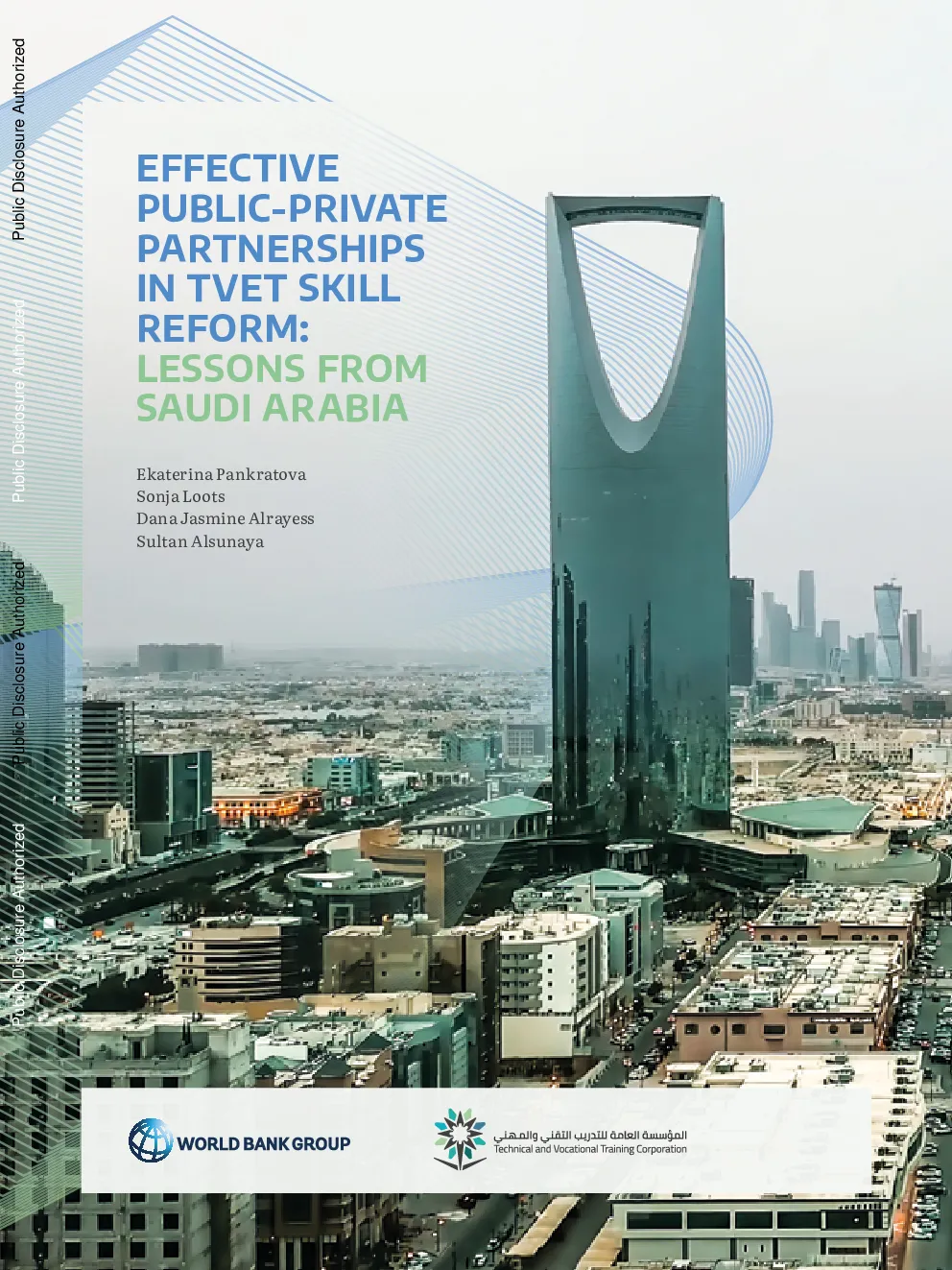
报告封面

Ekaterina PankratovaSonja LootsDana Jasmine AlrayessSultan AlsunayaPublic Disclosure Authorized Disclaimer This work was prepared by The World Bank at the request of the Government ofSaudi Arabia. The findings, interpretations, and conclusions expressed in this re-port do not necessarily reflect the views of the World Bank, its board of executivedirectors, or the governments they represent. The World Bank does not guaranteethe accuracy and completeness of the data included in this report and does notassume responsibility for any errors, omissions, or discrepancies in the informa-tion, nor does it assume liability for the use of or failure to use the information,methods, processes, or conclusions set forth in the report. The boundaries, colors,denominations, and other information shown on any map in this work do not im-ply any judgment on the part of the World Bank concerning the legal status of anyterritory or the endorsement or acceptance of such boundaries. © 2025 The World Bank1818 H Street NW, WashingtonDC 20433Telephone: (202) 473-1000Web: www.worldbank.org Rights and Permissions This work is available under the Creative Commons Attribution 3.0 IGO license (CCBY 3.0 IGO) http://cre- ativecommons.org/licenses/by/3.0/igo. Under the CreativeCommons Attribution license, you are free to copy, distribute, transmit, and adaptthis work, including for commercial purposes, under the following conditions: Attribution: Ekaterina Pankratova, Sonja Loots, Dana Jasmine Alrayess, SultanAlsunaya (2025). Effective Public Private Partnerships in TVET Skill Reform:Lessons from Saudi Arabia. World Bank. Washington, DC. Translations: If you create a translation of this work, please add the following dis-claimer along with the attribution: “This translation was not created by the WorldBank and should not be considered an official World Bank translation. The WorldBank shall not be liable for any content or error in this translation.” Adaptations: If you create an adaptation of this work, please add the followingdisclaimer along with the attribution: “This is an adaptation of an original workby the World Bank. Views and opinions expressed in the adaptation are the soleresponsibility of the author or authors of the adaptation and are not endorsed bythe World Bank.” Third-party content: The World Bank does not necessarily own each componentof the content contained within the work. The World Bank therefore does notwarrant that the use of any third party- owned individual component or partcontained in the work will not infringe on the rights of those third parties. EFFECTIVEPUBLIC-PRIVATEPARTNERSHIPSIN TVET SKILLREFORM:LESSONS FROMSAUDI ARABIA Ekaterina PankratovaSonja LootsDana Jasmine AlrayessSultan Alsunaya ACKNOWLEDGEMENTS This report is the product of collaboration between Saudi Arabia’s Technical andVocational Training Corporation (TVTC) and the World Bank under the TechnicalCooperation Program with the Saudi Arabian government. The collaboration wasled by Ekaterina Pankratova (Senior Social Protection Specialist and Task TeamLeader for Gulf Cooperation Council (GCC) Social Protection and Labor RAS Engage-ment, World Bank). The authors are Ekaterina Pankratova (Senior Social ProtectionSpecialist Task Team Leader, World Bank), Sonja Loots (Labor and Skills Expert,World Bank), Dana Jasmine Alrayess (Labor and Skills Economist, World Bank), andSultan Alsunaya (General Director for International Cooperation, TVTC). The re-port benefited from the technical insights and strategic guidance of Nayib Rivera(Labor Economist, World Bank), Sultan Khair (Labor and Skills Expert, World Bank),Simon Bilo (Economist and Labor Expert, World Bank), Nick Smith (Surveys Imple-mentation Expert, World Bank), Carole Chartouni (Senior Labor Economist, WorldBank), and Ebelechukwu Gloria Monye (Development Research Expert, World Bank).Harry David (Editor, World Bank) provided editorial support. Manuel Gache (Designer,World Bank) contributed to the design of the report. Larisa Marquez (Operations Offi-cer), provided operational support and guidance to the team. The authors are thank-ful to the World Bank peer reviewers, Venkatesh Sundararaman (Lead Economist,World Bank), Oulimata Ndiaye (Economist, World Bank), and Ama Koma BlanksonAnaman (Education Specialist, World Bank), for their valuable comments and sugges-tions. The report is available in Arabic and English and was translated into Arabic byYasmine Khaled Al Jasser (Translation and Arabization Expert, World Bank) for wid-er reach to Arabic-speaking audiences. The report benefited from the strategic guidance and insights of Safaa El Kogali(Division Director, GCC Countries, World Bank) and Cristobal Ridao Cano (PracticeManager, Social Protection and Labor, Middle East and North Africa, Afghanistan,and Pakistan, World Bank). The World Bank task team expresses its sincere appreciation for those involvedin the World Bank’s long-standing partnership with TVTC, who provided guidanceand va