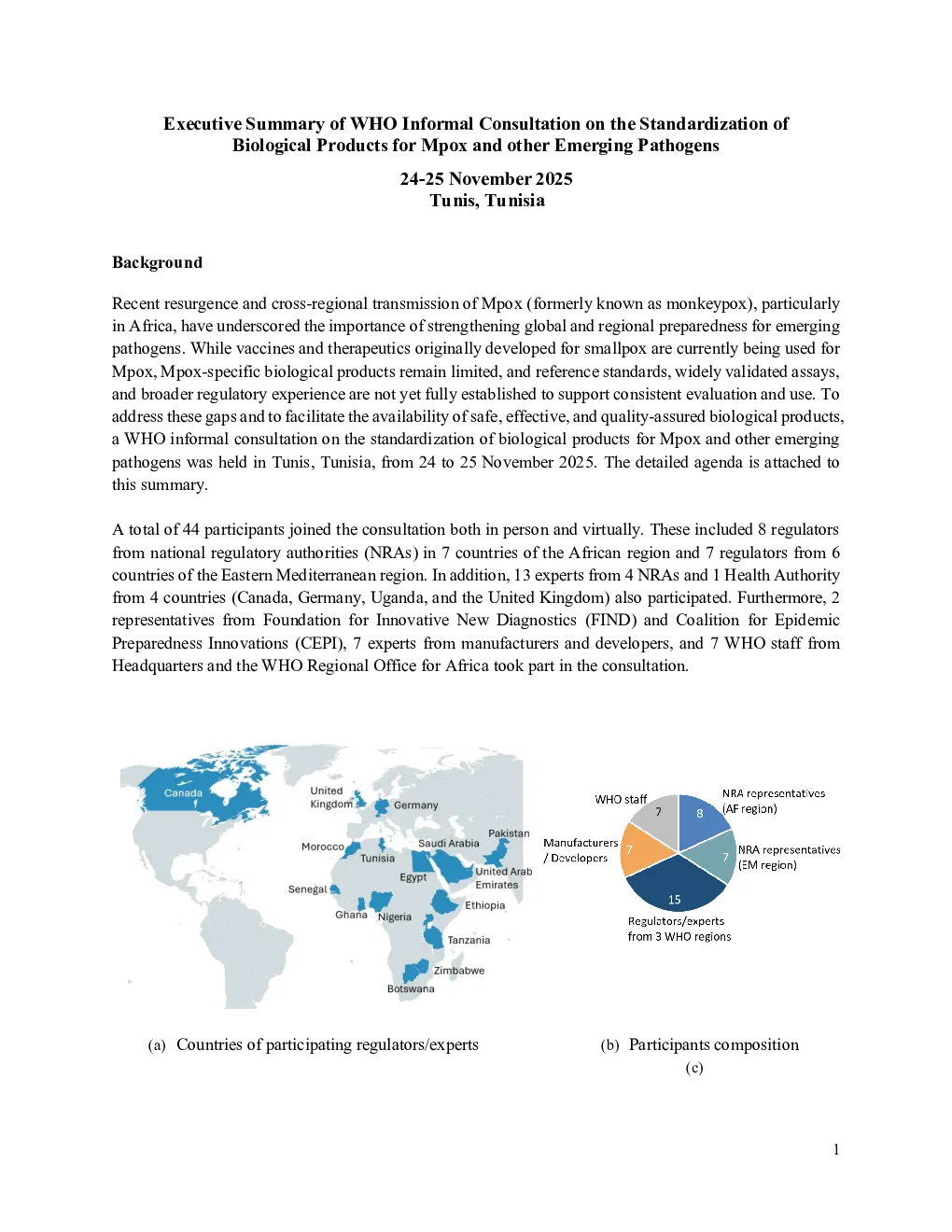
24-25 November 2025Tunis, Tunisia Background Recent resurgence and cross-regional transmission of Mpox (formerly known asmonkeypox), particularlyin Africa, have underscored the importance of strengthening global and regional preparedness for emergingpathogens. While vaccines and therapeuticsoriginally developed for smallpoxare currently being used forMpox, Mpox-specific biological products remain limited, and reference standards, widely validated assays,and broader regulatory experience are not yet fully established to support consistent evaluation and use. Toaddress these gaps and to facilitate the availability of safe, effective, and quality-assured biological products,a WHOinformalconsultation on the standardization of biological products for Mpox and other emergingpathogens was held in Tunis, Tunisia, from 24 to 25 November 2025.The detailedagenda isattachedtothis summary. A total of44participantsjoined the consultation both in person and virtually. These included 8 regulatorsfrom national regulatory authorities (NRAs) in 7 countries of the Africanregion and 7 regulators from 6countries of the Eastern Mediterraneanregion.In addition, 13experts from4NRAsand 1 Health Authorityfrom 4 countries(Canada, Germany, Uganda, and the United Kingdom)also participated. Furthermore,2representativesfromFoundation for Innovative New Diagnostics(FIND)andCoalition for EpidemicPreparedness Innovations(CEPI),7experts from manufacturers and developers, and7WHO staff fromHeadquarters and the WHO Regional Office for Africatook part in the consultation. Objectives The consultation aimed to advance the development, evaluation, and availability of safe, effective, andquality-assured biological products for Mpox and other emerging pathogens, while strengthening regionaland global collaboration. The meeting pursued three specific objectives: •To provide an overview of the current global Mpox situation and WHO’s ongoing activities,including updates on vaccine and monoclonal antibody (mAb) development.•To share progress on the development of WHO international reference standards and assays forMpox, including diagnostics and serological testing.•To address regulatory considerations and challenges for Mpox vaccines and mAbs, and to identifyopportunities to enhance regional collaboration and regulatory convergence. Key discussion pointsare briefly described below. Global Mpoxsituation and WHOinitiatives Participants reviewed the current epidemiological situation, noting an overall downward trend in reportedcasesglobally, which contributed to WHO’s decision to lift the Public Health Emergency of InternationalConcern in September 2025. Several African countries, however, continue to experience new or recurrenttransmission, and Mpox remains classified by Africa CDC as a public health emergency of continentalsecurity. The consultation highlighted the role of the WHO Global Strategic Preparedness and Response Plan 2024in strengthening surveillance systems, increasing testing capacity, and improving data management.Despite this progress, challenges persist, including limited funding for vaccine procurement, operationalconstraints affecting deployment, and the need to integrate Mpox response activities into primary healthcareto ensure long-term sustainability. DevelopmentofMpoxbiologicalproducts Discussionsreviewed the development ofMpox vaccinesandmonoclonal antibodies. Currently licensedvaccines are based on vaccinia virus platforms originally developed for smallpox. New Mpox-specificvaccines, including mRNA-based platforms, are under development.Participants identified correlates ofprotection (CoP) as a central scientific challenge. Differences in vaccine platforms, immune responseprofiles, population heterogeneity, and the influence of assay methodology were noted as key factorscomplicating the definition and measurement of relevant immunomarkers. Issues related to assay variabilitywere recognized as barriers to data comparability.For monoclonal antibodies, participants noted ongoing early-stage development efforts. Challenges include targetselection,potency assessment,production scalability,and the practicality of intravenousadministration. Lessons from antibody cocktail approaches used in other diseases, such as Ebola, werenoted as potentially informative. WHOinternationalreferencestandardsfor Mpox WHO presented ongoing work on the development of international standards for anti-Mpox and anti-vaccinia antibodies, as well as reference reagents forMpox DNA for nucleic acidtesting. These standardsare expected to play a critical role in supporting assay calibration, enabling comparability of data acrosslaboratories, and strengthening evaluation of vaccines and other biological products. Participants emphasized the importance of calibrating in-house assays to WHO International Standardswhen available and highlighted the need for additional training and guidance to ensure proper adoption andimplementation. Assays for Mpoxdiag