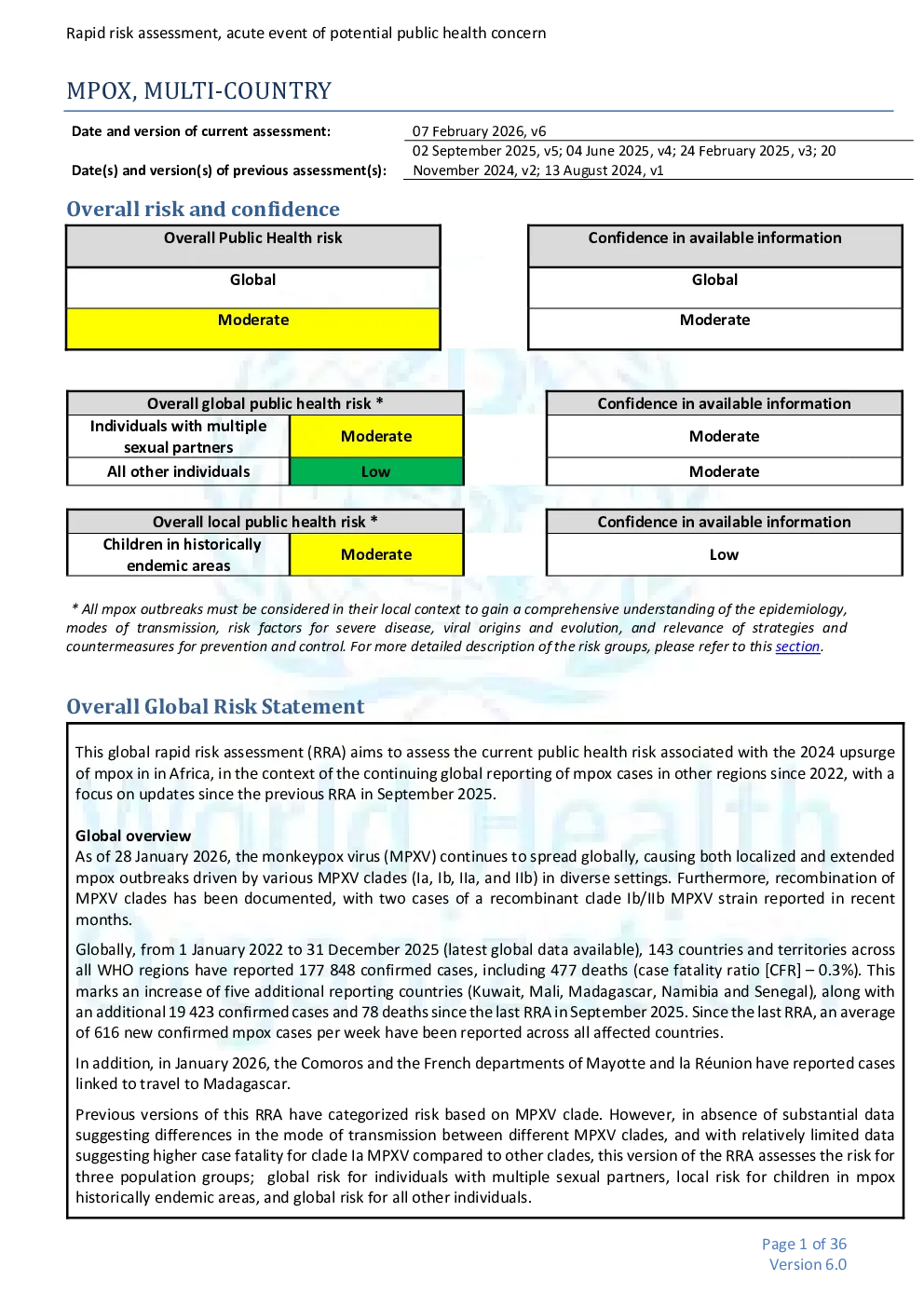
MPOX, MULTI-COUNTRY Dateandversionof current assessment: 02 September 2025, v5; 04 June 2025, v4; 24 February 2025, v3; 20November 2024, v2; 13 August2024, v1 Date(s) and version(s) of previous assessment(s): * All mpox outbreaks must be considered in their local context to gain a comprehensive understanding of the epidemiology,modes of transmission, risk factors for severe disease, viral origins and evolution, and relevance of strategies and Overall Global Risk Statement This global rapid risk assessment (RRA) aims to assess the current public health risk associated with the 2024 upsurgeof mpox in in Africa, in the context of the continuing global reporting of mpox cases in other regions since 2022, with a Global overviewAs of 28 January 2026, the monkeypox virus (MPXV) continues to spread globally, causing both localized and extended mpox outbreaks driven by various MPXV clades (Ia, Ib, IIa, and IIb) in diverse settings. Furthermore, recombination ofMPXV clades has been documented, with two cases of a recombinant clade Ib/IIb MPXV strain reported in recent Globally, from 1 January 2022 to 31 December 2025 (latest global data available), 143 countries and territories acrossall WHO regions have reported 177 848 confirmed cases, including 477 deaths (case fatality ratio [CFR] – 0.3%). Thismarks an increase of five additional reporting countries (Kuwait, Mali, Madagascar, Namibia and Senegal), along withan additional 19 423 confirmed cases and 78 deaths since the last RRA in September 2025. Since the last RRA, an average In addition, in January 2026, the Comoros and the French departments of Mayotte and la Réunion have reported caseslinked to travel to Madagascar. Previous versions of this RRA have categorized risk based on MPXV clade. However, in absence of substantial datasuggesting differences in the mode of transmission between different MPXV clades, and with relatively limited datasuggesting higher case fatality for clade Ia MPXV compared to other clades, this version of the RRA assesses the risk for Rapid risk assessment, acute event of potential public health concern Individuals with multiple sexual partners–global riskSince the start of the global mpox outbreak in 2022, sexual activity in linked sexual networks has been the primary driver of sustained transmission and geographic spread, particularly in newly affected areas. In Europe and theAmericas, up to 96% of cases were among men who have sex with men driven by spread among individuals withmultiple sexual partners in a short space of time and frequent partner change. While sexual behavior data for cases innewly affected African countries remain limited, the contribution of sexual transmission to the introduction, spread Sexual contact infection likely occurs during pre-symptomatic or less apparent stages of infection, the duration of whichcan vary between individuals. People with few or mild genital lesions might not even recognise the infection. Althoughthe secondary attack rate for sexual contact is high (estimated at 16-73%), for the epidemic to spread it requiresnetworks characterised by frequent partner change and high rates of partner turnover over short timeframe (days tofew weeks). This pattern was observed during the initial spread of clade IIb among communities of men who have sex Studies have shown that the virus can be present in genital and anal mucosae, as well as in seminal and vaginal fluidsof symptomatic infected individuals. Emerging data suggest that viral shedding from the genitals may occur up to fourdays before symptom onset, potentially contributing to undetected sexual contact transmission. This could explain the In most healthy adults of this group, mpox infection is mild and self-limiting. However, severe disease and death havebeen documented in people living with uncontrolled HIV, as well as other immunocompromising conditions, includingin countries such as Burundi, the Democratic Republic of the Congo, Sierra Leone and Uganda. While the overall casefatality ratio has remained below 1% in most settings, substantially higher fatality has been observed among individuals Most countries have activated outbreak response mechanisms, including surveillance, case investigation, contacttracing, and infection prevention and control. However, control efforts have been impeded when sexual transmissionis not adequately recognized and risk communication and community engagement do not effectively reach key While targeted mpox vaccination has been implemented for groups at higher risk of mpox exposure in several countries,coverage remains uneven and most individuals in this group, particularly in countries outside Europe and NorthAmerica, remain susceptible to mpox infection. In addition, new cohorts of individuals entering sexually active age Overall, while transmission in this population group is likely to continue and sustain geographic spread, severeoutcomes most often occur among immunocompromised individuals a