您的浏览器禁用了JavaScript(一种计算机语言,用以实现您与网页的交互),请解除该禁用,或者联系我们。[世界卫生组织]:世界卫生组织快速风险评估-猴痘,全球第3版 - 发现报告

世界卫生组织快速风险评估-猴痘,全球第3版

AI智能总结
查看更多
世界卫生组织快速风险评估-猴痘,全球第3版

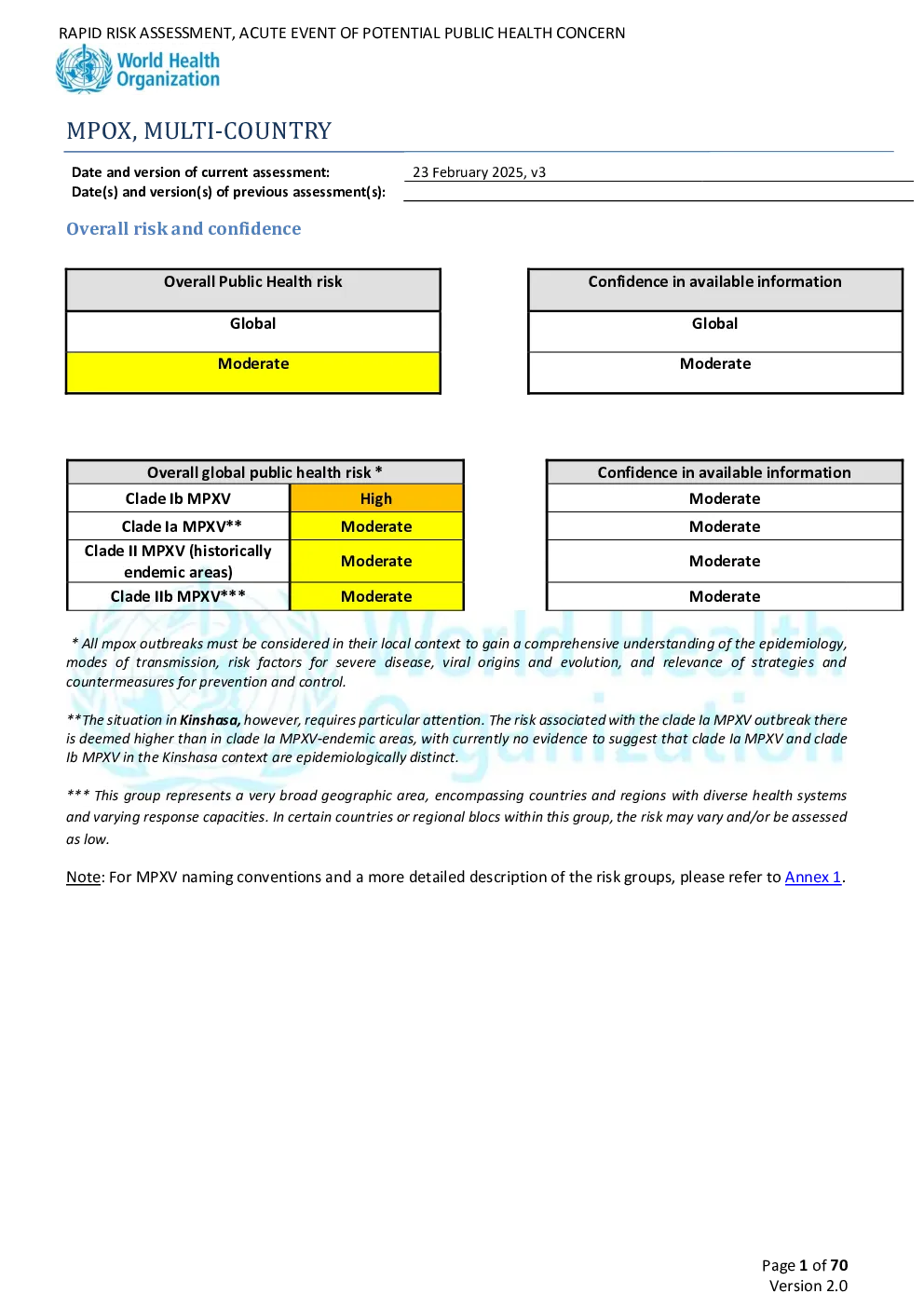
MPOX,MULTI-COUNTRY Dateandversionof current assessment:Date(s)and version(s)of previous assessment(s): Overallriskand confidence * All mpox outbreaks must be considered in their local contextto gain a comprehensiveunderstanding oftheepidemiology,modes of transmission, risk factors for severe disease, viral origins and evolution, and relevance of strategies andcountermeasures for prevention and control. **The situation inKinshasa,however,requiresparticular attention.The riskassociated withthe clade Ia MPXV outbreak thereis deemed higher than inclade Ia MPXV-endemic areas, with currently no evidenceto suggest thatclade Ia MPXVand cladeIb MPXVin the Kinshasa contextareepidemiologically distinct. *** This group represents a very broad geographic area,encompassingcountries and regionswithdiverse health systemsandvaryingresponse capacities. Incertaincountries or regional blocswithin this group, the risk may vary and/or be assessedas low. Note: For MPXV naming conventions andamore detailed description of the risk groups, please refer toAnnex 1. Overall GlobalRisk statement This global rapid risk assessment (RRA) aims toevaluatethe current public health risk associated with the 2024 upsurgeof mpox in the Democratic Republic of theCongo (DRC)and other countries in Africa, with a focus on updates since theprevious RRA in November 2024. Globally, the monkeypox virus (MPXV) continues to spread, causingbothlocal andextendedoutbreaksdriven byvariousMPXV clades(Ia, Ib, IIa, and IIb) in various settings. From1January 2022 to31January 2025,130countries andterritoriesacrossall WHO regionshavereported127 960confirmed cases, including 281deaths(casefatalityratio-0.2%).Thismarksan increaseoffouradditionalreporting countriesand territories(Angola,Azerbaijan, Kosovo[1],andSierra Leone),along withan additional12 859confirmed cases and26deaths sincethe lastRRA on10 November 2024. The African Regioncontinues to experiencesustained outbreaks, accounting for61% ofcasesreportedglobally(upfrom58% in November 2024) and72% of deaths(compared to72%in November 2024)overthe past12 months. Theincrease in mpox cases in the African Regionremainsprimarilydriven by theoutbreakinDRC(where both clade IaMPXV and Ib MPXV are circulating), and the expansion of the clade Ib MPXV outbreak ineasternAfrica. In the Democratic Republic of the Congo(DRC),where only clade I MPXV has been detected, all 26 provinces reportedbothsuspectedandconfirmed mpox casesbetween1 January 2024and16February 2025. Thecountrycontinues tohave the greatestdiseaseburden,accountingfor68% of confirmed cases(15 411 out of22 618 confirmed cases)and57% of deaths(43 out 76 deaths)among confirmed casesin Africaduringthisperiod.Thehighmpoxburdenin thecountryduringthis period was drivenbythesteadilyexpandingclade Ib MPXVoutbreak,which isspreading throughsexual and other forms of close physical contact, in non-endemic areas of the country (andrecently, someendemicareas), as well as by ongoingclade Ia MPXVoutbreaksinhistorically endemic provinces.Additionally, Kinshasa, thecapital,continues toreport an outbreak of both clade Ia MPXV and Ib MPXV,with77% of sequencesfrom thereduringthis periodidentified asclade Ia MPXV. Thisoutbreakin Kinshasais predominantlyaffectingadults, includingthosewithin high-risk sexual networks. Thishighlightsthepossibilitythattransmission risk profiles of MPXV clades mayvarybased on the contextandconfirmsthatboth clade Ia and clade Ib MPXV are spreadingwithinsexual networks. Clade Ib MPXVhas been spreading in the South Kivu province of the DRCsince September 2023. As of16February2025, cases have also been detected insevenother provinces:North Kivu, Kinshasa, Kasai, Tshopo,Tanganyika,Haut-KatangaandMai-Ndombe.Two of these provinces, Haut-Katanga and Mai-Ndombe,are newly reportingprovincessinceNovember 2024.While stable trendsin suspected cases have been reported in recent months,it isimportanttonote thatunder-ascertainment and underreporting of mpox casespersist,particularlydue to long-standinglimitationsin surveillance and diagnostic capacity. Thesechallengesare likely toworsenwiththe recent escalationofconflictinthe eastern part of the country,which is affectingoutbreakcontrolefforts.In provinces historically endemic for cladeIa MPXV,outbreaksofclade Ib MPXVhave been documented in urban settings, such asKisangani in Tshopo, andTshikapa in Kasai. The current outbreakscontinue to be drivenby human-to-human transmission throughclose physicalcontact, including sexual contact. Sexual contact transmission in high-risk networks, including sex workers, contributedto the initial rapid geographic expansion of clade Ib MPXV within the Democratic Republic of the Congo andneighbouring countries. Asthe outbreak expanded in communities, so did the age groups affected, shifting from anepidemic predominantly affecting adults to onenowimpactingchildrenas well, reflecting household and communitytransmission through close physical contact. Since July 2024, and as of16Feb