提升制造业价值:智能运营的影响
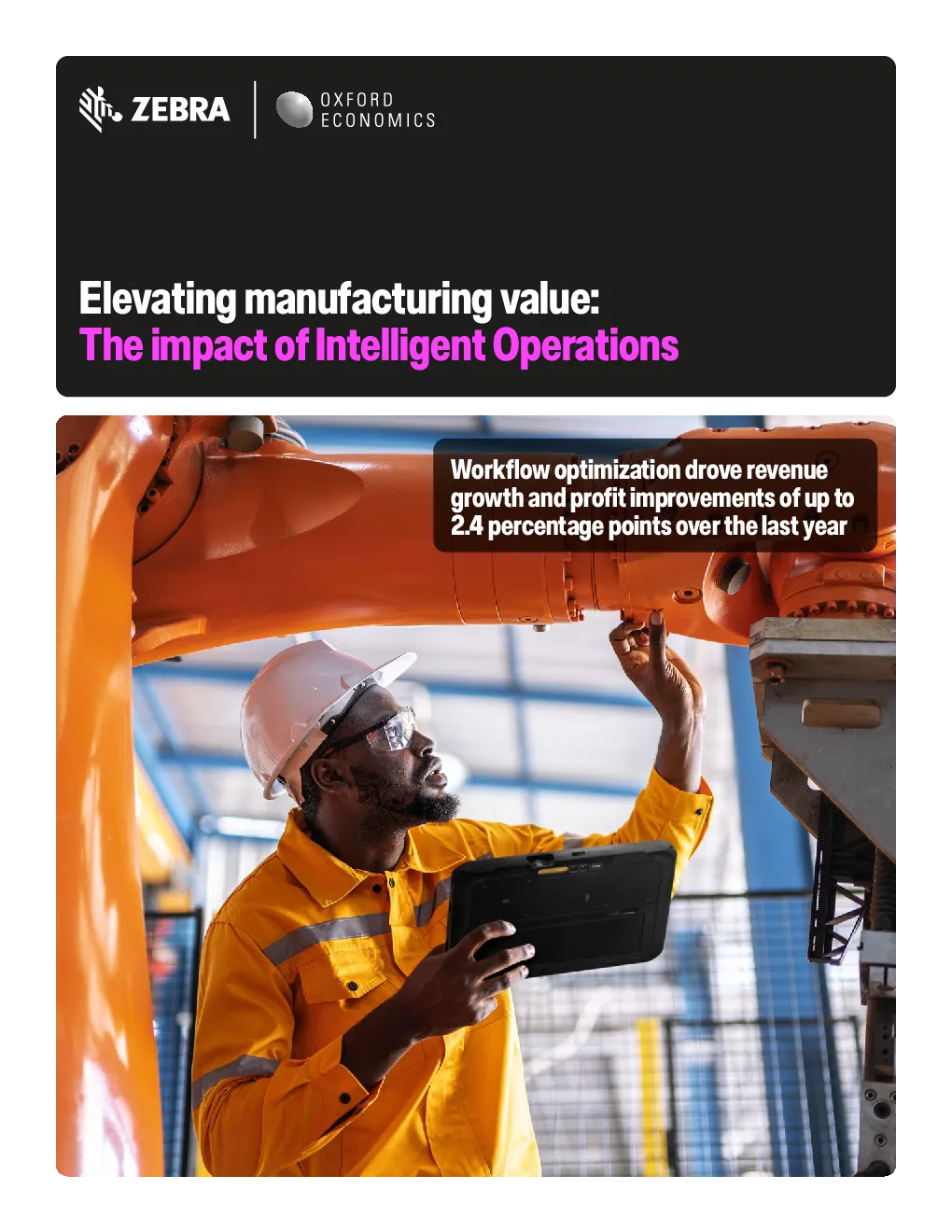
Workflow optimization drove revenuegrowth and profit improvements of up to2.4 percentage points over the last year Introduction Investments in plant floor operations across the manufacturing sector, from electronics andautomotive to food and beverage, are focused on workflow optimization and driving higherrevenues, profits, and employee productivity. Established manufacturing organizations are investingin tools that are foundational for intelligent operations, including mobile computers and RFIDtechnologies for supply chain coordination, machine learning and vision for product quality, andartificial intelligence (AI) for better demand forecasting. To understand how workflow improvements translate to financialbenefits, Oxford Economics and Zebra Technologies surveyed400 manufacturing decision-makers from around the world,then applied econometric analysis to their responses to measurebusiness performance. Our research focused on several keyworkflows—including production and assembly line, qualitycontrol and assurance, supply chain coordination and inventorymanagement, maintenance and equipment management, andmaterial movement and handling—and found significant levels ofprogress and payoff. Manufacturers that focused on improving quality control andassurance, for example—an area where many respondents havemade meaningful progress in recent years—reported, on average,higher top- and bottom-line impacts over the last year comparedto those that did not, including 2.4-percentage-point higherrevenue growth and 1.4-percentage-point higher profitability.1Among those that improved this workflow, discrete manufacturers,like electronics and automotive OEMs, reported higher revenueuplifts compared to other manufacturing subverticals. In addition to quality control and assurance, our reportfocuses on another key workflow: material movement andhandling, identified by respondents as an area most in need ofimprovement. In-depth interviews with industry leaders makeclear that the benefits of intelligent operations are not limited toa single workflow or even a single organization—these benefitsgenerate significant value for the entire supply chain, a complexinterdependent system spanning manufacturing, transportationand logistics, and retail organizations all working together to meetcustomer demands for high-quality products and timely services. Intelligent operations integrateadvanced technologies likeAI, automation, and data withhuman expertise to optimizebusiness processes. In fact, organizations across the entire supply chain thatreported meaningful workflow improvements saw, on average,2-percentage-point higher revenue growth and 1.7-percentage-point higher profitability than peers over the last year. Manufacturers are looking for ways tooptimize workflows Profitability and efficiency are the leading business goals for manufacturers—and major perceivedweak spots. Fewer than half say they are better than their industry peers in either area, and just athird say the same about their return on invested capital and ability to respond to market pressures. Improving product or service quality is a top goal for morethan half of process manufacturers (i.e., food & beverage andconsumer packaged goods), likely due to the regulatory focusaround health, safety, and labeling requirements. Discretemanufacturers (i.e., electronics and automotive OEMs andsuppliers), on the other hand, are prioritizing profitability and ROI. manufacturers. About one-third see it as the integration ofadvanced analytics and AI/ML to optimize decision-making andoperational performance—a complex approach that is far morecommon for larger manufacturers. By contrast, about one-fifth define automation as a broad,strategic concept encompassing different technologicalsolutions, from devices to software, to improve productivity andefficiency. Even fewer emphasize the use of robotics, machinery,or hardware systems to perform physical tasks previously carriedout by humans (11%). (For more detail on the differences betweenmid-sized manufacturers and their larger counterparts, see thesidebar on page 7.) Manufacturers are focusing on these business priorities byinvesting in technologies that make their frontline operationsmore intelligent. They report allocating, on average, 69% of theirIT budgets to devices, software, and other technologies usedto automate workflows. “There is a big pressure to automate,”says one director of manufacturing transformation at a topautomotive company in Europe. “Either you do that and cancompete on cost, or you will not survive.” Workflow automation takes on different meanings for differentorganizations. Roughly 4 in 10 define automation as the useof software and digital tools to streamline workflows andeliminate manual tasks; this is especially the case for mid-sized Fig. 1: Manufacturers are prioritizing profitability, efficiency, and quality Q. Which three of the following business goals are your top priorities over the n