AI智能总结
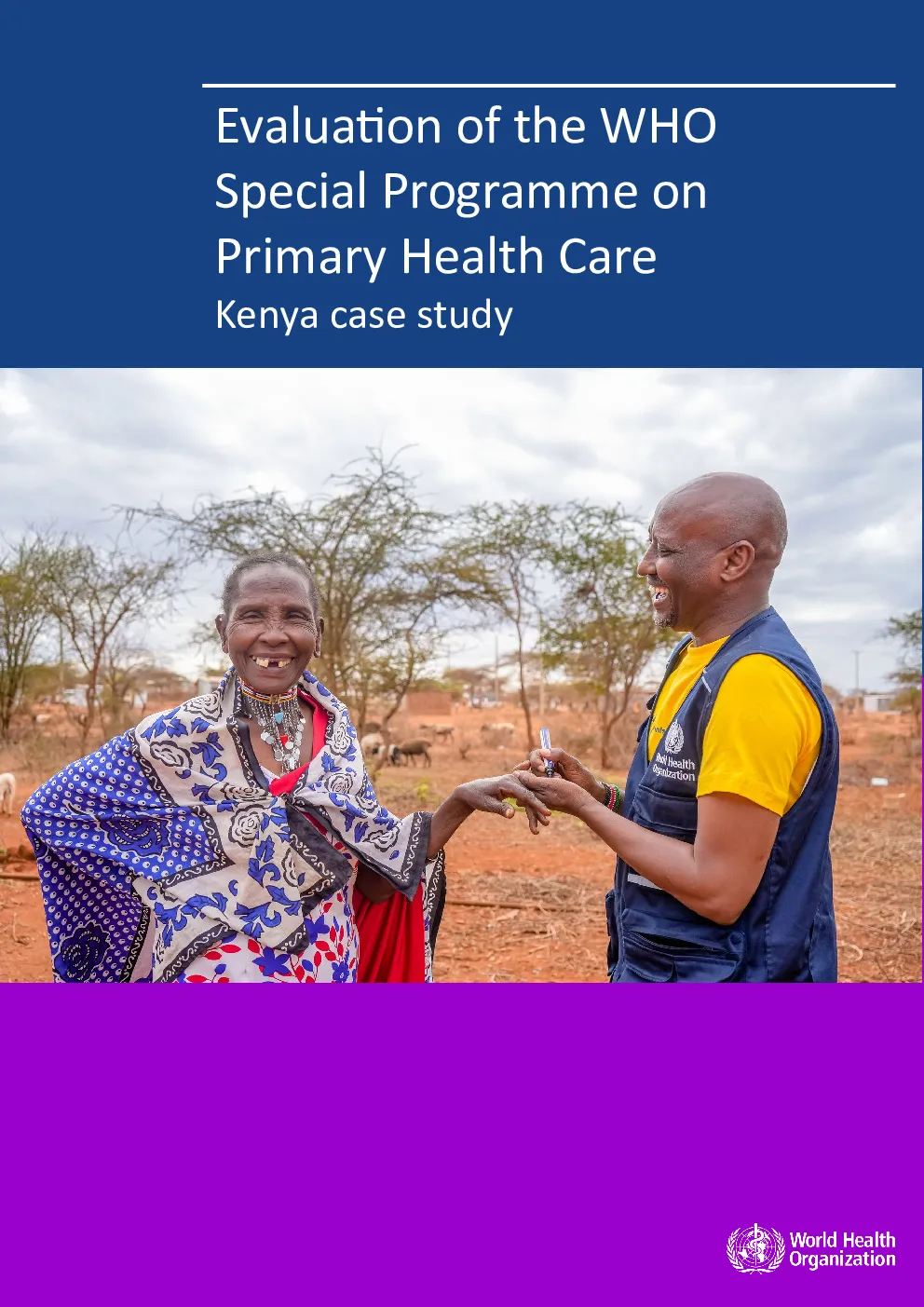
Evaluation of the WHO Special Programme on Primary Health Care: Kenya case study ISBN 978-92-4-010701-4 (electronic version)ISBN 978-92-4-010702-1 (print version) © World Health Organization 2025 Some rights reserved. This work is available under the Creative Commons Attribution-NonCommercial-ShareAlike 3.0 IGOlicence (CC BY-NC-SA 3.0 IGO;https://creativecommons.org/licenses/by-nc-sa/3.0/igo). Under the terms of this licence, you may copy, redistribute and adapt the work for non-commercial purposes, provided thework is appropriately cited, as indicated below. In any use of this work, there should be no suggestion that WHO endorsesany specific organization, products or services. The use of the WHO logo is not permitted. If you adapt the work, then youmust license your work under the same or equivalent Creative Commons licence. If you create a translation of this work, youshould add the following disclaimer along with the suggested citation:“This translation was not created by the World HealthOrganization (WHO). WHO is not responsible for the content or accuracy of this translation. The original English editionshall be the binding and authentic edition”. Any mediation relating to disputes arising under the licence shall be conducted in accordance with the mediation rules of theWorld Intellectual Property Organization (http://www.wipo.int/amc/en/mediation/rules/). Suggested citation. Evaluation of the WHO Special Programme on Primary Health Care: Kenya case study. Geneva: WorldHealth Organization; 2025. Licence:CC BY-NC-SA 3.0 IGO. Cataloguing-in-Publication (CIP) data.CIP data are available athttp://iris.who.int. Sales, rights and licensing.To purchase WHO publications, seehttps://www.who.int/publications/book-orders. To submitrequests for commercial use and queries on rights and licensing, seehttps://www.who.int/copyright. Third-party materials.If you wish to reuse material from this work that is attributed to a third party, such as tables, figuresor images, it is your responsibility to determine whether permission is needed for that reuse and to obtain permission from thecopyright holder. The risk of claims resulting from infringement of any third-party-owned component in the work rests solelywith the user. General disclaimers.The designations employed and the presentation of the material in this publication do not imply theexpression of any opinion whatsoever on the part of WHO concerning the legal status of any country, territory, city or area orof its authorities, or concerning the delimitation of its frontiers or boundaries. Dotted and dashed lines on maps representapproximate border lines for which there may not yet be full agreement. The mention of specific companies or of certain manufacturers’ products does not imply that they are endorsed orrecommended by WHO in preference to others of a similar nature that are not mentioned. Errors and omissions excepted, thenames of proprietary products are distinguished by initial capital letters. All reasonable precautions have been taken by WHO to verify the information contained in this publication. However, thepublished material is being distributed without warranty of any kind, either expressed or implied. The responsibility for theinterpretation and use of the material lies with the reader. In no event shall WHO be liable for damages arising from its use. In line with theWHO Evaluation Policy 2018(EB143(9)), this publication contains an independent evaluation report by theWHO Evaluation Office. It does not reflect the views or policies of WHO. WHO/DGO/EVL/2024.6 Cover page photo caption: A woman from the local Maasai community laughs when she gets a mark on herfinger to indicate that she's received the oral cholera vaccine (OCV) by the roadside in Ilkilunyeti, Kajiado, on 6August 2023.Credit: WHO/Billy Miaron Contents Abbrevia�ons and Acronyms iv1. Purpose of the case study12. Methods and approach13. Background24. Key findings105. Conclusions and opportuni�es for future SP-PHC support to Kenya246. References27Annex 1: Bibliography29Annex 2: Discussion guides for interviews and focus groups31 List of tablesTable 1: Performance impact indicators of Kenya’s health systemTable 2: Key health financing indicatorsTable 3Overview of SP-PHC support to Kenya from 2020-2023 359 List of figuresFigure 1: Timeline for development of key na�onal PHC policies and strategies3Figure 2: Primary care network model6Figure 3Structure of WHO Kenya8 Abbreviations and Acronyms CHUcommunity health unitCRVScivil registra�on and vital sta�s�csGAPGlobal Ac�on PlanGPWGeneral Programme of WorkHHhouseholdsHPAhealth policy advisorHRHhuman resources for healthKI(I)key informant (interview)PCNprimary health care networkPHCprimary health carePHCMFIPHC measurement framework and indicatorsSDGSustainable Development GoalSDG3 GAPGlobal Ac�on Plan for Healthy Lives and Well-beingSP-PHCSpecial Programme on Primary Health CareUHCuniversal health coverageUHC-CNUHC communicable