《通胀削减法案》:健康计划和D部分赞助商需要知道什么才能准备
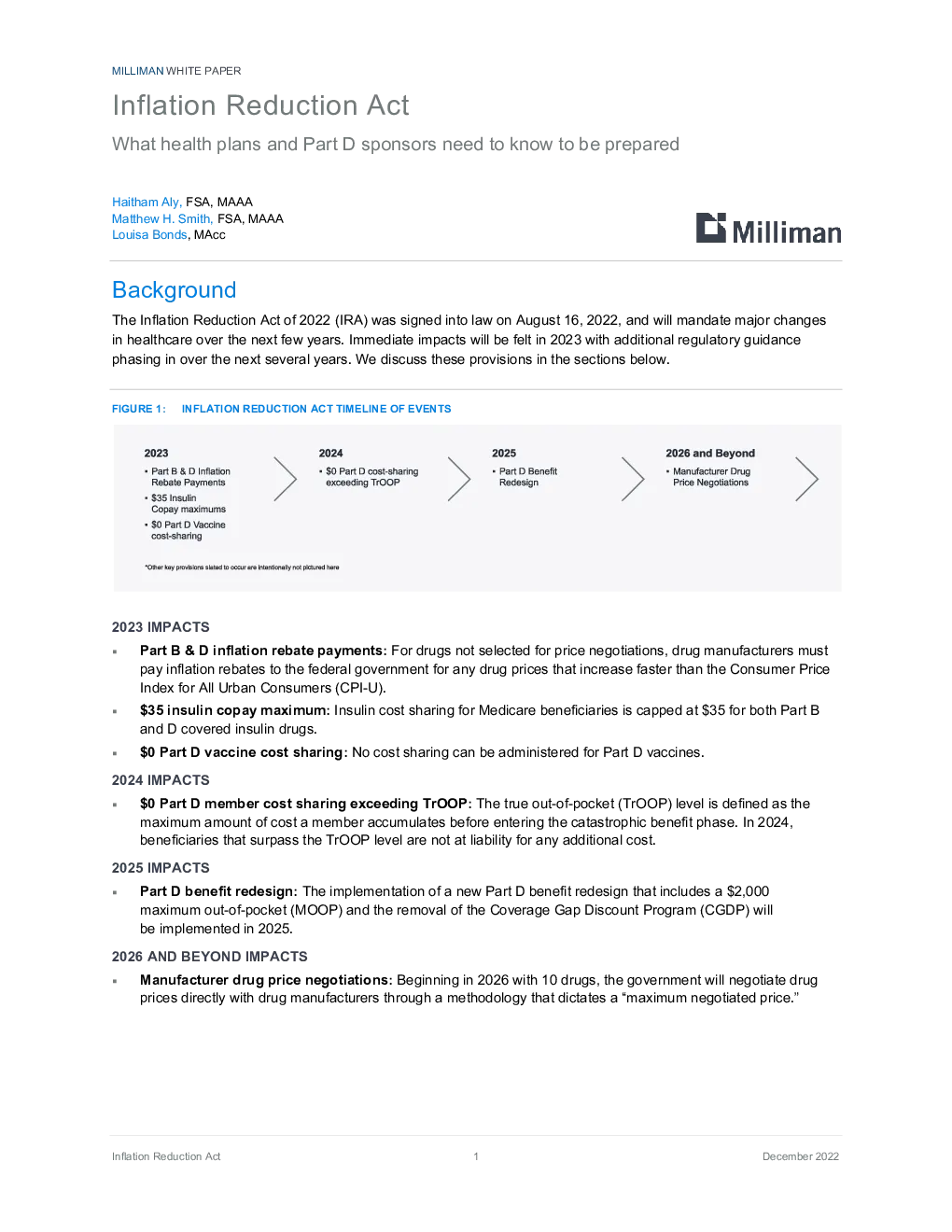
Inflation Reduction Act What health plans and Part D sponsors need to know to be prepared Haitham Aly, FSA, MAAAMatthew H. Smith, FSA, MAAALouisa Bonds, MAcc Background The Inflation Reduction Act of 2022 (IRA) was signed into law on August 16, 2022, and will mandate major changesin healthcare over the next few years. Immediate impacts will be felt in 2023 with additional regulatory guidancephasing in over the next several years. We discuss these provisions in the sections below. 2023 IMPACTS Part B & D inflation rebate payments:For drugs not selected for price negotiations, drug manufacturers mustpay inflation rebates to the federal government for any drug prices that increase faster than the Consumer PriceIndex for All Urban Consumers (CPI-U).$35 insulin copay maximum:Insulin cost sharing for Medicare beneficiaries is capped at $35 for both Part Band D covered insulin drugs.$0 Part D vaccine cost sharing:No cost sharing can be administered for Part D vaccines. 2024 IMPACTS $0 Part D member cost sharing exceeding TrOOP:The true out-of-pocket (TrOOP) level is defined as themaximum amount of cost a member accumulates before entering the catastrophic benefit phase. In 2024,beneficiaries that surpass the TrOOP level are not at liability for any additional cost. 2025 IMPACTS Part D benefit redesign:The implementation of a new Part D benefit redesign that includes a $2,000maximum out-of-pocket (MOOP) and the removal of the Coverage Gap Discount Program (CGDP) willbe implemented in 2025. 2026 AND BEYOND IMPACTS Manufacturer drug price negotiations:Beginning in 2026 with 10 drugs, the government will negotiate drugprices directly with drug manufacturers through a methodology that dictates a “maximum negotiated price.” While the bill is specifically focused on Medicare, there is potential for these changes to impact all types of healthcarecoverage, including the commercial health insurance market. This paper primarily focuses on considerations for health plans and their Medicare-eligible population, while alsohighlighting potential spillover into other sources of healthcare coverage. For additional detail, you can also refer tothe Milliman Brief “Weathering the Reform Storm.”1 Expected Medicare changes from the IRA 2023: INFLATION REBATES Beginning in 2023, the Centers for Medicare and Medicaid Services (CMS) will require drug manufacturers to pay aninflation rebate to the government if drug prices (measured by average manufacturer price, or AMP) increase fasterthan the CPI-U, compared to their 2021 costs. These inflation rebate payments would be made from manufacturers tothe federal government for all single-source and biologic drugs (starting in 2026, drugs selected for price negotiationwill be exempt from inflation rebates). Manufacturers affected by this provision could respond in a few different ways. Two potential responses include (1)directly reducing drug prices and/or AMP, or (2) paying the inflation rebate to the government. Figure 2 considersthree illustrative scenarios for a Part D drug that is applied to a non-low-income member currently positioned in theinitial coverage phase, where the member pays 25% and the plan pays 75%. Pre-IRA:In the first scenario, which is prior to the impact of the IRA, the drug costs $1,000.Rebate paid:In the second scenario, the manufacturer would pay a $200 rebate.AMP reduction:In the last scenario, the manufacturer reduces the drug price to $800. From a plan and member perspective, a direct reduction in cost occurs if the AMP is reduced compared to what themanufacturer would pay as a rebate to the government.2At the same time, there may be a deterioration of rebatecontracts relative to the pre-IRA scenario, as many rebate contracts currently have an inflation protection component,and manufacturers may be resistant to “double-pay” rebates to both the government and plans. The manufacturer perspective tells a different story. Focusing only on the Medicare market, the net cost impact isrelatively straightforward: in the above example, whether the manufacturer pays the rebate or reduces AMP, it wouldsee a $200 reduction in net revenue. Therefore, manufacturers have little or no direct incentive to prefer reducingtheir prices instead of paying the rebate in the Medicare market alone. However, a reduction in AMP would affect other lines of business, so a manufacturer that reduces its prices in theMedicare market to avoid paying inflation rebates could also see reductions in revenue in the commercial market.Additionally, the timing of cash flows further favors paying the rebate from the manufacturer perspective, as theyreceive payment in full first, and then pay the inflation rebate to the government later. And finally, if the CPI-U is unknown in advance, manufacturers may prefer to be more conservative in their pricing, asthere is no recovery mechanism should they set prices to match inflation and instead undershoot the CPI-U trend.This considera