AI智能总结
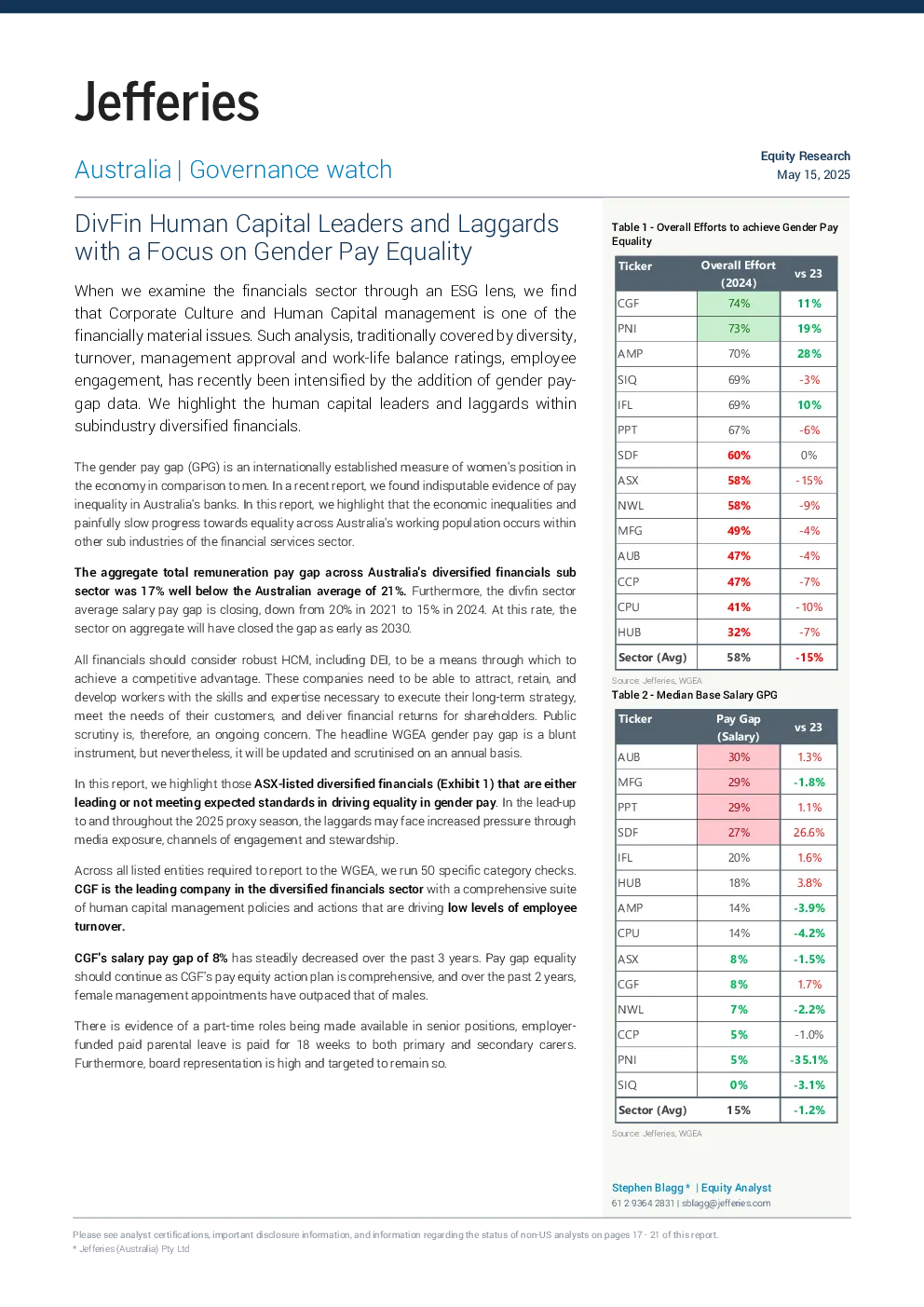
Australia | Governance watch DivFin Human Capital Leaders and Laggardswith a Focus on Gender Pay Equality When we examine the financials sector through an ESG lens, we findthat Corporate Culture and Human Capital management is one of thefinancially material issues. Such analysis, traditionally covered by diversity,turnover, management approval and work-life balance ratings, employeeengagement, has recently been intensified by the addition of gender pay-gap data. We highlight the human capital leaders and laggards withinsubindustry diversified financials. The gender pay gap (GPG) is an internationally established measure of women's position inthe economy in comparison to men. In a recent report, we found indisputable evidence of payinequality in Australia's banks. In this report, we highlight that the economic inequalities andpainfully slow progress towards equality across Australia's working population occurs withinother sub industries of the financial services sector. The aggregate total remuneration pay gap across Australia's diversified financials subsector was 17% well below the Australian average of 21%.Furthermore, the divfin sectoraverage salary pay gap is closing, down from 20% in 2021 to 15% in 2024. At this rate, thesector on aggregate will have closed the gap as early as 2030. All financials should consider robust HCM, including DEI, to be a means through which toachieve a competitive advantage. These companies need to be able to attract, retain, anddevelop workers with the skills and expertise necessary to execute their long-term strategy,meet the needs of their customers, and deliver financial returns for shareholders. Publicscrutiny is, therefore, an ongoing concern. The headline WGEA gender pay gap is a bluntinstrument, but nevertheless, it will be updated and scrutinised on an annual basis. In this report, we highlight thoseASX-listed diversified financials (Exhibit 1) that are eitherleading or not meeting expected standards in driving equality in gender pay. In the lead-upto and throughout the 2025 proxy season, the laggards may face increased pressure throughmedia exposure, channels of engagement and stewardship. Across all listed entities required to report to the WGEA, we run 50 specific category checks.CGF is the leading company in the diversified financials sectorwith a comprehensive suiteof human capital management policies and actions that are drivinglow levels of employeeturnover. CGF's salary pay gap of 8%has steadily decreased over the past 3 years. Pay gap equalityshould continue as CGF's pay equity action plan is comprehensive, and over the past 2 years,female management appointments have outpaced that of males. There is evidence of a part-time roles being made available in senior positions, employer-funded paid parental leave is paid for 18 weeks to both primary and secondary carers.Furthermore, board representation is high and targeted to remain so. Stephen Blagg * | Equity Analyst61 2 9364 2831 | sblagg@jefferies.com Gender Pay Gap Leaders andLaggards How Big is the Gender Pay Gap for Australian DiversifiedFinancials? Thetablesacrossthepagehighlightthecompanies that have made the greatest effortstoimprovegenderpayequality,acrossasignificant % of category checks. The average total remuneration gap for companies covered in this report has consistentlyreduced over the past 4 years, and is now well below the national average. Long overdue, considering companies have been collecting and reporting this data for some timenow, the WGEA has published base salary and total remuneration median gender pay gaps forprivate sector employers in Australia with 100 or more employees. Overall,theFinancialServicesSectorhasreceived a significant proportion of criticismwith sector high gender pay gaps. However, wenote that relative to peersCGF has developedthe most comprehensive suite of policies andcorporate actions to address the pay gaps. The 2024 results showed that: • 50% have a total remuneration average gender pay gap larger than 12.1%. For median totalremuneration, the employer gender pay gap mid-point is 8.9%. • There was a noticeable spike in the number of employers who undertook a gender pay gapanalysis, 68%, up from 55% in the PCP. • Of the employers that did an analysis, 75 per cent took action on the results. • The publication of employer gender pay gaps made employers more likely to review theirpolicies about caring responsibilities to ensure men had equal access We recently deconstructed the current suite of WGEA data to find potential reasons for excessivegender pay gaps. The tables on the next few pages highlight outcomes for those listed diversifiedfinancials that are required to report to the WGEA. Particular attention is drawn to those thatreport gender pay gaps and either do not have sufficient policies or committed actions to balancethese inequalities or whose suite of policies is proving insufficient. ASX Gender Pay Gap (GPG) Screen This screening of