您的浏览器禁用了JavaScript(一种计算机语言,用以实现您与网页的交互),请解除该禁用,或者联系我们。[FAO]:2024综合消防管理自愿指南报告 - 发现报告

2024综合消防管理自愿指南报告

公用事业2024-07-06-FAO张***
AI智能总结
查看更多
2024综合消防管理自愿指南报告

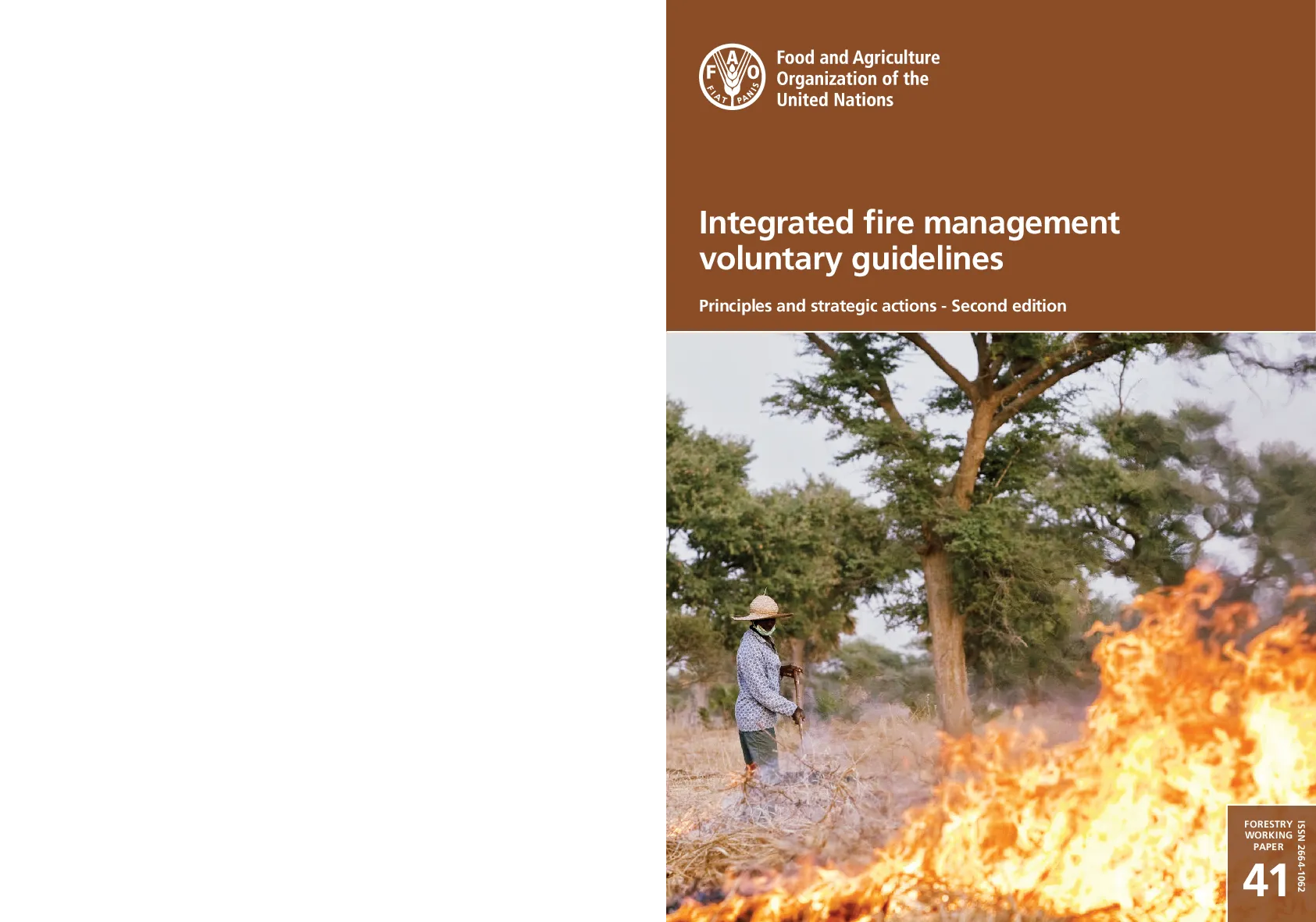
Principles and strategic actions - Second edition Integrated fire managementvoluntary guidelines Principles and strategic actions Second edition Required citation:FAO. 2024.Integrated fire management voluntary guidelines – Principles and strategic actions.Second edition. Forestry Working Paper, No. 41. Rome. https://doi.org/10.4060/cd1090en The designations employed and the presentation of material in this information product do not imply theexpression of any opinion whatsoever on the part of the Food and Agriculture Organization of the UnitedNations (FAO) concerning the legal or development status of any country, territory, city or area or of itsauthorities, or concerning the delimitation of its frontiers or boundaries. The mention of specific companiesor products of manufacturers, whether or not these have been patented, does not imply that these have beenendorsed or recommended by FAO in preference to others of a similar nature that are not mentioned. ISSN 2664-1062 [print]ISSN 2664-1070 [online] ISBN 978-92-5-138916-4© FAO, 2024First edition 2006 Some rights reserved. This work is made available under the Creative Commons Attribution-NonCommercial-ShareAlike 3.0 IGO licence (CC BY-NC-SA 3.0 IGO; https://creativecommons.org/licenses/by-nc-sa/3.0/igo/legalcode). Under the terms of this licence, this work may be copied, redistributed and adapted for non-commercialpurposes, provided that the work is appropriately cited. In any use of this work, there should be no suggestionthat FAO endorses any specific organization, products or services. The use of the FAO logo is not permitted.If the work is adapted, then it must be licensed under the same or equivalent Creative Commons licence. If atranslation of this work is created, it must include the following disclaimer along with the required citation:“This translation was not created by the Food and Agriculture Organization of the United Nations (FAO).FAO is not responsible for the content or accuracy of this translation. The original [Language] edition shallbe the authoritative edition.” Disputes arising under the licence that cannot be settled amicably will be resolved by mediation and arbitrationas described in Article 8 of the licence except as otherwise provided herein. The applicable mediation ruleswill be the mediation rules of the World Intellectual Property Organization http://www.wipo.int/amc/en/mediation/rules and any arbitration will be conducted in accordance with the Arbitration Rules of the UnitedNations Commission on International Trade Law (UNCITRAL). Third-party materials. Users wishing to reuse material from this work that is attributed to a third party, suchas tables, figures or images, are responsible for determining whether permission is needed for that reuse andfor obtaining permission from the copyright holder. The risk of claims resulting from infringement of anythird-party-owned component in the work rests solely with the user. Sales, rights and licensing. FAO information products are available on the FAO website (www.fao.org/publications) and can be purchased through publications-sales@fao.org. Requests for commercial use shouldbe submitted via: www.fao.org/contact-us/licence-request. Queries regarding rights and licensing should besubmitted to: copyright@fao.org. Contents ForewordvAcknowledgementsviAbbreviationsviii 1.Introduction 1.1.Background11.2.Rationale21.3.Objectives41.4.Relationship to other international instruments41.5.Implementation of the principles and strategic actions51.6.Diversity of contexts and special requirements5 2.Cross-sectoral issues 7 2.1.Livelihoods and poverty72.2.Sustainable ecosystems and environmental impacts72.3.Impacts on human health and safety92.4.Fire as a tool in sustainable land use andresource management102.5.Safety considerations for firefighters and civilians102.6.Legal, policy, institutional and financial frameworks112.7.Science and technology122.8.Knowledge management132.9.Education, training and public awareness142.10.Cooperation and partnerships14 3.Principles 17 3.1.Economic173.2.Environmental193.3.Institutional203.4.Social and cultural233.5.Enhanced fire management capacity25 4.Strategic actions 27 4.1.Integrated fire management in natural and protectedareas and reserves274.2.Fire awareness and education294.3.Wildfire prevention294.4.Fire danger rating and early-warning systems30 4.5.Fire preparedness, including technical training314.6.Other preparatory activities324.7.Fire detection, communications, and dispatch334.8.Initialattack344.9.Large-wildfire suppression and management354.10.Managing multiple incidents364.11.Fuel management374.12.Planned fire/prescribed burning384.13.Burned area repair, rehabilitation and restoration394.14.Resource management and integrated fire planning414.15.Working with Indigenous Peoples and other localknowledge-holders424.16.Equity in integrated fire management434.17.Monitoring and assessment44 Conclusion47 Bibliography 49 Annex 1