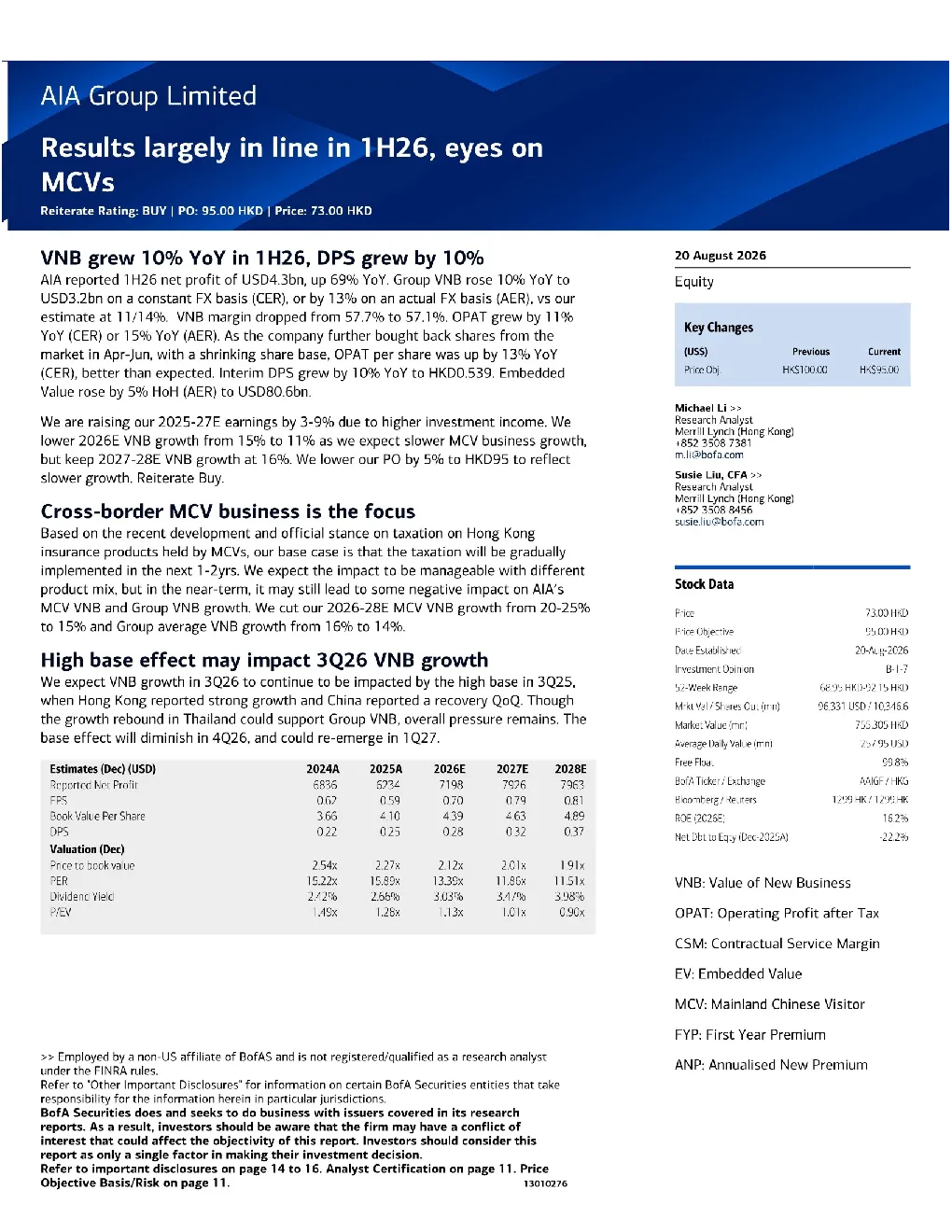
MCVsReiterateRating:BUYIPO:95.00HKDIPrice:73.00HKD VNBgrew10%YoYin1H26,DPSgrewby10% USD3.2bn on a constant FX basis (CER), or by 13% on an actual FX basis (AER), vs ourestimate at 11/14%. VNB margin dropped from 57.7% to 57.1%.OPAT grew by 11% YoY (CER) or 15% YoY (AER). As the company further bought back shares from themarket in Apr-Jun, with a shrinking share base, OPAT per share was up by 13% YoY(CER), better than expected. Interim DPS grew by 10% YoY to HKD0.539. EmbeddedValue rose by 5% HoH (AER) to USD80.6bn.Weare raising our 2025-27E earnings by 3-9% due to higher investment income.Welower2026EVNBgrowthfrom15%to11%asweexpectslowerMCVbusinessgrowth, Key Changes +852 3508 7381m.li@bofa.comSusie Liu, CFA >>Research AnalystMerill Lynch (Hong Kong) but keep2027-28EVNBgrowthat16%.WelowerourPOby5%toHKD95to reflectslower growth.Reiterate BuyCross-borderMCvbusinessisthefocus +852 3508 8456susie.liu@bofa.com Based on the recent development and official stance on taxation on Hong Konginsuranceproducts held by MCVs, our base case is that the taxation will be gradually implemented in the next 1-2yrs.We expect the impact to be manageable with differentproduct mix, but in the near-term, it may still lead to some negative impact on AlA'sMCV VNB and Group VNB growth.Wecut our2026-28EMCVVNB growth from20-25%to 15%and Group average VNBgrowth from16% to14%.Highbaseeffect mayimpact3Q26VNBgrowth We expect VNBgrowthin3Q26to continue tobe impactedbythe highbase in3Q25,when Hong Kong reported strong growth and China reported a recovery QoQ.Though the growth rebound in Thailand could support Group VNB, overall pressure remains. Thebase effect will diminish in 4Q26, and could re-emerge in 1Q27.Estimates (Dec) (USD)2024A2025A2026E2027E2028E OPAT:Operating Profit after TaxCSM:Contractual ServiceMarginEV:Embedded ValueMCV:Mainland Chinese VisitorFYP: First Year PremiumANP:AnnualisedNewPremium >> Employed by a non-US affiliate of BofAS and is not registered/qualified as a research analystunder the FINRA rules.Refer to Other Important Disclosures'for information on certain BofA Securities entities that takeresponsibility for the information herein in particular jurisdictions.BofA Securities does and seeks to do business with issuers covered in its researchreports. As a result, investors should be aware that the firm may have a conflict ofinterest that could affect the objectivity of this report. Investors should consider thisreport as onlyasinglefactor inmaking their investment decisionRefer to important disclosures on page 14 to 16. Analyst Certification on page 11.PriceObjectiveBasis/Risk onpage11.13010276 Insurance -Life AIA is a leading insurer in Asia-Pacific and has had a presence in the region for more than 90 years. Thecompany is the largest insurer in its key operating marketssuch as Hong Kong, Singapore and Thailand. AIA is one ofthe few insurers that has the potential to offer solid ROEand growth prospects. We rate AIA Buy as its keeps steady business growth in AsiaPac. We expect expansion in China will accelerate afterit converts its branch to subsidiary and acquire morelicenses in new markets. The return of Mainland Visitors toHong Kong will be a key driver in the mid-term and ASEANmarkets are expected to further grow with increasingdemand. AIA's strength in agency and bancassurancechannels and its prudent management of products andrisks make it the leading insurer in AsiaPac, in our view Stock Data Current P/BV2.12 Our key focusesChina's tightening measures on cross-border financial activities from May to Aug. including the penalty on online brokers, tax charge on offshore trust and reported tax oncross-border insurance policyholders,made MCV business, which contributes ~2o% ofAIA Group VNB, the key focus in 1H26 results. Our base case is that tightening is thenew normal and tax on insurance is not far away. Insurers may need to be prepared forthe impact on sales growth from future regulation changes as well as product strategychanges to meet new client demands in the new environment. There are always concerns...Ever since the start of the MCV business in early 2010s, there have been concerns on potential regulatory risks from China as FX fund outflow from the country is undercontrol. After 3Oyrs strong economy growth, high net worth individuals and middle-classpeople, with their accumulated wealth, started to look for overseas wealth allocationopportunities to diversify their investment portfolio and to increase USD exposure.Large regional insurers, including AIA and Pru, provided them with USD-denominatedinsurance policies in Hong Kong which met their demands for investment and protection. the social unrest in Hong Kong in 2H19, the full year MCV VNB of AIA could have hadreached USD8oOmn or more. The rapid growth resulted in the first batch of tightening.In 2016, China FX regulators banned domestic residents using UnionPay credit cards topublic to remind potential insurance clients of offsho