您的浏览器禁用了JavaScript(一种计算机语言,用以实现您与网页的交互),请解除该禁用,或者联系我们。 [国际货币基金组织]:毛里求斯货币政策的现代化:毛里求斯银行的实施、分析与沟通 - 发现报告

毛里求斯货币政策的现代化:毛里求斯银行的实施、分析与沟通

2026-08-18 国际货币基金组织 木子学长v3.5
报告封面

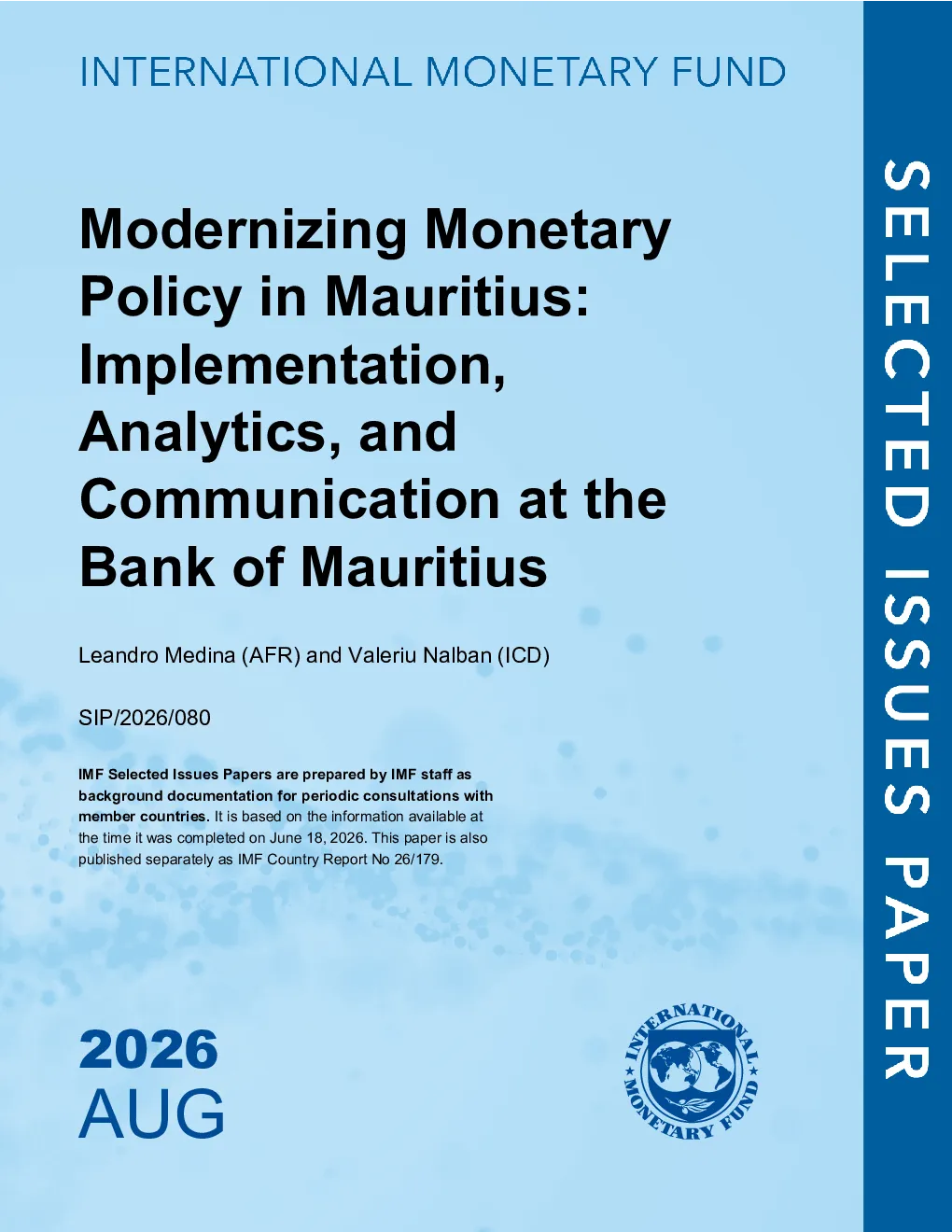
Modernizing MonetaryPolicy in Mauritius:Implementation,Analytics, andCommunication at theBank of Mauritius Leandro Medina (AFR)andValeriu Nalban (ICD) SIP/2026/080 IMF Selected Issues Papers are prepared by IMF staff asbackground documentation for periodic consultations withmember countries.It is based on the information available atthe time it was completed on June 18, 2026. This paper is alsopublished separately as IMF Country Report No26/179. 2026AUG IMF Selected Issues PaperAfrican Department Modernizing Monetary Policy in Mauritius: Implementation, Analytics, and Communication at the Bankof MauritiusPrepared by Leandro Medina and Valeriu Nalban Authorized for distribution by Mariana ColacelliAugust2026 IMF Selected Issues Papersare prepared by IMF staff as background documentation for periodicconsultations with member countries.It is based on the information available at the time it wascompleted on June 18, 2026.This paper is also published separately as IMF Country Report No26/179. ABSTRACT:Since the adoption of an explicit inflation-targeting regime in 2023, Mauritius has made notableprogress in modernizing its monetary policy framework. Reforms have strengthened the design of monetarypolicy implementation, enhanced analytical capacity through a modern Forecasting and Policy AnalysisSystem (FPAS), and improved central bank communication. At the same time, incomplete implementation ofthe operational framework—particularly persistent excess liquidity that generates deviations between theannounced policy rate and the effective stance—has constrained monetary transmission, while forward-lookinganalytical insights need to be enhanced in external communication. This Selected Issues Paper reviews recentachievements and highlights that stronger alignment between implementation, analytics, and communicationwould enhance policy effectiveness, further anchor inflation expectations, and reinforce the credibility ofmonetary policy in Mauritius. RECOMMENDED CITATION:Leandro Medina. 2026. “Modernizing Monetary Policy in Mauritius.” IMFSelected Issues Paper(SIP/26/080). SELECTED ISSUES PAPERS Modernizing Monetary Policy inMauritius: Implementation,Analytics, and Communicationat the Bank of Mauritius Mauritius Prepared by Leandro Medina, and Valeriu Nalban1 Abstract Since the adoption of an explicit inflation-targeting regime in 2023, Mauritius has made notable progress inmodernizing its monetary policy framework. Reforms have strengthened the design of monetary policyimplementation, enhanced analytical capacity through a modern Forecasting and Policy Analysis System(FPAS), and improved central bank communication. At the same time, incomplete implementation of theoperational framework—particularly persistent excess liquidity that generates deviations between theannounced policy rate and the effective stance—has constrained monetary transmission, while forward-lookinganalytical insights need to be enhanced in external communication. This Selected Issues Paper reviews recentachievements and highlights that stronger alignment between implementation, analytics, and communicationwould enhance policy effectiveness, further anchor inflation expectations, and reinforce the credibility ofmonetary policy in Mauritius. A.Introduction and Motivation 1.Mauritius has undertaken a significant modernization of its monetary policy framework overrecent years, culminating in the adoption of an explicit inflation-targeting (IT) regime in January 2023.This transition marked a structural shift away from a framework characterized by multiple objectives and lessclearly defined operational targets toward a forward-looking, interest-rate-based regime aligned withinternational good practice. 2.In parallel, the Bank of Mauritius (BOM) has invested in strengthening its analytical capacityand institutional processes, notably through the development, with technical assistance support fromthe IMF, of a Forecasting and Policy Analysis System (FPAS), and has expanded and professionalizedits communication with financial markets and the public. Together, these reforms have laid the foundationsfor a more consistent and transparent monetary policy framework. 3.At the same time, the effectiveness of the overall framework depends critically on the degree ofconsistency and alignment across its core components. Monetary policy implementation, analyticalcapacity, and communication are mutually reinforcing pillars: weaknesses or misalignments in any one of themcan undermine policy transmission, weaken expectations formation, and erode credibility. This paper reviewsrecent developments across these three dimensions and discusses priorities to consolidate Mauritius’sinflation-targeting framework. B.Monetary Policy Implementation: Achievements and Next Steps The 2023 Operational Framework 4.The 2023 reform of the monetary policy framework introduced a clear hierarchy between the ultimateobjective of price stability, the intermediate target