适应性是新的工作保障:人工智能和工作的未来
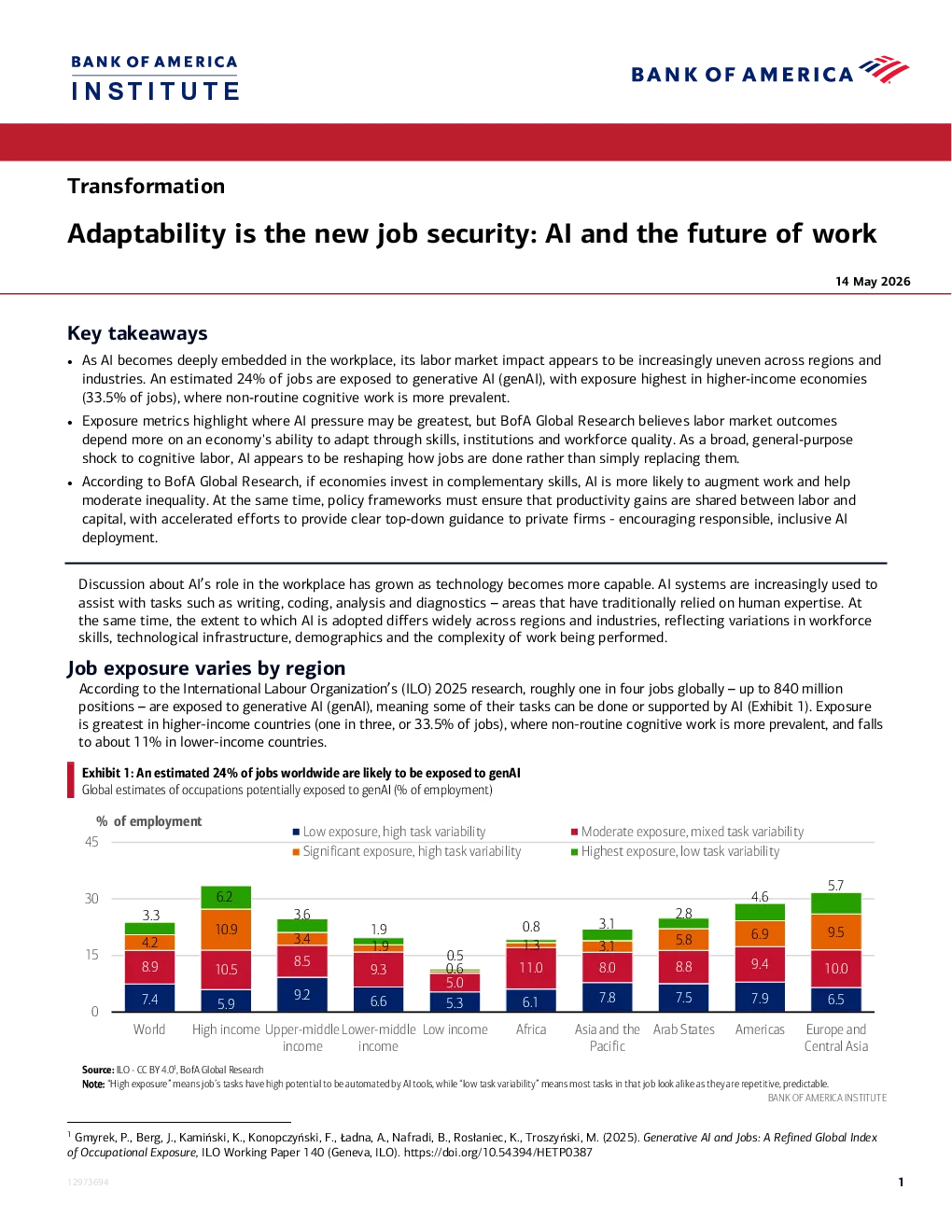
Adaptability is the new job security: AI and the future of work 14 May 2026 Key takeaways •As AI becomes deeply embedded in the workplace, its labor market impact appears to be increasingly uneven across regions andindustries. An estimated 24% of jobs are exposed to generative AI (genAI), with exposure highest in higher‑income economies(33.5% of jobs), where non‑routine cognitive work is more prevalent. •Exposure metrics highlight where AI pressure may be greatest, but BofA Global Research believes labor market outcomesdepend more on an economy's ability to adapt through skills, institutions and workforce quality. As a broad, general‑purposeshock to cognitive labor, AI appears to be reshaping how jobs are done rather than simply replacing them. •According to BofA Global Research, if economies invest in complementary skills, AI is more likely to augment work and helpmoderate inequality. At the same time, policy frameworks must ensure that productivity gains are shared between labor andcapital, with accelerated efforts to provide clear top‑down guidance to private firms - encouraging responsible, inclusive AIdeployment. Discussion about AI’s role in the workplace has grown as technology becomes more capable. AI systems are increasingly used toassist with tasks such as writing, coding, analysis and diagnostics–areas that have traditionally relied on human expertise. Atthe same time, the extent to which AI is adopted differs widely across regions and industries, reflecting variations in workforceskills, technological infrastructure, demographics and the complexity of work being performed. Job exposure varies by regionAccording to the International Labour Organization’s (ILO) 2025 research, roughly one in four jobs globally–up to 840 million positions–are exposed to generative AI (genAI), meaning some of their tasks can be done or supported by AI (Exhibit 1). Exposureis greatest in higher-income countries (one in three, or 33.5% of jobs), where non-routine cognitive work is more prevalent, and fallsto about 11% in lower-income countries. Exhibit1:An estimated24% of jobs worldwide are likely to be exposed togenAIGlobal estimates of occupations potentially exposed togenAI (% of employment) In higher-income economies, genAI-exposed jobs also tend to have higher exposure intensity (a larger share of roles with highexposure scores). These countries may be better positioned to capture productivity gains, but the inequality risk could besignificant: firms that lead the AI evolution may capture a disproportionate share of gains unless access to AI tools broadens,according to BofA Global Research. Regionally, AI exposure is highest in Europe and Central Asia (31.7% of jobs), followed by the Americas (28.8%), Arab States(24.9%) and Asia-Pacific (APAC) (22%), according to the ILO’s research. However, BofA Global Research notes that relativeshares alone understate the global impact: because a disproportionate amount of global employment is concentrated in APAC,about 442 million jobs there could face some level of exposure–roughly equal to all other regions combined. This highlights thatthe scale of disruption depends on both exposure rates and the size of the workforce at risk. Labor and resource reallocation are keyExposure metrics show where AI pressure may be highest, but BofA Global Research notes that outcomes depend more on how well economies adapt through skills, institutions and workforce quality. According to International Monetary Fund (IMF), jobqualifications are evolving.“New skills”–especially in AI and information technology (IT)–are now required in roughly one in 10 jobpostings in advanced economies and one in 20 in emerging markets.2 Many roles are therefore more likely to be redesigned than eliminated–for example, marketing specialists may spend more timeon strategy and message refinement while AI drafts content and analyzes data.Whether workers adjust depends on transferableskills and access to retraining. As a result, countries with stronger human-capital systems may face less disruption even atsimilar levels of AI exposure. Recent research from the Yale Budget Lab similarly highlights that the trajectory of AI’s economic impact may hinge on thebalance between productivity gains and labor supply effects. While stronger productivity growth could materially improve long-term economic and fiscal outcomes, declines in labor force participation could partially offset these gains–underscoring theimportance of how economies adapt to technological change.3 AI impacts: Job redesign, not replacementAI is increasingly viewed as a broad, general-purpose shock to cognitive labor–not a narrow, sector-specific automation wave– according to BofA Global Research. The key question is therefore not whether AI affects jobs, but how it reshapes work. Analystspoint to three questions that frame the long-term labor market impact: 1.In AI‑exposed occupations, does AI primarily function as an augmenting tool or