评估AI投资对冰岛克朗的影响
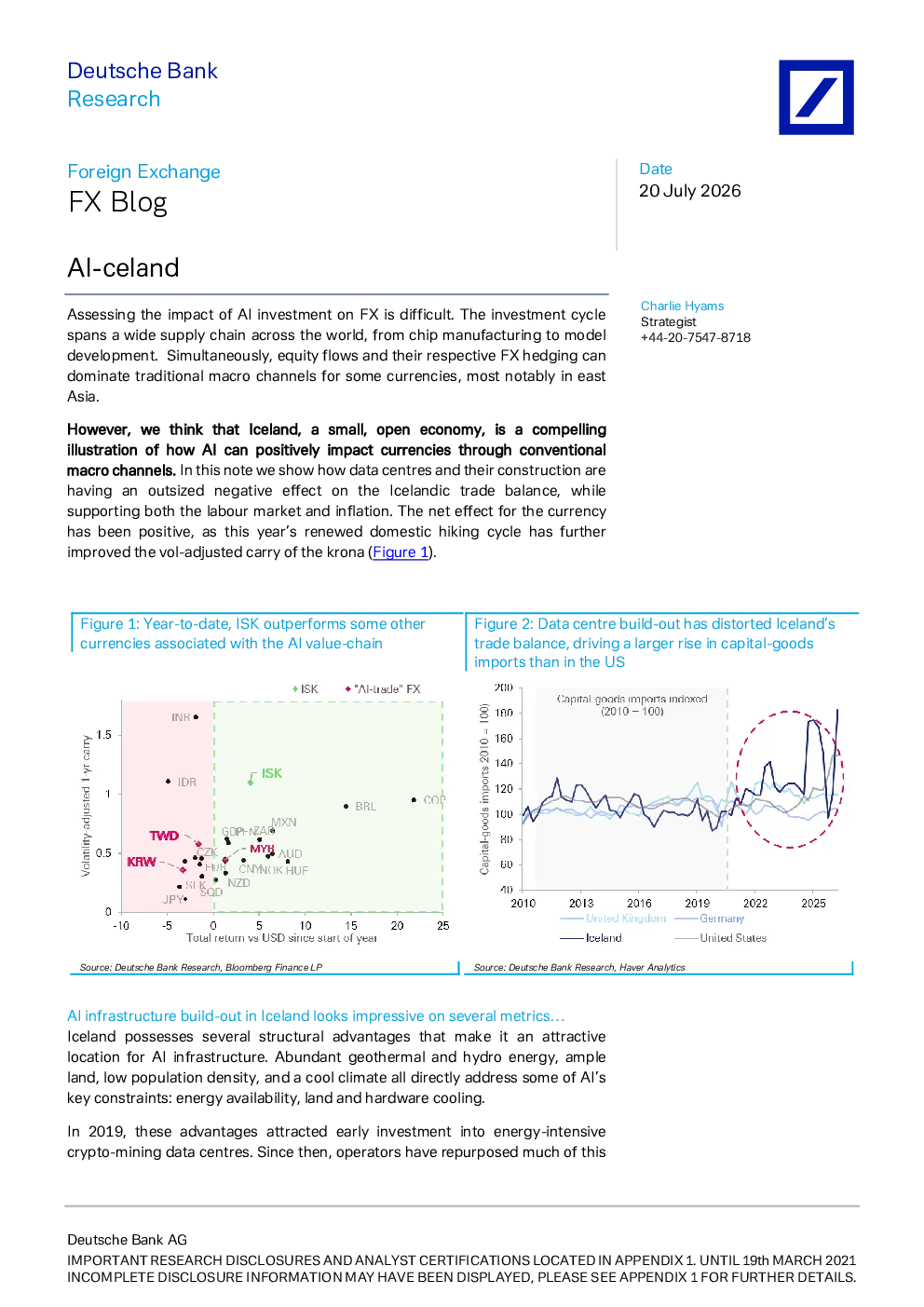
Date20 July 2026 AI-celand Charlie HyamsStrategist+44-20-7547-8718 Assessing the impact of AI investment on FX is difficult. The investment cyclespansa widesupply chainacross the world, from chip manufacturing to modeldevelopment.Simultaneously, equity flowsand their respectiveFX hedging candominate traditional macro channels for some currencies, most notably in eastAsia. However,we think that Iceland,a small,open economy,is a compellingillustration of how AI can positively impact currencies through conventionalmacro channels.Inthis note we show howdata centres and their construction arehavingan outsized negative effect on the Icelandic trade balance,whilesupporting both thelabour market and inflation.Thenet effect for the currencyhas been positive, as this year’s reneweddomestic hiking cyclehas furtherimproved the vol-adjusted carry of the krona(Figure 1). AI infrastructure build-out inIcelandlooks impressive on several metrics… Icelandpossesses several structural advantages that make it an attractivelocation for AI infrastructure.Abundant geothermal andhydroenergy, ampleland, low population density,and a cool climateall directly address some of AI’skey constraints: energy availability, land and hardware cooling. In 2019, these advantages attracted early investment into energy-intensivecrypto-mining data centres. Since then, operators have repurposed much of this 20 July 2026FX Blog infrastructure to host AI-compute.Iceland’scapital-goods importsrequiredfordata centreconstructionhave climbed sharply since 2021 (Figure 2). Thebuild-outis nowbeing monetised and is increasingITexports, withAI-compute exportsrisingover60% YoY (Figure 3) as the first phase ofIceland'slargest AI-focuseddata centreprojectentered operationin late 2025/early 2026. ISK has remained remarkably resilient despite a worsening current account… Beforethe start of the data centre build-out,ISK had a broadly positiverelationship with the current account (Figure 4). By that logic, one wouldhaveexpectedthe currency to weaken in recent years as the external balancedeteriorates. Yet,despite a historically large goods-trade deficit–which there’sreason to believe will persist given plannedinvestment and a high capital-replacement rate-the krona has remained remarkably stable against its tradingpartners. This is because these investments have been primarily financed through FDI(Figure 5), meaning thatdata centreoperators fund hardware imports withoutselling ISK, thereby producing no net negative effect on the currency.To be sure,a similar dynamicmaynowalsobetaking placeon the export sidetoo, withrevenues fromforeign-owned data centreexports likely to accrue in foreigncurrency rather than being immediately converted into ISK. Figure4:From 2021–2026 ISK strengthened as thecurrent account worsened… Data centre construction has played a part in the recent hiking cycle through thelabour market… While FX hasn’t beendirectly impacted by these trade-balance swings, theindirecteffects of the AIbuild-outhave been positive.Indeed, the FDI highlightedabove hasmore than coveredthe current account deficit, with someof theinvestment passingthrough into the domestic economy via the constructionsector (Figures 6 and 7). Indeed, while data centres are capital-intensive to operate, they are labour-intensive to build and suitable workers are inshort supply.Iceland's workforce issmall (250k), unemployment is low and the country's geographic isolation limitsthefreemovement of labour. As a result, construction wages have grown fasterthan the economy-wide average for the first sustained period since 2015, whilethe sector’s share of the labour force has increased (Figures 6 and 7). More broadly, after cutting rates once in 2025, the central bank resumedtightening this year, citingprivate sectorpay growth and persistent inflationpressures (Figures 8 and 9). While policymakers describe the labour market as“cooling”, wage growth remains well above the3.7%y/y growth rate associatedwith its 2.5% inflationtarget. What does this all mean for the currency? The risks to ISK may be skewed to the upside if investment continues.If it does,a high capital-replacement rate and labour demand for construction may continuetoput upward pressure on wages,thereby providing a positive domesticbackdrop for the currencyif policy rates remain high. More broadly, we’ve recentlyarguedthat vol-adjusted carry is likely to remain thedriver of FX in the near term,andso ISKlookswell placed to benefit fromthis,inpart thanks to AI investment(Figure 1).The main risk we see for ISK isovervaluation.Indeed,on a basic relative PPP model,ISK screens~9.0%overvalued (Figure 10), consistent with thecentral bank’s assessment thattheexchange rateis“above equilibrium”. 20 July 2026FX Blog Appendix 1 Analyst Certification The views expressed in this report accurately reflect the personal views of the undersigned leadanalyst(s). Inaddition, the undersigned lead analyst(s) has not and will not r