可持续投资:化肥与天气风险的关联——化肥供应中断与潜在超级厄尔尼诺的担忧
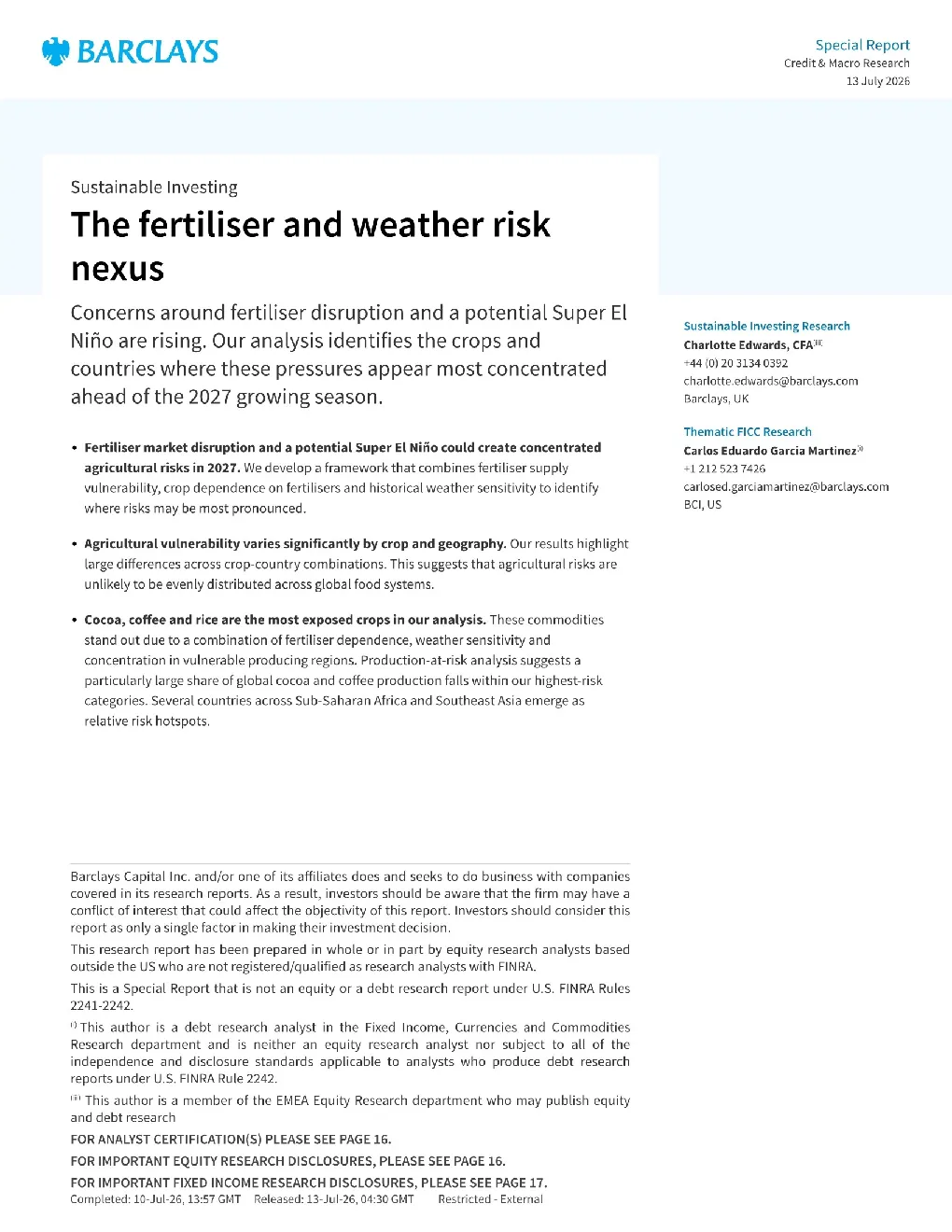
The fertiliser and weather risknexus Concerns around fertiliser disruption and a potential Super ElNino are rising. Our analysis identifies the crops andcountries where these pressures appear most concentratedahead of the 2027 growing season. Charlotte Edwards, CFAli)+44 (0) 20 3134 0392charlotte.edwards@barclays.comBarclays, UK Carlos Eduardo Garcia Martinez(0)+12125237426carlosed.garciamartinez@barclays.comBCI, US .Fertiliser market disruption and a potential Super El Nino could create concentratedagricultural risks in 2027.We develop a framework that combines fertiliser supplyvulnerability, crop dependence onfertilisers and historical weather sensitivity to identifywhere risks maybemostpronounced. ·Agricultural vulnerability varies significantly by crop and geography.Our results highlightlarge differences across crop-country combinations. This suggests that agricultural risks areunlikelyto be evenly distributed across global food systems. .Cocoa,coffee andrice arethe most exposed crops in ouranalysis.These commoditiesstand out due to a combination of fertiliser dependence, weather sensitivity andconcentration in vulnerable producing regions. Production-at-risk analysis suggests aparticularly large share of global cocoa and coffee production falls within our highest-riskcategories.Several countries across Sub-Saharan Africa and Southeast Asia emergeasrelative risk hotspots. categories ofthesurvey.Thankyou in advanceforyoursupport. A perfect storm: two key global agricultural risks areconvergingAgricultural disruptions affect more than justfood production. They can influence food prices, inflation,tradebalances, sovereignfinances, supply chains and corporate earnings. Ouranalysis suggests that vulnerabilityto a combination offertiliser disruption and El Nino-relatedweather stress is highly concentrated ratherthan evenly distributed across global agriculture,with cocoa, coffee and rice emerging among the most exposed crops.At the country level, wefind severalcountries in Sub-Saharan Africa ranking amongthemost vulnerable,alongside asmallernumberofcountries in SoutheastAsia and LatinAmerica. Global food systems are facing two simultaneous risks.The first is disruption to fertilisermarkets following tensions in the Middle East. The second is the growing possibility of a strongEl Nino event,with someforecastspointingto conditions comparableto the 2015/16SuperElNino.While eitherfactor could affect agricultural production independently,their coincidenceincreases the risk of meaningful disruptions to crop yields and production in 2027. The fertiliserbackdrop is particularly important.The Middle East accounts for approximately14% of global fertiliser exports and is a key supplier of natural gas, ammonia, sulphur andphosphate products used throughout the agricultural sector (Strategic autonomy:food securityinfocus).Fertilisers remain amongthemost importantinputs in modern farming,with researchsuggesting they contribute roughly 40-60% of crop yields in modern agricultural systems',withcrops such as maize,rice and wheat particularly dependent on nutrient applications to achievecommercially viable yields. As a result, disruptions to fertiliser availability or affordability havethepotentialtoaffectproduction across majorfood systems. and nutritional status of around 6o millionpeople2,whileacademic research suggests climateanother strong El Nino cycle could develop through 2026 and into 2027,raising the prospect ofsignificant agricultural disruption across key producing regions. Importantly,these risks are interconnected.Fertiliser availability influences how agriculturalsystems respond to climatic stress, supporting crop development and resilience to drought,heat, pests and disease. Reducedfertiliser application can therefore amplify the impact ofadverse weather conditions, increasing the likelihood that supply-chain disruptions andweather shocks reinforce one anotherratherthan occurin isolation. Thekey question for investors is not whether disruption occurs, but where it is most likely to beconcentrated.Historicalevidence shows that El Nino impactsvary considerablyacross dependence, supplier concentration and crop-specific fertiliser requirements. This reportcombines both risks into a single framework to identify the crop-country combinations mostexposed to a scenario in which fertiliser market disruption coincides with a strong El Ninoevent. Building the framework attention, the next challenge is identifying where these risks are most likely to beconcentrated. Agricultural production is influenced by a wide range offactors, and the sameshock can have very different consequences depending on the crop, country and farmingsystem involved.We construct a framework that combines indicators of fertiliser supplydisruption, crop dependence on fertiliserinputs and historical sensitivity to El Nino-relatedweatherpatterns to assess boththe likelihood of disruption and its potential consequences foragricultural p