中期选举博弈手册:美股后中期选举周期的科技股行情
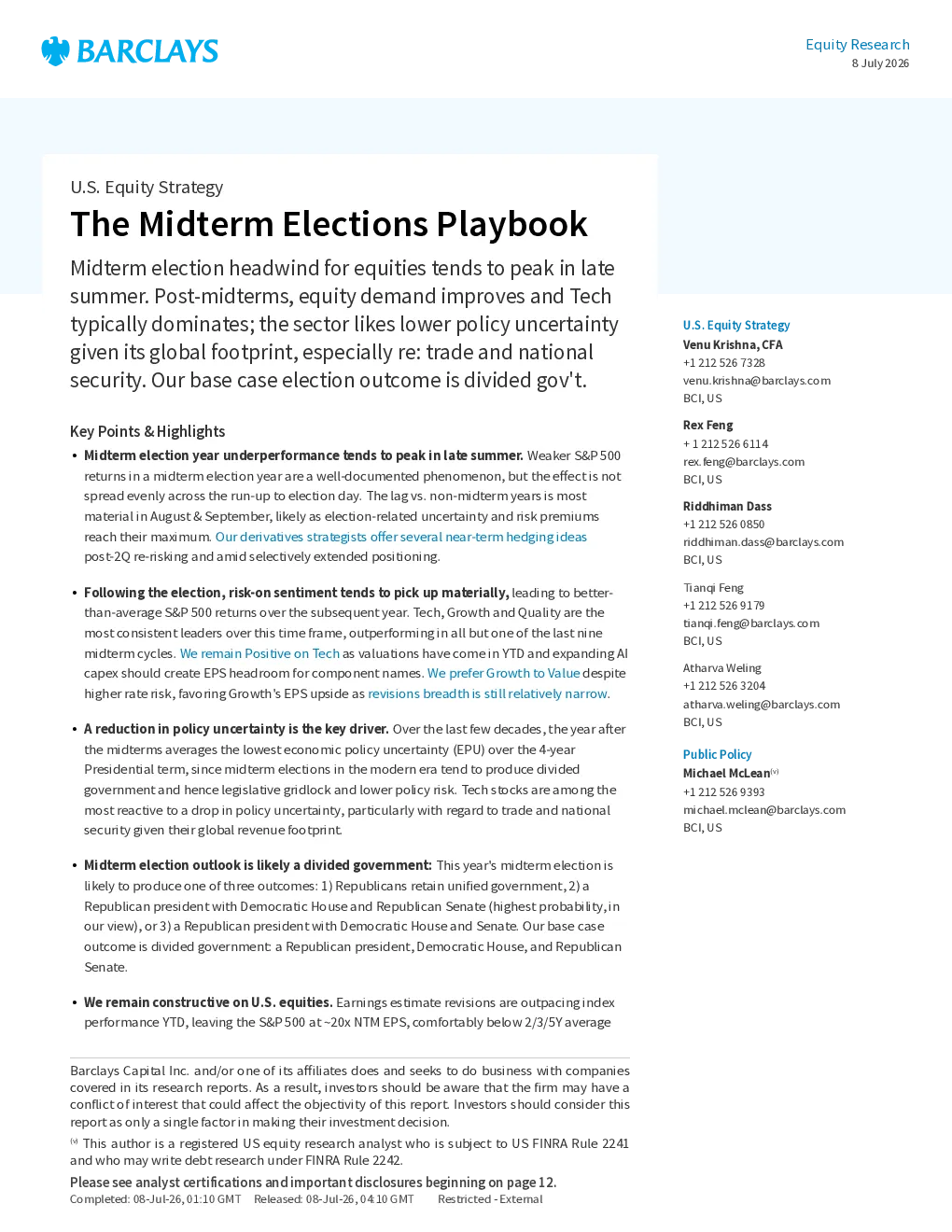
中期选举攻略 中期选举对股票市场的负面影响通常在夏末达到顶峰。中期选举后,股票需求通常会改善,科技股通常表现突出;该行业偏好较低的政策不确定性,鉴于其全球业务范围,尤其是在贸易和国家安全的方面。我们基准情景下的选举结果是分裂政府。 Venu Krishna, CFA+1 212 526 7328venu.krishna@barclays.comBCI, US美国股票策略 + 1 212 526 6114rex.feng@barclays.comBCI, US雷克斯·冯 要点与亮点 • 中期选举年表现疲软通常在夏末达到顶峰。中期选举年标普500指数回报较弱是一种有据可查的现象,但该影响并非均匀分布在选举日前的整个期间。与非中期选举年相比,这种滞后效应在8月和9月最为显著,这可能是由于与选举相关的Uncertainty(不确定性)和风险溢价达到顶峰所致。我们的衍生品策略师在完成第二季度重新风险评估,并鉴于部分策略的仓位选择性延展之际,提供了一些近期的对冲思路。 +1 212 526 0850riddhiman.dass@barclays.comBCI, US黎迪曼·达斯 Tianqi Feng+1 212 526 9179tianqi.feng@barclays.comBCI, US 选举后,风险偏好往往会显著提升,导致随后的年度标普500指数回报率好于平均水平。在此期间,科技、成长和优质股是最稳定的表现领涨板块,在过去九个中期周期中,除一个周期外均表现优于大盘。我们对科技板块持乐观态度,因为当前估值已年内触底,且人工智能资本开支的扩张应能为相关个股创造每股收益的增长空间。尽管利率风险较高,我们更偏好成长股而非价值股,更青睐成长股的每股收益上行潜力,因为当前盈利预测的调整范围仍然相对狭窄。 Atharva Weling+1 212 526 3204atharva.weling@barclays.comBCI, US 政策不确定性的降低是关键驱动力。在过去的几十年里,中期选举后的那一年通常平均在总统任期的四年中具有最低的经济政策不确定性(EPU),因为现代时期的中期选举往往导致两党分立,进而造成立法僵局和政策风险降低。鉴于其全球收入版图,科技股是对政策不确定性下降反应最为敏感的股票之一,尤其是在贸易和国家安全的方面。 公共政策 (v)+1 212 526 9393michael.mclean@barclays.comBCI, US迈克尔·麦克林 • 中期选举前景可能呈现两党分立:今年的中期选举可能产生三种结果之一:1) 共和党保持执政党地位;2) 共和党总统与民主党众议院、共和党参议院(我们认为概率最高);3)共和党总统与民主党众议院、参议院。我们的基准情景结果是两党分立:共和党总统、民主党众议院和共和党参议院。 我们对美国股票保持积极看法。截至目前,盈利预测的调整幅度已超过指数表现,标普500指数的市盈率约为20倍未来12个月每股收益,远低于过去2年、3年和5年的平均市盈率。 巴克莱资本有限公司及其附属公司中的任何一家均与其研究报告涵盖的公司进行或寻求进行业务往来。因此,投资者应注意,该公司可能存在利益冲突,从而影响本报告的客观性。投资者应将本报告视为其投资决策的单一因素。 该作者为注册的美国股票研究分析师,受美国FINRA规则2241约束,并可能根据FINRA规则2242撰写债务研究。 已完成:26-07-08 01:10 GMT 请参阅第12页开始的分析师资质认定和重要披露。发布:26-07-08 04:10 GMT 限制 - 外部 尽管增长前景有所改善,但估值仍处于高位。考虑到“第三年”通常的股权回报提升以及当前风险溢价(由仍处高位的经济政策不确定性指数EPU所隐含),我们将任何短期头寸的平仓视为买入机会,且更倾向于科技板块。 中期选举前后的股权投资回报 “中期选举效应”对美国股票回报的影响是一个有据可查的现象。我们先前的研究表明,与其它年份相比,标普500指数在美国中期选举年的前三个季度往往表现明显疲软,这也往往伴随着整体波动率升高和最大回撤幅度增大。在本报告中,我们将进一步详细阐述中期选举如何重塑事件前后美国股票回报的轨迹,包括风格和行业层面的模式,以及选举影响风险资产定价的可能传导机制。 如前所述,中期选举年的标普500回报率往往弱于其他年份,但这一影响并非均匀地分布在11月前的整个期间。我们发现,中期选举年与非中期选举年之间的年内回报率差异在夏季月份最为显著,均值差异在9月达到约900个基点的表现不佳,这可能是由于与选举相关的不确定性和风险溢价达到顶峰所致。选举之后,风险偏好往往显著回升,导致随后的标普500回报率好于平均水平。 就长期持有策略而言,中期选举前各地区和各行业指数的回报情况: 我们发现,在年中选举年,动量(Momentum)和质量(Quality)的表现通常优于平均水平,而小盘股(Small-cap)和成长股(Growth)的表现则低于平均水平。但低命中率表明,这些超额收益并不稳定。我们认为这与我们观察到在长/短因子组合中存在的年内轮动有关,即年中选举年早期的因子偏好趋势,在选举后往往会逆转。 欧洲、亚洲以及新兴市场的区域股债表现也参差不齐,在中期选举年,其平均表现低于美国股债,但胜率较低。 各行业回报率有所不同;在选举年期间,医疗保健行业表现优于标普500指数,而工业行业在超过75%的时间里表现落后,其他行业的命中率则较低。 事后回溯显示模式更为一致:自1990年以来,在每一轮选举周期的中期选举后12个月内,成长型股票均跑赢大盘,平均超额总回报率达460个基点。价值型股票除一个例外均跑赢大盘,平均超额总回报率为410个基点。科技板块往往在中期选举后12个月成为行业龙头,并且在自1990年以来的每一轮选举周期中除一个例外均跑赢标普500指数,平均超额总回报率达1450个基点。 35年间经历了9个选举周期,这引入了一定的样本量小偏差。然而,前后期在风格和行业命中率上的显著差异,促使我们进一步探究可能影响美国国会/总统选举周期中股票回报的潜在宏观和政策效应。 经济周期与经济不确定性 当前的主要论点是,中期选举充当了政治不确定性的消解事件,从而消除了投资者风险偏好的暂时性阴影,并为进一步股市上涨铺平了道路。然而,我们首先想排除美国选举周期与宏观经济或商业周期之间的任何同步关系。我们测试了美国大选周期中4年的宏观因素均值差异,这些因素与我们在盈利和公允价值模型中使用的因素类似(包括增长、通胀、名义国债收益率、实际消费和金融状况):就职典礼年、中期选举年、“第三年”以及总统大选年。 尽管在周期的4年里,一些变量的平均数值表现出适度差异,但方差分析表明这些均值并没有系统性的差异。相对于普通的宏观经济波动,年度间的模式通常较小。公平地说,年度平均值可能会忽略年内时序效应以及政策传导的潜在滞后影响,但我们并未发现这些宏观指标的选举周期变异能够解释上一节强调的股票回报模式中具有显著意义的部分。直观上,这是因为宏观经济周期并非局限于4年的节奏,导致美国的中期选举在整体宏观/商业周期中随时间落在不同的时点。 因此,我们回到政策不确定性上,在那里我们可以观察到更有意义的选举周期变化。经济政策不确定性(EPU)往往在一届美国总统任期的第一年达到最高点,然后在第二年(中期选举年)下降,在“第三年”触底,然后在下次总统选举前再次上升。拜登总统任期的政策不确定性走势与特朗普总统第二任期至今相似。EPU在一届总统任期的第一年可能达到最高点,因为历史数据显示,在总统任期的前半段比后半段更常见于政府统一。 这很重要,因为美国股票市场对EPU的变化呈反向反应;政策不确定性下降与更好的股票回报相关,反之亦然。此外,我们发现变化率也对股票表现有显著影响。EPU从高位快速下降(实质上是一种“压力缓解”情景)往往与滚动12个月期标普500指数的最佳回报期相吻合。我们认为这有助于解释中期选举后12个月内美国股票回报的改善,因为在选举周期中的“第三年”,EPU在任何给定月份通常会出现最大的同比降幅。 降低不确定性有利于长期增长 我们回归科技、成长和质量板块,这些板块自1990年以来在超过12个月的期中后期间,表现均优于标普500指数。对于科技板块,我们发现其对该板块EPU(经济政策不确定性指数)起始水平的反应程度,不如标普500指数整体那么敏感。相反,对于科技板块而言,EPU下降本身更为关键;无论不确定性起初是高、低还是中等,只要EPU下降,科技板块的超额收益在未来12个月内都会显著改善。这很可能已经促成了科技板块在“第三年”超额收益的一致性,但我们更进一步,将主要EPU分解为其基本组成部分,以查看其中是否存在任何关系。 在主要的EPU类别中,我们发现税收、贸易和国家安全政策方面的不确定性在选举周期的第三年往往下降最多。与此同时,单变量回归表明,国家安全的减少不确定性对任何给定12个月期间科技超额回报的影响最大,这表明该类别可能是“第三年”科技表现更好的传导机制。虽然贸易政策最初看似无关紧要,但当我们借用上一节中的“压力缓解”框架时,这种关系就变得清晰起来:当不确定性在正常化之前处于高位时,往往是贸易政策对科技超额回报产生最大的积极影响。 贝克·布卢姆 & 戴维斯,彭博,巴克莱研究 定义为观测值前四分位的“压力”水平,1990-2025年。 贝克·布卢姆 & 戴维斯,彭博,巴克莱研究 总体而言,我们相信,在中期选举后12个月内科技板块持续跑赢,是基于该板块对下降的总体经济政策不确定性(EPU)的反应,而后者往往在选举周期的第三年触底。在EPU类别中,国家安全和贸易政策(后者从高位下降时)周围的不确定性降低,成为科技板块超额收益最可能的驱动因素;这两者通常在“第三年”有意义地解决。当监管或税收政策是美国科技领域热门的启发式方法时,类别结果可能会令人惊讶。然而,考虑到科技板块的外国收入敞口(这是标准普尔500指数中最高的),我们认为这很有道理。一个国家安全和贸易政策不确定性都在下降的环境,通过提高其全球业务范围内的收入可见性,为长期跨国成长型股票解锁了估值上行空间。 有趣的是,在长线风格指数方面,我们发现“第三年”成长股的超额收益似乎很大程度上是科技股效应。成长股的超额收益不仅与科技股的超额收益高度相关,而且控制了科技股收益后,“第三年”成长股的超额收益会大幅缩小。这表明,更具经济意义的模式并非成长股本身的普遍超额收益,而是随着经济政策不确定性指数(EPU)根据典型的选举周期季节性规律正常化,科技股表现领先。 然而,对于质量超额收益(Quality outperformance),情况则并非如此。在整个周期中,技术(Tech)仅解释了质量超额收益变化的一小部分,并且对质量表现(Quality performance)的“第三年”效应('Year 3' effect)仍然可见。这表明,在中期之后对质量的追逐,既不同于,又与转向成长/技术(Rotation into Growth/Tech)同时发生。 选举结果与政党控制的影响 关于回报模式是否因中期选举结果以及白宫和国会党派控制的潜在组合而变化的问题,这引入了更多的样本量偏差。然而,从政策角度来看,重要的是总统的政党是否控制国会,因为这是“统一”或“分裂”政府的分界线,这一点值得考虑。 通过这个视角,在任何一个给定年份截至10月31日结束的12个月内(大致与选举时间一致),标普500指数的回报率在政府分裂的情况下往往表现更强劲。此外,与统一政府相比,科技板块的超额回报率(鉴于我们之前的分析,也伴随着成长板块)在政府分裂时也有所改善。我们认为政策不确定性与此关联仍然重要;在过去的几十年里,与统一政府相比,政府分裂通常伴随着较低水平的经济政策不确定性,这表明立法僵局降低了政策风险,并在其他条件相同的情况下支持了额外的股市上涨。值得注意的是,自1990年以来,除了2002年之外,所有的中期选举都导致了政府分裂。