您的浏览器禁用了JavaScript(一种计算机语言,用以实现您与网页的交互),请解除该禁用,或者联系我们。 [AGFEP]:中国可持续健康膳食的战略方向等相关研究 - 发现报告

中国可持续健康膳食的战略方向等相关研究

2023-05-24 AGFEP 章嘉艺
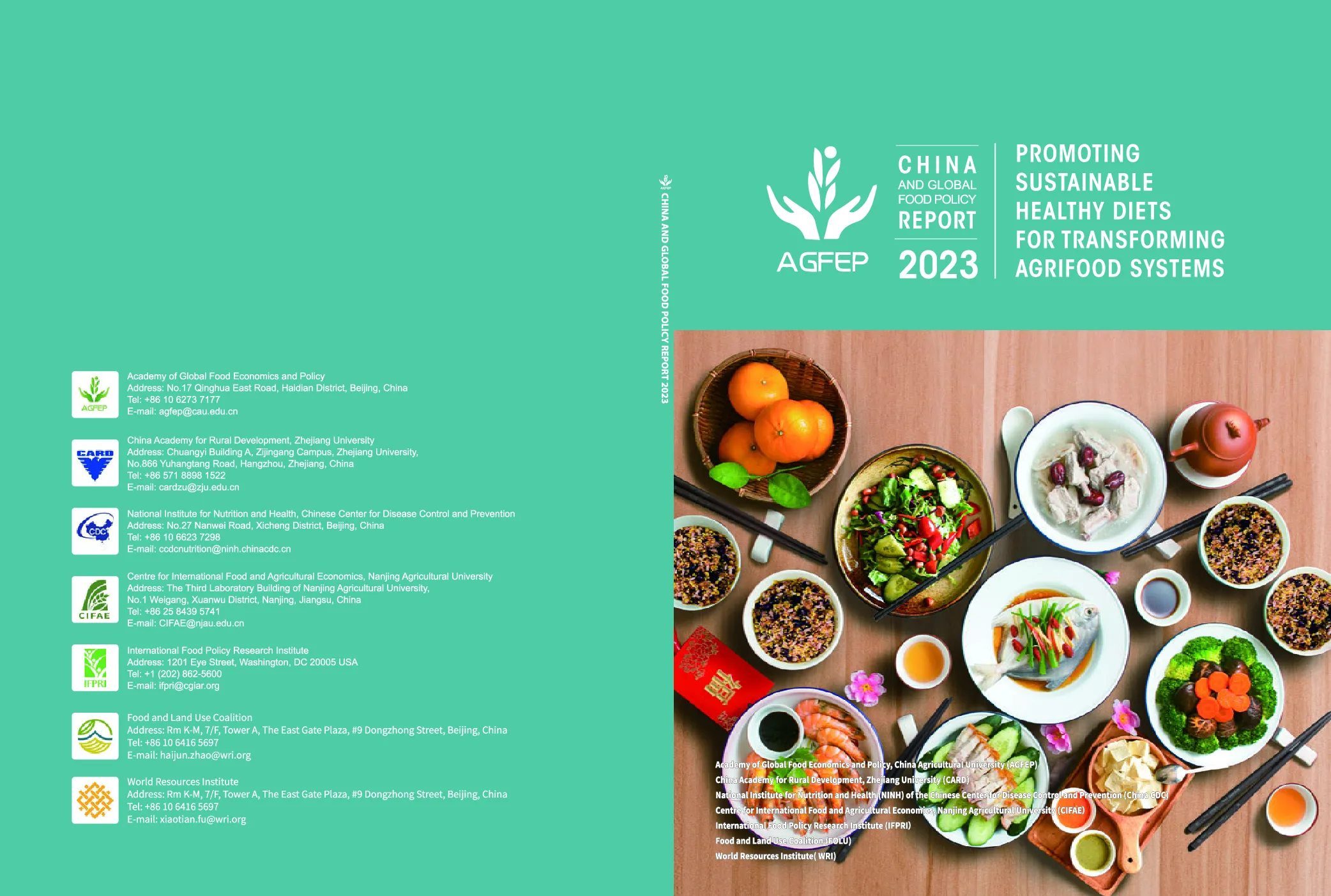
报告封面

Contents Foreword I…………………………………………………………………………………………………………vQixin Sun Foreword II……………………………………………………………………………………………………… viiKeming Qian Acknowledgments……………………………………………………………………………………………ix Executive Summary……………………………………………………………………………………………xiShenggen Fan, Kevin Z. Chen, Wei Si, and Ting Meng Chapter 1Strategic Direction of Chinese Sustainable Healthy Diets in an International Context…… 2Jiayu Xia, Shenggen Fan, Kevin Z. Chen, Yumei Zhang, Xiaolong Feng, Ting Meng Chapter 2Healthy Diets in China…………………………………………………………………………… 14Qiran Zhao, Xinyue Ding, Chen Zhu, Wenhua Zhao, Shenggen Fan, Liyun Zhao, Dongmei Yu Chapter 3Sustainable Healthy Diets in China…………………………………………………………… 34Yumei Zhang, Li Xue, Shenggen Fan, Kevin Z. Chen, Xinyue Ding, Xiaolong Feng, Ting Meng, Zhiming Yuan,Xiangyang Zhang Chapter 4Trade, FDI, and the Transition of Chinese Diets……………………………………………… 52Xu Tian, Faqin Lin, Xuejun Wang, Wei Si Chapter 5Consumer-side Interventions: Enabling Sustainable and Healthy Food Choices………… 72Jingjing Wang, Fuli Tan, Xin Zhang, Wen Lin, Xiaotian Fu, Haijun Zhao Foreword I Since the reforms and opening up, China’s economy and society have continued to develop rapidly; the income levelof urban and rural residents has continuously grown, the dietary structure of residents has gradually diversified, anddietary energy intake has increased. However, the issue of residents’ unbalanced dietary structure and nutritionalintake is becoming increasingly prominent, leading to an upward trend in the incidence of nutrition-related chronicdiseases and bringing new challenges to the sustainability of resources and the environment. If no measures areadopted, the realization of the strategic goals of “Healthy China 2030” and the country’s sustainable developmentwill be constrained. In 2019, the EAT-Lancet Commission first published the EAT-Lancet report, the first scientificelaboration of healthy diets based on sustainable food production systems. In the same year, the Food and AgricultureOrganization of the United Nations and the World Health Organization also formulated guidelines for sustainable andhealthy diets. Nevertheless, these discussions remain at the global level and have limited significance in guiding thedietary patterns of Chinese residents. Therefore, there is an urgent need to conceptualize a sustainable and healthydietary pattern suitable for Chinese residents and China's natural resources endowment. To this end, the Academy of Global Food Economics and Policy (AGFEP) of China Agricultural University (CAU),led by Professor Fan Shenggen, has published 2023 China and Global Food Policy Report (in both English andChinese) in collaboration with several domestic and international institutions. Adhering to an international perspectiveand using case studies and data from China, this report focuses on systematic research into the following topics:healthy diets for Chinese residents, the environmental impacts of chinese diets, impacts of international tradeand overseas investment on residents’ dietary patterns, and interventions to change residents’ food consumptionbehaviors. The purpose is to help promote Chinese residents’ dietary transformation for improving both population'shealth and environmental sustainability This is another instance where AGFEP has conducted systematic research formajor national need and released another flagship report after 2021 and 2022. The report has attracted widespreadattention and inspired discussion among policymakers and researchers worldwide. The 2023 report points out that China must adopt healthy diets suitable for Chinese residents, formulate asustainable and healthy diet ais guidance by region, use international trade and investment to improve diets ofresidents, establish a concept of a sustainable healthy diet for all, and guide residents’ food consumption towarda sustainable and healthy pattern through the popularization of “food education.” This will contribute to achievingthe goals of the “Healthy China 2030” plan. The report fully embodies the characteristics of multidisciplinary cross-sectional research, providing a decision-making reference to promote the dietary transformation of its populationand presenting a Chinese solution for the transformation to globally sustainable and healthy diets. In the future, CAUwill continue to be guided by China’s major strategic needs, fully leverage the advantages and characteristics ofmultidisciplinary and cross-sectional research teams, and conduct emerging and cutting-edge research on agriculture.Further, it will better serve national multidimensional development strategic goals such as food security, nationalnutrition and health, green and low-carbon development, and rural revitalization and will contribute the wisdom ofCAU to the development of a strong agricultural country. Foreword II The report of the 20th National Congress of the Communist Party of China proposed to accelerate the building of astrong agricult