您的浏览器禁用了JavaScript(一种计算机语言,用以实现您与网页的交互),请解除该禁用,或者联系我们。 [世界银行]:从数据到劳动力市场情报:利用全球最佳实践建立有效的劳动力市场观察站 - 发现报告

从数据到劳动力市场情报:利用全球最佳实践建立有效的劳动力市场观察站

综合 2026-06-01 世界银行 土豆不吃泥
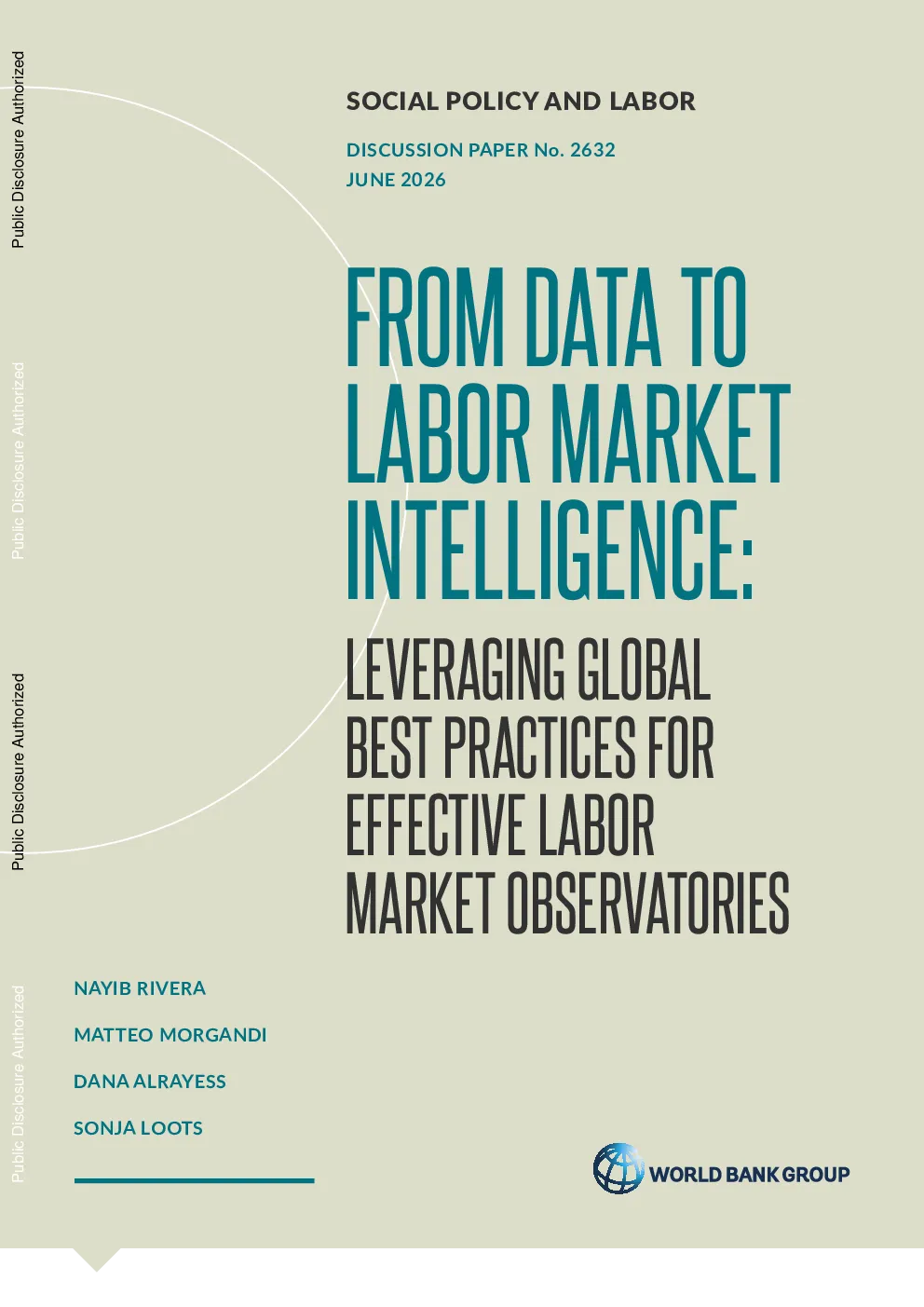
报告封面

DISCUSSION PAPER No. 2632JUNE 2026 FROM DATA TOLABOR MARKETINTELLIGENCE: LEVERAGING GLOBALBEST PRACTICES FOREFFECTIVE LABORMARKET OBSERVATORIES NAYIB RIVERAMATTEO MORGANDIDANA ALRAYESSSONJA LOOTS SERIES DESCRIPTION The Social Policy and Labor Discussion Paper series presents analysis and research that in-forms policy dialogue and operational practice across social protection, social development,and labor markets. Social Protection: the collection covers the full lifecycle of Social Assis-tance, Social Insurance, Care, and Social Services. Labor: the collection covers Active and Passive Labor Market Programs, Training and SkillsDevelopment, Youth Employment, Economic Inclusion, and International Labor Mobilityand Migration. Social Development: the collection covers Community and Local Develop-ment, Inclusion, Cohesion, Forced Displacement, Gender, and Human Rights. Across all areas, the series highlights cross-cutting issues such as Climate Change, Fragilityand Conflict, and Resilience. COPYRIGHT ©2026InternationalBankforReconstructionandDevelopment/TheWorldBank1818HStreetNW,WashingtonDC20433Telephone:+1(202)4731000;Internet:www.worldbank.org. This work is a product of the staff of The World Bank with external contributions. The find-ings, interpretations, and conclusions expressed in this work do not necessarily reflect theviews of The World Bank, its Board of Executive Directors, or the governments they repre-sent. The World Bank does not guarantee the accuracy of the data included in this work. Theboundaries, colors, denominations, and other information shown on any map in this workdo not imply any judgment on the part of The World Bank concerning the legal status of anyterritory or the endorsement or acceptance of such boundaries. RIGHTS AND PERMISSIONS The material in this work is subject to copyright. Because The World Bank encourages dis-semination of its knowledge, this work may be reproduced, in whole or in part, for noncom-mercial purposes as long as full attribution to this work is given. Any queries on rights andlicenses, including subsidiary rights, should be addressed to World Bank Publications, TheWorld Bank Group, 1818 H Street NW, Washington, DC 20433, USA; fax: +1 (202) 522 2625;e-mail: pubrights@worldbank.org. FROM DATA TO LABORMARKET INTELLIGENCE: LEVERAGING GLOBAL BESTPRACTICES FOR EFFECTIVE LABORMARKET OBSERVATORIES NAYIB RIVERAMATTEO MORGANDIDANA ALRAYESSSONJA LOOTS ABSTRACT JEL CODES Labor Market Observatories (LMOs) convert data into actionableintelligence for policymakers, employers, educators, and job seek-ers. Despite their recognized importance, many countries remainlocked in fragmented, survey-dependent systems that fall short ofthe integrated, forward-looking functions that effective labor mar-ket governance demands. This paper develops a practical frame-work for designing and strengthening LMOs across institutionalcontexts. Drawing on case studies of advanced LMO functions in fivehigh-income countries – Australia Germany, the Republic of Korea,Singapore, and the United Kingdom – it distills transferable lessonsorganized around five building blocks: mission and policy intent,governance, data infrastructure, analytics capacity, and dissemi-nation. A maturity assessment framework helps countries identifywhere they stand and how to progress. High-performing LMOs con-sistently demonstrate a clear legal mandate, interoperable data sys-tems, and credible analytical capacity. There is no single institution-al model, but context-sensitive application of these building blockscan substantially strengthen a country's capacity for evidence-basedlabor market policymaking. J08 —Labor Economics PoliciesJ21 —Labor Force and Employ-ment StructureJ48 —Particular Labor Markets:Labor MarketStudies,Wages, EmploymentC80 —Data Collection and DataEstimation MethodologyH40 —Publicly Provided Goodsand ServicesI38 —Government Policy andWelfare Programs KEYWORDS Labor Market Observatories,Labor Market Intelligence, LaborMarket Information Systems,Data Infrastructure, InstitutionalCapacity, Skills and EmploymentPolicy, Workforce Analytics, CaseStudies AKNOWLEDGEMENTS and Vocational Training Corporation (TVTC), whosecollaboration through the World Bank TechnicalCooperation Program (TCP) led to many of the richknowledge exchanges that laid the foundation forthe preparation of this report. The team benefitedfrom the technical contributions and guidance ofEkaterina Pankratova (Senior Social Protection Spe-cialist, World Bank), Carole Chartouni (Senior Econ-omist, World Bank), Mohammed Ihsan Ajwad (SeniorEconomist, World Bank), Ramy Zeid (Economist,World Bank), Neil Butcher, Jan Rutkowski, and EricaGroshen (Consultants, World Bank). This report was prepared by Nayib Rivera (Econo-mist and Task Team Leader, World Bank), MatteoMorgandi (Senior Economist and Global Lead forLabor, World Bank), Sonja Loots (Labor and SkillsConsultant, World Bank) and Dana Jasmine Alrayess(Labor and Skills Con