您的浏览器禁用了JavaScript(一种计算机语言,用以实现您与网页的交互),请解除该禁用,或者联系我们。 [汇丰前海证券]:中国生猪行业:探底中,构建复苏之路 - 发现报告

中国生猪行业:探底中,构建复苏之路

农林牧渔 2026-06-25 汇丰前海证券 Franky!
报告封面

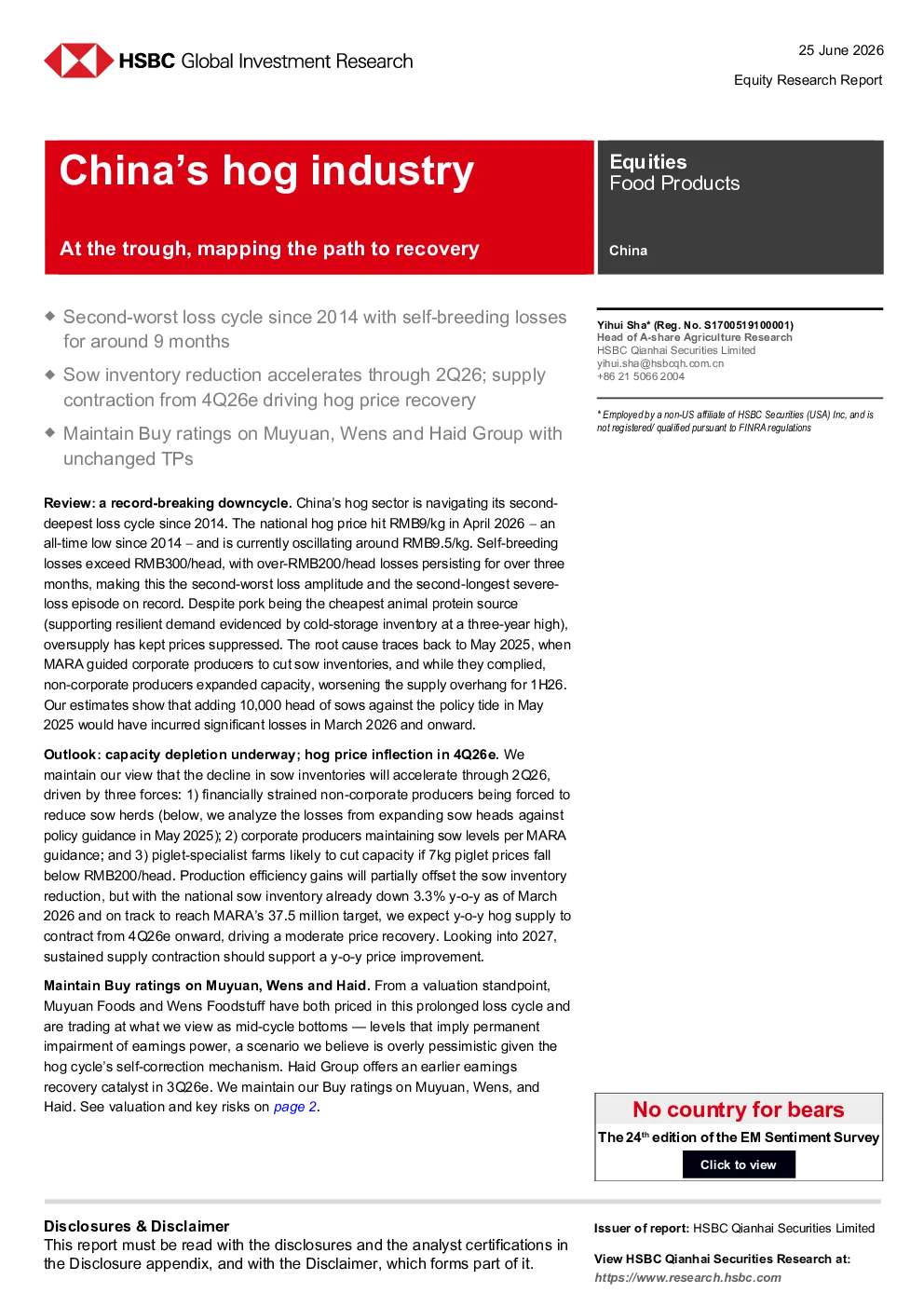
EquitiesFood Products At the trough, mapping the path to recovery China Second-worst loss cycle since 2014 with self-breeding losses Yihui Sha* (Reg. No. S1700519100001)Head of A-share Agriculture ResearchHSBC Qianhai Securities Limitedyihui.sha@hsbcqh.com.cn+86 21 5066 2004 ◆Sow inventory reduction accelerates through 2Q26; supplycontraction from 4Q26e driving hog price recovery * Employed by a non-US affiliate of HSBC Securities (USA) Inc, and isnot registered/ qualified pursuant to FINRA regulations Maintain Buyratingson Muyuan, Wens and Haid Group with Review: a record-breakingdowncycle.China’s hog sector is navigating itssecond-deepestloss cycle since 2014. The national hog price hit RMB9/kg in April 2026−anall-timelowsince 2014−and iscurrently oscillatingaroundRMB9.5/kg. Self-breedinglosses exceed RMB300/head, withover-RMB200/head losses persisting for over threemonths, making this the second-worst loss amplitude and thesecond-longest severe-loss episode on record. Despite pork being the cheapest animalprotein source(supporting resilient demand evidenced by cold-storage inventory at a three-year high), Outlook: capacitydepletionunderway;hog priceinflection in 4Q26e.Wemaintain our view thatthe decline insow inventories willacceleratethrough 2Q26,driven bythreeforces:1) financially strained non-corporate producers being forced toreduce sow herds(below, we analyze the losses from expanding sow headsagainstpolicy guidance in May 2025);2) corporate producers maintaining sow levels per MARAguidance; and3) piglet-specialist farms likely to cut capacity if 7kg piglet prices fallbelow RMB200/head. Production efficiency gains will partially offset the sow inventory MaintainBuy ratingsonMuyuan, Wens and Haid.From a valuation standpoint,Muyuan Foods and Wens Foodstuff have bothpriced in this prolonged loss cycle andare trading at what we view as mid-cycle bottoms—levels that imply permanentimpairment of earnings power, a scenario we believe is overly pessimistic given the The 24thedition of the EM Sentiment Survey Click to view Disclosures & DisclaimerThis report must be read with thedisclosures and the analyst certifications in Issuer of report:HSBC Qianhai Securities Limited the Disclosure appendix, and with the Disclaimer, which forms part of it. View HSBC Qianhai Securities Research at:https://www.research.hsbc.com Where arehogpricesnow? Absoluteprice:In April 2026, the national average hog price (source:National Bureau ofStatistics, NBS) hit RMB9/kg,the lowestpointsince 2014(Exhibit 1). Themarket has sincerecovered modestly to ~RMB9.5/kg butremains deeply depressed by historical standards. Relativeprice (proteinsubstitution):Pork prices relative to chicken, beef, eggs, and fish have all fallen to historical trough levels(Exhibit 2), making pork theone of thecheapest animal-proteinsourcesin the current consumer environment. This provides a structural demand floor Profitabilityand loss cycle duration: deep andpersistentlosses.Self-breedingfarmersare currently losing ~RMB300/head(source:Wind,Exhibit 3). Losseshaveendured for over9months (sinceSep 2025, averaging RMB215/head). This is thesecond-deepest loss amplitude Whyarepricessolow? Supply-side driven, not demand-side.Pork’s relative-value advantage as the cheapestanimal protein should sustain resilient consumer demand. Indeed, downstream cold-storageinventory hit a three-year high year-to-date(source: SCI), signalling robust off-take from the Why theoversupply? Hog supply from March 2026 onward is determined by the breeding sowinventory ~10 months In May 2025, the Ministry of Agriculture and Rural Affairs (MARA) held multiple meetings urginglarge-scale corporate farms to cap or reduce their sow herds, signaling an impending sector- By end-September 2025,Muyuan’s sow reduction alone exceeded the national total decline(Exhibit 5),suggesting that while corporate players complied with MARA’s guidance toreduce or stabilise sow herds,non-corporate (smallholder) producers were still expanding This is consistent with our previously published view: corporate players would pare sow numbersunder policy direction but would simultaneouslyoptimise their sow herd structure(higherPSY, better survival rates), boosting per-sow productivity and partially offsetting the headcountreduction. Meanwhile, non-corporate producers continued adding sows through at least Howmuchdidadding 10,000sows in May 2025lose? We simplify the hog production chain totwocases forbreedingsows:1) selling piglets; or 2) Scenario 1: Purchasingculledsows asbreedingsows.Culled sows typically weigh180kg+. InMay 2025, the average culled-sow price was RMB11.7/kg, implying a total Weaned piglet path.Weaned piglets from these sows would be ready by October2025. At that time, the weaned-piglet price was RMB172/head vs. a cost of Finishing hog path.We believe most non-specialised piglet producers would not sellpigletsat a loss; they would instead raise piglets to finishing wei