中国互联网:AI模型架构的战略性影响
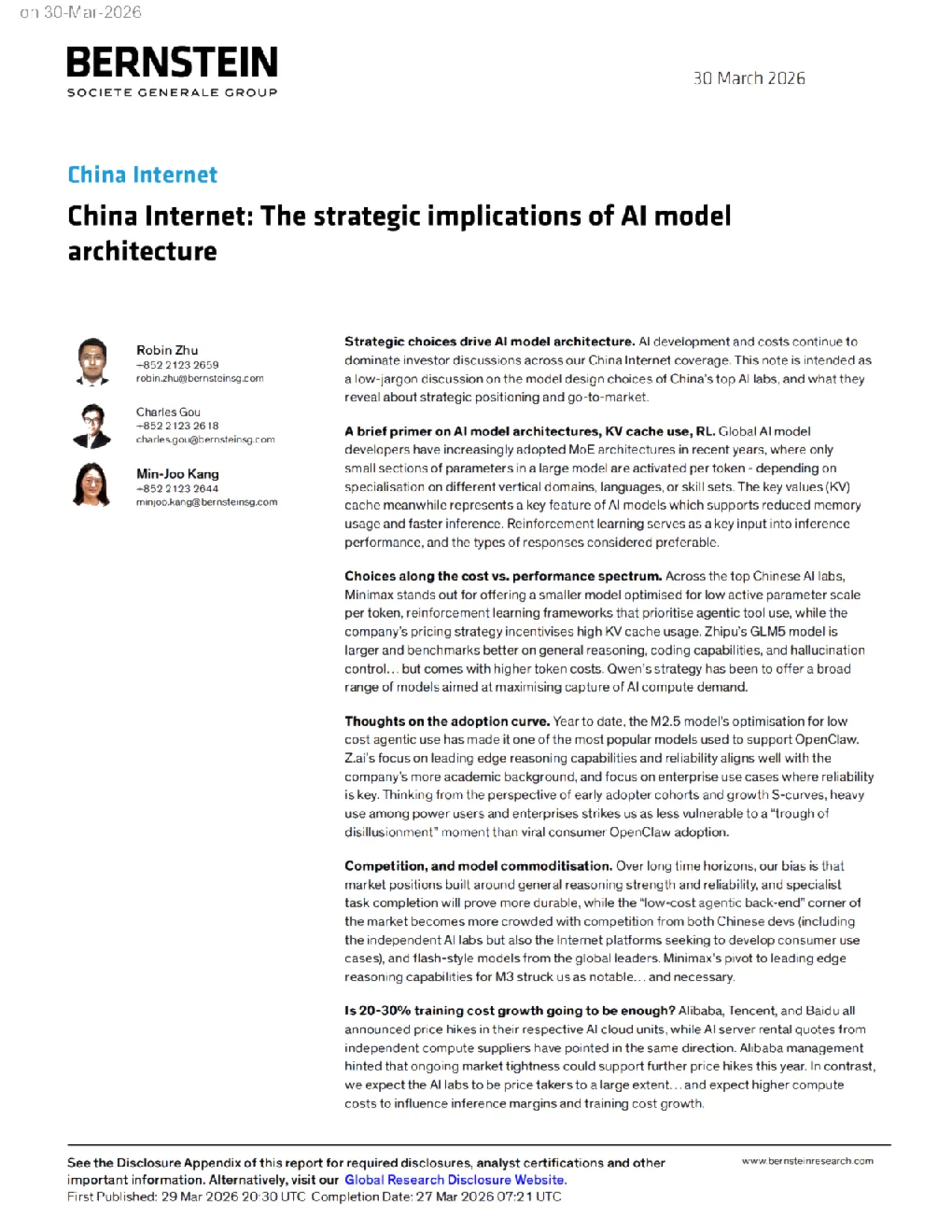
China Internet: The strategic implications of Al modelarchitecture Strategic choices drive Al model architecture. Al development and costs continue todominate investordiscussionsacrossourChinaInternetcoverage.Thisnoteis intendedasa low-jargon discussion on the model design choices of China's top Al labs, and what theyreveal about strategic positioning and go-to-market. Robin Zhu+852 2123 2659robin.zhu@bernsteinsg.com Charles Gou+85221232618charles.gou@bernsteinsg.com A brief primer on Al model architectures, KV cache use, RL. Global Al modeldevelopers have increasingly adopted MoE architectures in recent years, where onlyspecialisation on different vertical domains, languages, or skill sets. The key values (KV)cache meanwhile represents a key feature of Al models which supports reduced memoryusage and faster inference. Reinforcement learning serves as a key input into inferenceperformance, and the types of responses considered preferable. Min-Joo Kang+85221232644minjoo.kang@bernsteinsg.com Choices alongthe costvs.performance spectrum.Across the top Chinese Al labs.per token, reinforcement learning frameworks that prioritise agentic tool use, while thelarger and benchmarks better on general reasoning, coding capabilities, and hallucinationcontrol... but comes with higher token costs. Qwen's strategy has been to offer a broadrange of models aimed at maximising capture of Al compute demand. Thoughts on the adoption curve. Year to date, the M2.5 model's optimisation for lowcost agentic use has made it one of the most popular models used to support OpenClawcompany's more academic background, and focus on enterprise use cases where reliabilityis key. Thinking from the perspective of early adopter cohorts and growth S-curves, heavyuse among power users and enterprises strikes us as less vulnerable to a "trough ofdisillusionment" moment than viral consumer OpenClaw adoption. Competition, and model commoditisation. Over long time horizons, our bias is thatmarketpositionsbuiltaroundgeneralreasoningstrengthandreliability,andspecialisttask completion will prove more durable, while the "low-costagentic back-end" corner ofthe market becomes more crowded with competition from both Chinese devs (includingthe independent Al labs but also the Internet platforms seeking to develop consumer usecases), and flash-style models from the global leaders. Minimax's pivot to leading edgereasoning capabilities for M3 struck us as notable.. and necessary. Is 20-30% training cost growth going to be enough? Alibaba, Tencent, and Baidu allannounced price hikes in their respective Al cloud units, while Al server rental quotes fromindependent compute suppliers have pointed in the same direction. Alibaba managementhinted that ongoing market tightness could support further price hikes this year. In contrast,costs to influence inference margins and training cost growth. BERNSTEINTICKERTABLE INVESTMENT IMPLICATIONS Al development and costs continue to dominate investor discussions across our China Internet coverage. In this note we'veoutlinedsomeobservationsaboutdifferencesinAlmodelarchitecturechoicesacrosstheleadingChineseAllabs,andwhat these choices say about developer market positioning and competitive strategy. While Minimax's recent (M2+) modelreleases have been optimised for low-cost agentic tool use, Z.ai's GLM5 model was much more focused on general reasoningcapabilities,andhallucinationcontrol.Alibaba'sstrategyforitsQwenfamilyofmodelsmeanwhilehasbeentoofferabroadrange of models across model sizes andmodalities..to capture as broad ofa range of compute use cases as possible, for thepurposes ofdrivingdemandforMaaS andbroadercomputedemand. Over long time horizons, we expect leading edge general reasoning and specialised task completion capabilities to representmoredefensivecompetitivepositionsthanalow-cost,goodenough"agenticAibackbone...unlessthelatterisembeddedwithin a large consumer-facing ecosystem. For the latter, our bias remains that most consumers care more about "getting stuffdone" efficiently and cheaply than necessarily differentiating between underlying reasoning capabilities. To date, the top Chinese Al labs have done a good job keeping pace with the global SOTA, albeit with help from developmenttechniques like distillation. As agentic workflows become more complex, and task completion horizons lengthen, the possibilitythat the latter becomes less effective will be important to monitor. Nearer-term, we'd expect the rising cost of compute (e.g. seeAlicloud and Tencent price hikes) to support hyperscaler growth - but serve as a source of training and inference cost pressurefor Al labs like Minimax and Z.ai. The 25-30% training cost growth that investors seem to contemplate for these stocks strikesus as being too low in an environment of rising compute costs. VALUATIONCOMPSTABLE DETAILS A PRIMER ON MODEL AI ARCHITECTURE... AND STRATEGIC IMPLICATIONS Research on Al development has dominated our research bandwidth