美股与私募股权:二十年来最宽的股权回报差距
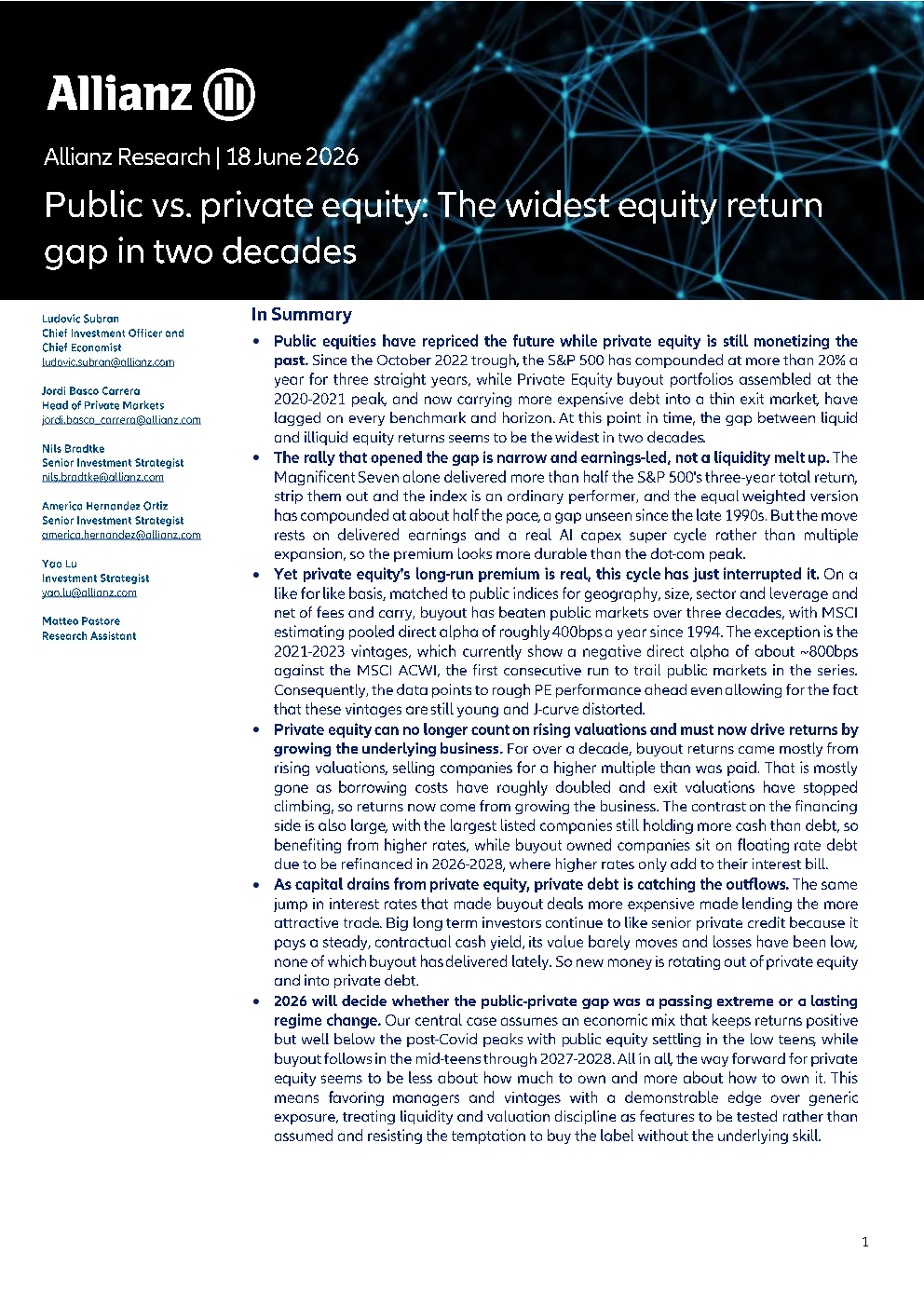
安联研究 | 2026年6月18日 公共股权与私募股权:二十年来最广的股权回报差距 总而言之 ludovic.subran@allianz.com苏博兰 首席投资官兼首席经济学家 2026年将决定公共与私营的差距是短暂的极端现象,还是持久的体制变革。我们的核心观点假设了一种经济结构,该结构能保持回报率为正但远低于新冠疫情后的峰值,公共股权将稳定在低位 teens,而杠杆收购则将在2027-2028年期间达到中位 teens。总而言之,私募股权未来的发展似乎与其应持有多大份额关系不大,而更多地在于如何持有。这意味着要青睐那些具有明显优势的管理者和投资周期,将流动性和估值纪律视为需要检验的特征而非理所当然,并抵制仅凭标签而非实际能力就进行投资的诱惑。私募股权已无法再依赖估值上涨,现在必须通过发展底层业务来驱动回报。十多年来,收购回报主要来自估值上涨,即以高于付出的 multiples 出售公司。随着借贷成本大致翻倍以及退出估值停止上涨,这种情况已基本消失,如今回报来自业务增长。在融资方面,对比也很大,最大的上市公司仍持有比债务更多的现金,因此受益于高利率,而收购持有的公司则因2026-2028年需再融资而承担浮动利率债务,高利率只会增加它们的利息负担。• 打开差距的板块较为狭窄,且由盈利驱动,并非流动性飙升。仅“七巨头”就贡献了标普500三年总回报率的一半以上,若剔除这些板块,指数表现就平平无奇,而等权重版本的增长速度也慢了一半左右,这种差距是自1990年代末以来未见过的。但这一行情建立在已实现的盈利和真实的AI资本开支超级周期之上,而非估值扩张,因此其溢价看起来比互联网泡沫时期更为持久。• 公募股权正在重新定价未来,而私募股权仍在盘活过去。自2022年10月触底以来,标普500指数连续三年年复合增长率超过20%,而那些在2020-2021年峰值时组建、如今背负着更昂贵债务进入狭窄退出市场的私募股权收购组合,在所有基准和时间段内均表现落后。此时此刻,液态与非液态股权回报之间的差距似乎达到了二十年来最宽的程度。• 随着资本从私募股权领域流出,私募债务正接棒成为资金外流的主要去向。同样,利率的飙升使得收购交易成本增加,但也让借贷业务更具吸引力。大型长期投资者继续青睐高级私募信贷,因为它能提供稳定、有合约保障的现金回报,其价值变动不大,且损失率低——这些恰恰是近期私募股权领域难以提供的。因此,新资金正从私募股权流向私募债务。然而,私募股权的长期超额收益是真实存在的,只是这个周期暂时中断了它。在可比基础上,即按地域、规模、行业和杠杆率与公共指数匹配,并扣除费用和附带收益后,收购基金在过去三十年中一直跑赢公共市场,MSCI估计自1994年以来其组合直接alpha约为每年400个基点。例外的是2021-2023年的基金,目前对MSCI ACWI指数显示约-800个基点的负直接alpha,这是该系列首次出现连续年份跑输公共市场。因此,即使考虑到这些年份的基金尚年轻且呈现J曲线扭曲,数据也预示着私募股权未来表现仍将相对疲软。 jordi.basco_carrera@allianz.comJordi Basco Carrera 私募市场负责人 nils.bradtke@allianz.com尼尔·布拉特克 高级投资策略师 america.hernandez@allianz.com美國·赫南德茲·奧爾蒂斯 高級投資策略師 yao.lu@allianz.com瑶露投资策略师 马特奥·帕斯托雷 研究助理 公共市场已大幅领先。 自2022年10月触底以来,公共股票市场经历了现代记忆中最剧烈的再估值之一。标普500指数在过去三个连续年份中复合增长率超过20%,其他大型股基准指数紧随其后。但头寸数据掩盖了市场真相。反弹范围异常狭窄:仅“七巨头”(苹果、微软、字母表公司(谷歌)、亚马逊、英伟达、Meta(脸书)和特斯拉)就贡献了标普500指数三年总回报率的一半以上。去除这七家公司后,该指数表现平平。这种分化也体现在估值上。目前排名前十的公司,其市盈率相较于指数其他部分溢价约50%,按任何历史标准衡量都显得过高。但这一溢价建立在远超2000年代互联网泡沫峰值的盈利预期之上,表明当前基本面比当时更具韧性(图1)。盈利广度也在缓慢修复(图2):仅三分之一左右的标普500成分股在2025年超越指数,较前一年创下的历史低点有所回升。与此同时,小型股几乎毫无动静。等权重版本的同一指数则揭示了更清醒的图景,标普500等权重指数的复合增速约为其市值加权母指数的一半,这一差距自1990年代末以来未见。总而言之,从指数层面看读作普涨市场,但从机制上看,实际上是少数几家公司资产负债表的再估值。 数据来源:IBES、LSEG Datastream、安联研究报告:盈利广度衡量的是指数成分股中收到盈利上调预测的占比。 近期缺口之规模,对照私募股权的长期记录更容易理解。若按可比标准,将每支收购基金与地理、规模、行业和杠杆率相匹配的公共指数进行比较,并衡量扣除费用和资金管理费后的超额回报,事实上,私募股权在过去三十年中已经超越了公共市场。MSCI估计,自1994年以来,收购基金的直接Alpha值约为每年4%。这一长期溢价恰恰是当前周期所中断的。按成立年份划分,自1990年代中期以来,收购基金在几乎所有群体中都对全球股票实现了正Alpha。例外的是2021-2023年的群体,目前显示出 与MSCI ACWI指数相比,直接alpha约为-5%至-12%,这是连续年份首次跑输该系列公共市场。当然,这些读数有一个重要的注意事项,因为基金尚年轻,早期费用侵蚀(J曲线)会机械性地压低回报,而这类回报通常会随着投资组合成熟而恢复,因此这些回报是暂时的而非最终的。但即使考虑到这一点,信息也是一致的:投资于低成本资金峰值的年份,迄今为止是过去一代中相对表现最差的,并且可能仍会导致未来几年的一些困境(图3)。 来源:MSCI私募资本 universe;Lester, O'Shea & Warren (2025), 安联研究笔记:直接 alpha 是杠杆与行业匹配的公共指数的年化超额回报,扣除费用和资金占用成本。2021-2023 年代的样本被阴影标出,表示其仍存在 J 曲线扭曲,尚未能代表自成立以来的业绩;2024-2025 年代的样本被省略,因其太年轻,尚未产生有代表性的退出数据。 这一举措的性质与规模同等重要。这并非2020-2021年那种由流动性驱动的飙升。而是一个基于真实资本支出超级周期的盈利和利润率主导的重新估值(图4)。在此背景下,标普500指数的预期盈利自2022年谷底以来增长了约三分之一,而指数的大部分价格回报是由已实现的盈利驱动,而非估值倍数的扩张。这一区别对于我们解读与私募市场的表现差距(图5)至关重要。公共股权不仅重新定价了风险,还围绕人工智能基础设施、超大规模计算和轻资产平台的运营杠杆,重新定价了特定且可识别的增长逻辑。私募股权,其投资组合是为不同的体制构建的,没有可比的增长逻辑可以乘势而上,而软件——其疫情后最大的配置之一——正遭受重大潜在中断的困扰。 来源:LSEG 数据流,安联研究 来源:LSEG 数据流,安联研究 公共市场已吸收了私募股权的增长引擎 公共股市场的反弹幅度值得深入审视,因为它既是与私募股权出现分歧的根源,本身也是一个风险因素。如今,七大巨头(Mag 7)约占标普500总市值的五分之一,而十年前还只占八分之一(图7),它们的总市值已超过除美国和中国之外所有国家的GDP。当然,这种集中度也具有自我强化的特点,因为这些公司规模扩大后,被动型和基准跟踪资金会自动将更多资本流向它们,使其指数权重独立于基本面分析而持续加重。 盈利集中度也处于极端水平,并且现在与价格集中度并行发展。少数几家主导指数权重的巨型股也产生了不成比例且不断增长的标普500盈利份额,因此该基准指数的利润,不仅是其市值,越来越依赖于单一群体。在估值方面,该指数的交易价格远高于其长期平均前瞻市盈率,但溢价几乎完全是巨型股现象;剔除最大几家股票后,其余市场则更接近其历史常态,留下一个两级的指数,其中最昂贵部分也是最大部分(图8)。由于该指数现在大量投资于长期成长型股票,市盈率对利率和增长预期的变动也异常敏感;任何一方的微小变动都可能显著影响指数水平。作为该敏感性的基准,在盈利基本面发生变化之前,该集群的估值溢价仅回归其长期平均值,就将使标普500损失其价值的近10-20%。 同样的集中度引出了两种截然相反的解读,而它们之间的竞争本身也是一种市场风险。看涨的观点认为,Mag 7并不像 2000 年的 dot-com 领导者,因为它们合计每年产生数百亿美元的自由现金流,拥有净现金资产负债表,并主导着本十年最具影响力的长期趋势:AI 计算、云基础设施和广告数据网络。一致预期的未来盈利增长轻松超过 broader market,并且在 PEG(市盈率相对增长率)基础上,这个板块的交易价格处于平价或折价状态。尽管如此,看跌的观点认为,AI 逻辑依赖于超大规模资本支出的当前水平得以维持,企业 AI 收入尚未扩展到资本支出所暗示的回报水平,并且这种集中本身就是一个脆弱性的来源。一家或两家公司的盈利不及预期,可能在几天内就使整个指数贬值。两种观点都可能同时正确,但哪种观点占主导取决于当时哪种叙事占上风(图 9)。 为什么公私对比中集中度的重要性比最初看起来要微妙。Mag 7 本身就是“长期”增长型资产,资本开支密集且研发投入高,其收入流在十年内复合增长,而非在五年 LBO(杠杆收购)窗口期内实现变现。实际上,美国公共市场已经吸收了原本会流向私募市场的成长型股权投资。如今,超大规模资本开支已接近全球风险投资(VC)的整个投资部署规模。在早期周期中,私募投资者会通过后期风险投资轮来资助下一代计算或人工智能基础设施,而现在他们可以通过公开上市的巨型公司获得这种投资敞口,无论公司规模大小,且摩擦成本很低(见图10)。 这一推论让私募市场感到不适。可独家供私募投资者投资的高增长、规模化、盈利型科技公司的范围已经缩小。截至本文写作时,一些私募巨头仍保持私募状态(尽管这种情况不会持续太久,因为SpaceX、Anthropic和OpenAI已经上市或提交了上市申请)。 但是,随着融资和部署放缓,可比机会在私人市场的深度也恰好缩小了。 相比之下,私募股权领域仍在消化上一轮周期的影响。该资产类别在2022年利率冲击中经历了募资峰值、估值倍数峰值、杠杆峰值以及激进的增长预期。尤其是2020-2021年的基金,其定价是基于一个廉价资金和持续估值倍数扩张的世界,而这个世界在18个月内宣告终结。即使是顶尖的买断基金,在2025年也仅录得个位数内部收益率(IRR),远落后于标普500和MSCI全球指数,而过去十年的平均基金表现也仅仅勉强达到个位数中段(图11)。 滞后现象有多种原因,但最机械性的原因是资本成本的重置。十年前,典型交易以约10倍的EBITDA成交,其中一半资本来自个位数收益率的债务;而如今,成交倍数更接近13倍,但杠杆率大幅降低,融资成本却高得多。赞助商支付了创纪录的价格,期待退出时能实现进一步的倍数扩张。这种扩张并未到来,并且由于杠杆率降低提供了缓冲,对股权回报的拖累比单纯倍数变化所暗示的更为深远(见图12)。 这种不匹配既关乎行业组合,也关乎时机。当前的公共基准主要由超大型科技、半导体和通信服务主导,而恰恰是AI资本支出周期重新评估了这些行业,同时金融、医疗保健和工业则构成了平衡。私募股权的配置则呈现相反的趋势,软件和技术是过去十年中最大的收购领域,在2020-2021年的交易中约占交易价值的三分之一,而医疗保健、商业服务和工业则填补了大部分剩余部分。 问题在于,公众市场所青睐的软件与私募股权所持有的软件并非同一种投资标的。上市科技领导者集中在超大规模计算、人工智能基础设施和平台业务,拥有净现金资产负债表;而典型的私募股权持有的软件资产,是成熟且通过杠杆融资的垂直或