农光互补如何帮助新兴市场满足粮食与能源需求
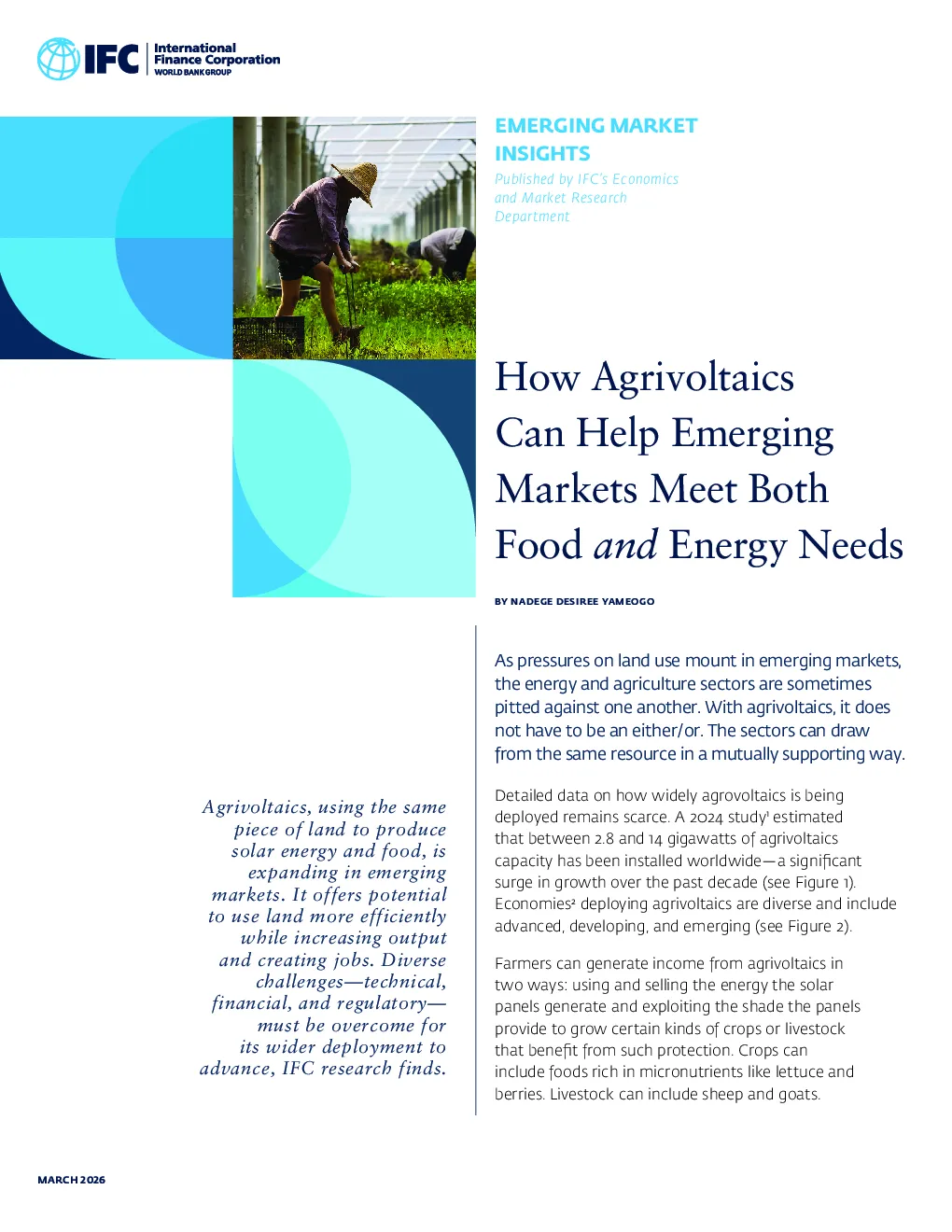
Published by IFC’s Economicsand Market Research How AgrivoltaicsCan Help EmergingMarkets Meet Both BY NADEGE DESIREE YAMEOGO As pressures on land use mount in emerging markets,the energy and agriculture sectors are sometimespitted against one another. With agrivoltaics, it does Detailed data on how widely agrovoltaics is beingdeployed remains scarce. A 2024 study1estimatedthat between 2.8 and 14 gigawatts of agrivoltaicscapacity has been installed worldwide—a significant Agrivoltaics, using the samepiece of land to producesolar energy and food, isexpanding in emergingmarkets. It offers potentialto use land more efficientlywhile increasing outputand creating jobs. Diverse Farmers can generate income from agrivoltaics intwo ways: using and selling the energy the solarpanels generate and exploiting the shade the panelsprovide to grow certain kinds of crops or livestock Penetration* by income groups IFC’s research7finds that while developing countriesare not yet leading in share of acreage deployingagrivoltaics, there is interest and innovation. Thisis highlighted by a global review of data on filed seeks to ramp up such support, specifically targetingsmallholders to help connect them better to global To ensure that neighboring communities benefit too,farmers require support and partnership to connectthe power they generate to the grid. They can also use As promising as this technology is, there are significantbarriers to wider deployment that sustained effortfrom public and private players can help overcome.For example, public authorities can adopt clearregulations that explicitly support dual land use foragriculture and energy. Financial institutions—including Considerations here include panel height, spacingbetween panels, and angle of tilt, all of which need tobe tailored to the crop or livestock as well as the local While the challenges are real, so too is the opportunityfor investment. With agrivoltaics creating so manyon- and off-farm jobs, tapping this potential can be a Emerging Market Insights is anarticle series covering business References William R. Sutton; Alexander Lotsch; Ashesh Prasann. 2024. Recipe for a Livable Planet:Achieving Net Zero Emissions in the Agrifood Systemhttps://openknowledge.worldbank.org/ 2US Department of Energy. 2022. Market Research Study: Agrivoltaics.https://science.osti.gov/-/media/sbir/pdf/Market-Research/SETO---Agrivoltaics-August-2022-Public.pdf?utm_ Cover Photo: Planting under solarpanels | Photo © Jenson via Shutterstock 3Mordor Intelligence. 2026. (accessed February 2026) Agrivoltaics Market Size & ShareAnalysis—Growth Trends and Forecast (2026 - 2031)https://www.mordorintelligence.com/ Editingby Brian Beary andScott Wenger 4Golumbeanu, Raluca Georgiana; Besnard, Juliette; Koo, Bonsuk; Hinrichs, FedericoNicolas; Finucane, James Robert; Purcell, Chris; Barnes, Douglas French. Accelerating theProductive Use of Electricity: Enabling Energy Access to Power Rural Economic Growth (ESMAPPaper). Sept, 21, 2023. Washington, D.C. : World Bank Group.https://documents.worldbank.org/ Infographicsby Irina Sarchenko 5World Bank. 2024. Off-Grid Solar Market Trends Report.https://www.esmap.org/Off-Grid_Solar_Market_Trends_Report_2024 6William R. Sutton; Alexander Lotsch; Ashesh Prasann. 2024. Recipe for a Livable Planet:Achieving Net Zero Emissions in the Agrifood System.https://www.worldbank.org/en/topic/ 7IFC. 2025. Innovations in Green Technologies: An opportunity for business in low andmiddle income countries?https://www.ifc.org/en/insights-reports/2025/innovation-in-green- 8World Bank. 2025. Partnership for Market Implementation (PMI) Facility AnnualReport 2025.https://documents.worldbank.org/en/publication/documents-reports/