您的浏览器禁用了JavaScript(一种计算机语言,用以实现您与网页的交互),请解除该禁用,或者联系我们。 [巴克莱银行]:主题投资:赋能人工智能——亚马逊数据中心水披露隐含高用电需求 - 发现报告

主题投资:赋能人工智能——亚马逊数据中心水披露隐含高用电需求

信息技术 2026-06-12 巴克莱银行 Hallam贾文强
报告封面

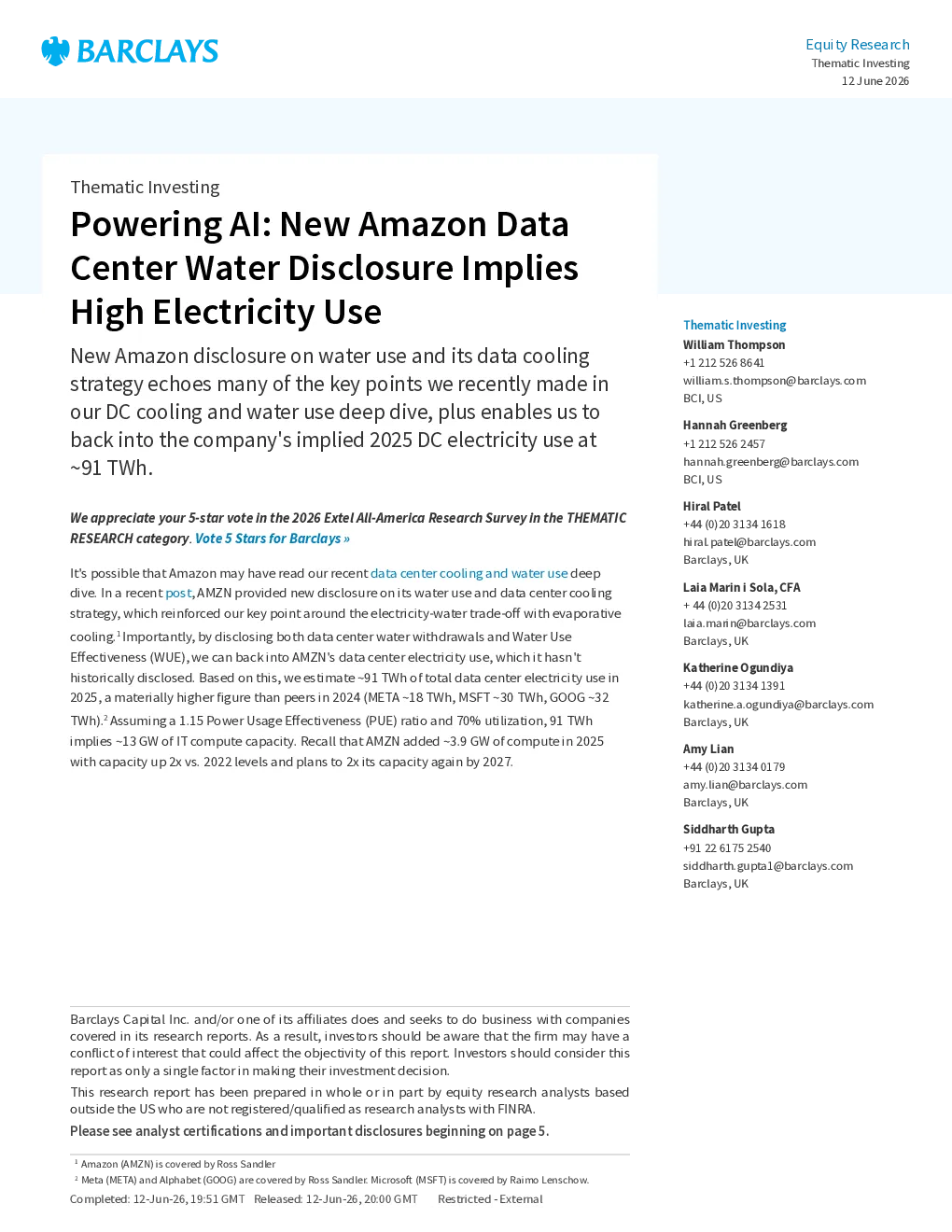
Powering AI: New Amazon DataCenter Water Disclosure ImpliesHigh Electricity Use Thematic Investing William Thompson+1 212 526 8641william.s.thompson@barclays.comBCI, US New Amazon disclosure on water use and its data coolingstrategy echoes many of the key points we recently made inour DC cooling and water use deep dive, plus enables us toback into the company's implied 2025 DC electricity use at~91 TWh. Hannah Greenberg+1 212 526 2457hannah.greenberg@barclays.comBCI, US Hiral Patel+44 (0)20 3134 1618hiral.patel@barclays.comBarclays, UK We appreciate your 5-star vote in the 2026 Extel All-America Research Survey in the THEMATICRESEARCH category.Vote 5 Stars for Barclays » It's possible that Amazon may have read our recent data center cooling and water use deepdive. In a recent post, AMZN provided new disclosure on its water use and data center coolingstrategy, which reinforced our key point around the electricity-watertrade-offwith evaporativecooling.1Importantly, by disclosing both data center water withdrawals and Water UseEffectiveness(WUE), we can back into AMZN's data center electricity use, which it hasn'thistorically disclosed. Based on this, we estimate ~91 TWh of total data center electricity use in2025, a materially higher figure than peers in 2024 (META ~18 TWh, MSFT ~30 TWh, GOOG ~32TWh).2Assuming a 1.15 Power UsageEffectiveness(PUE) ratio and 70% utilization, 91 TWhimplies ~13 GW of IT compute capacity. Recall that AMZN added ~3.9 GW of compute in 2025with capacity up 2x vs. 2022 levels and plans to 2x its capacity again by 2027. Laia Marin i Sola, CFA+ 44 (0)20 3134 2531laia.marin@barclays.comBarclays, UK Katherine Ogundiya+44 (0)20 3134 1391katherine.a.ogundiya@barclays.comBarclays, UK Amy Lian+44 (0)20 3134 0179amy.lian@barclays.comBarclays, UK Siddharth Gupta+91 22 6175 2540siddharth.gupta1@barclays.comBarclays, UK This research report has been prepared in whole or in part by equity research analysts basedoutside the US who are not registered/qualified as research analysts with FINRA. Please see analyst certifications and important disclosures beginning on page 5. THE EXTEL SURVEY IS CLOSING SOON Support our industry-leadinganalysts with 5-Star votes inthe 2026 Extel All-AmericaResearch Survey. View Analysts Vote Now AMZN again improved its water useefficiency.AMZN reports that its global data centeroperations withdrew ~2.5 billion gallons (~9.5bn liters) of water in 2025, with withdrawals atsites it owns and operates declining ~2% YoY, despite continued expansion. The company alsodisclosed a global WUE of 0.12 L/kWh in 2025, down from 0.15 L/kWh in 2024. AMZN attributesthese improvements to: •Years of investment in custom cooling technology, smarter systems, and a commitment tominimize water use wherever possible. •Steadily raising the temperature thresholds at which its data centers operate, while designingservers to tolerate more heat. Higher allowable server operating temperatures allows it tomaximize “free air cooling” for the majority of the year (~90%), while relying on water use forevaporative cooling only during the hottest and most humid days. AMZN also explicitly defended its use of water for evaporative cooling, rather than relyingmore heavily on energy-intensive mechanical chillers (i.e., large air conditioning systems).The company notes that, "with currently available technology, using water during hot hoursactually reduces overall environmental and community impact," since the chillers typicallyrequire 25-35% more electricity, and that extra power demandoftenoccurs when the grid isconstrained. This echoes the key points we outlined in Powering AI: Demystifying Data CenterCooling & Water Use: •Evaporative cooling—not liquid cooling—is the primary driver of direct (on-site) wateruse in data centers.Liquid cooling systems are typically closed-loop: once filled, the coolantis continuously recirculated and not consumed during normal operation. By contrast,evaporative cooling is a long-standing HVAC technique that removes heat by convertingwater into vapor, resulting in net water consumption to the atmosphere. While this processincreases direct water use, it can significantly reduce electricity demand by lowering relianceon energy-intensive mechanical cooling systems (e.g., compressors, chillers, and high-powerfans). •It’s not simply a matter of “less direct water use is better.”Data center cooling and wateruse decisions involve a multidimensionaltrade-offbetween electricity demand, direct (on-site) water use, and indirect (upstream) water use and emissions for power generation.Minimizing direct water use be eliminating evaporative cooling can increase electricitydemand, which may drive higher emissions and greater upstream water consumption, giventhe water intensity of thermoelectric power generation (e.g., natural gas, coal, and nuclear).For example, Meta’s embedded water consumption from purchasing electricity was nearly13x its direct facility water use in