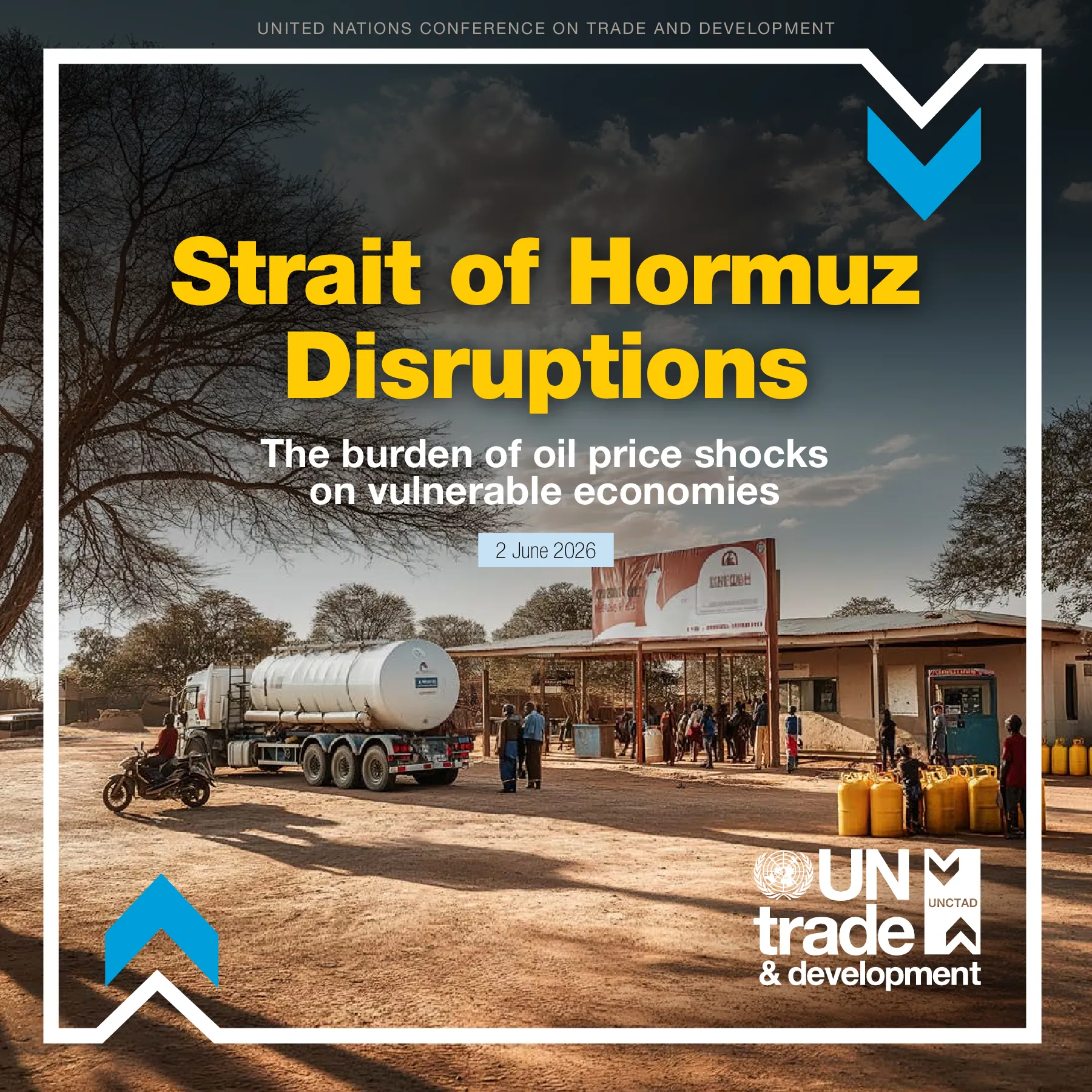
Introduction Disruptions in the Strait of Hormuz are sendingshockwaves through the global energy system. Vulnerable economies are on the front line:of 75 economies1–least developed countries (LDCs) andsmall island developing States (SIDS)–65 depend onimported oil. For these countries, rising energy prices will translateinto higher costs and difficult trade-offs—between coveringfuel bills and investing in essential public services.This will affect nearly 1 billion lives. Without relief, these shocks will further entrenchstructural vulnerabilities. Prices of oil and refined oil productshave risen sharply. Source:UN Trade and Development (UNCTAD), based on LSEG Data & Analytics. Notes:Price increases compare average prices for the period 1 January 2024 – 27 February 2026 with pricesduring the period following the military escalation, 28 February 2026 – 28 May 2026. Average crude oil pricesrefer to: Brent FOB (Europe), WTI Cushing (Northern America), Dubai Cash (Middle East), Urals CIF (RussianFederation). Average gasoline prices refer to: Regular Unleaded 10PPM Amsterdam, Rotterdam and Antwerp(Europe); Regular Unleaded FOB New York Harbour (Northern America); and 95 RON Singapore (Asia). Most vulnerable economies and theirpeople are exposed to the oil shock. vulnerable economies are net importers of oil65out of75 87%of small island developing States 86%of least developed countries More than30%live below the extremepoverty line of3$ per day million peoplelive in these vulnerable economies Source:UN Trade and Development (UNCTAD), based on UN Comtrade, UNCTADStat, Asian DevelopmentBank, and World Bank. Notes:Oil products refer to HS 2709 and 2710. Net importers excluding Singapore. Seven small islanddeveloping States are also least developed countries. Latest available data for the poverty headcount ratio at$3.00 a day, using 2021 purchasing power parities. Vulnerable economiesmainly import refined oil products. Share of net imports of crude and refined oil in 2024 Source:UN Trade and Development (UNCTAD), based on UN Comtrade. Notes:Lacking sufficient refining infrastructure, vulnerable economies mainly import refined oil products. Oilproducts refer toHS 2709 and HS 2710. The figures correspond to the 65 net oil importing vulnerable economies,excluding Singapore. What is theadditional costfor the vulnerable? The shock could raise the cost ofimporting oil by $20 billion yearly. Change in the net oil import bill from a 50% price increase,assuming quantities remained unchanged at 2024 levels Least developedcountries (LDCs)16.1 Small islanddeveloping States (SIDS)4.3 Source:UN Trade and Development (UNCTAD), based on UN Comtrade. Notes:Oil products refer to HS 2709 and 2710. Figures for 65 least developed countries and small islanddeveloping States that are net importers of crude and refined oil products, excluding Singapore. Seven leastdeveloped countries are also small island developing States; they are shown in the LDC aggregate. Least developed countries with an importbill increase above 0.5% of GDP Change in the net oil import bill from a 50% price increase,in per cent of GDP Source:UN Trade and Development (UNCTAD) computations, based on UN Comtrade and UNCTADStat. Note:Change in the cost of importing crude and refined oil (HS2709 and HS2710) related to a price increaseof 50% if quantities were held constant at 2024 levels. Small island developing States with animport bill increase above 0.5% of GDP Change in the net oil import bill from a 50% price increase,in per cent of GDP Source:UN Trade and Development (UNCTAD) computations, based on UN Comtrade and UNCTADStat. Notes:Change in the cost of importing crude and refined oil (HS2709 and HS2710) related to a price increaseof 50% if quantities were held constant at 2024 levels. Net importers excluding Singapore. Furthermore, some economies needto secure alternative supplies. Share of oil imports sourced from the Hormuz region in 2024,in per cent Source:UN Trade and Development (UNCTAD) computations, based on UN Comtrade. Notes:Countries sourcing more than 5% of their oil imports from the Hormuz region. Oil products refer to HS2709 and 2710. Hormuz region considered as Bahrain, Iran, Iraq, Kuwait, Qatar, Saudi Arabia, and UnitedArab Emirates. Net importers excluding Singapore. Key considerations INCREASED COST Higher oil prices raise freight and fuel costs, increasing theoverall cost of goods. BROADER INFLATION Many vulnerable economies rely heavily on fuel imports, whereoil price increases quickly raise the cost of living. Broaderinflationary pressures may also affect net oil-exporters. FISCAL PRESSURE Oil price shocks increase fiscal pressure in net-importingvulnerable economies, forcing trade-offs between shieldinghouseholds from price spikes and sustaining essentialservices and long-term investment, including for sustainabledevelopment. ECONOMIC SLOWDOWN Increased oil import bills can widen current account def