您的浏览器禁用了JavaScript(一种计算机语言,用以实现您与网页的交互),请解除该禁用,或者联系我们。 [PitchBook]:Consumer AI Landscape (English) 2026 - 发现报告

Consumer AI Landscape (English) 2026

信息技术 2026-06-15 PitchBook 胡冠群
报告封面

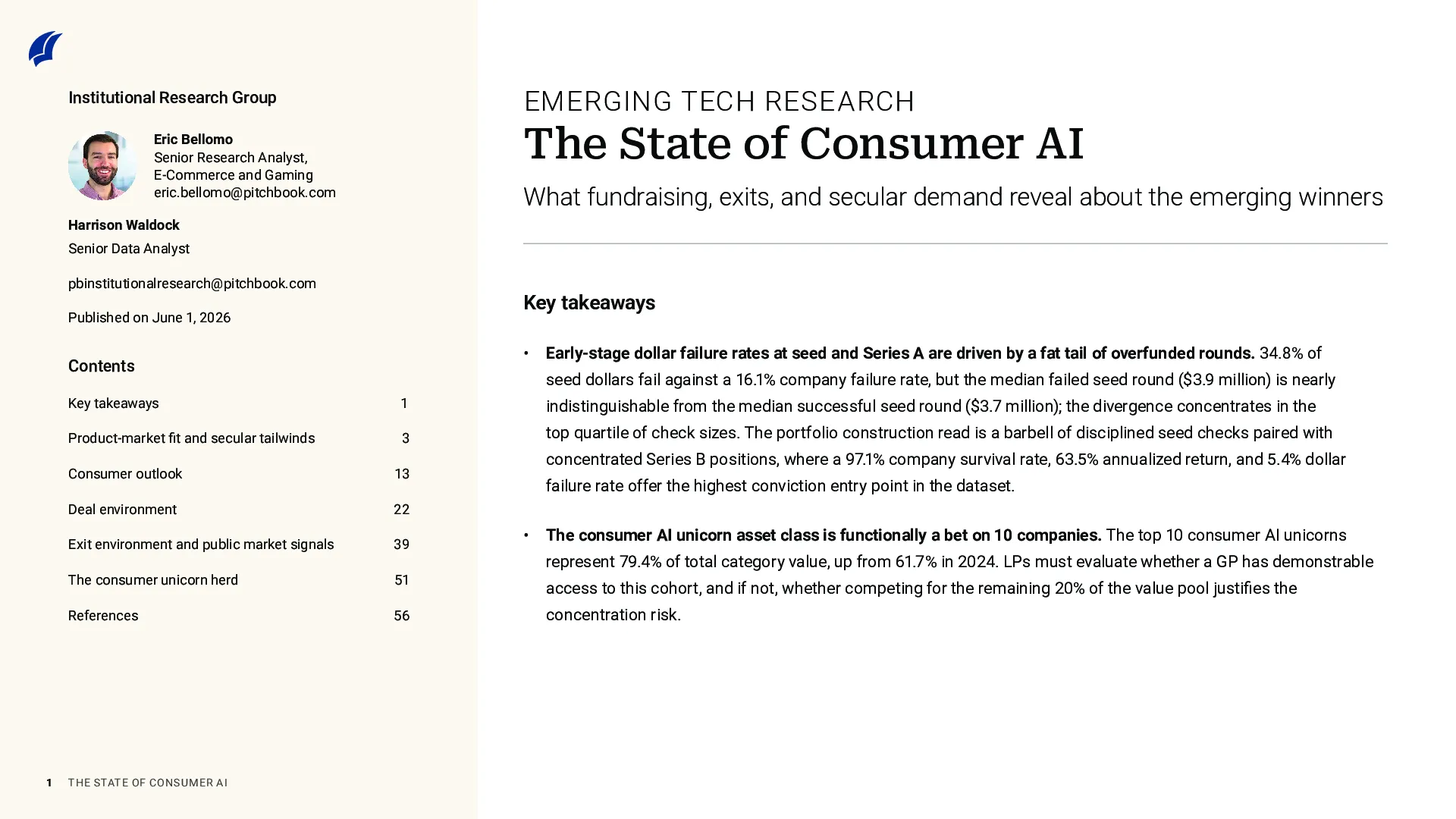
Institutional Research Group Eric BellomoSenior Research Analyst,E-Commerce and Gaming What fundraising, exits, and secular demand reveal about the emerging winners Harrison WaldockSenior Data Analystpbinstitutionalresearch@pitchbook.com Key takeaways •Early-stage dollar failure rates at seed and Series A are driven by a fat tail of overfunded rounds.34.8% ofseed dollars fail against a 16.1% company failure rate, but the median failed seed round ($3.9 million) is nearlyindistinguishable from the median successful seed round ($3.7 million); the divergence concentrates in the Contents Key takeaways1Product-market fit and secular tailwinds3Consumer outlook13Deal environment22Exit environment and public market signals39The consumer unicorn herd51References56 •The consumer AI unicorn asset class is functionally a bet on 10 companies.The top 10 consumer AI unicornsrepresent 79.4% of total category value, up from 61.7% in 2024. LPs must evaluate whether a GP has demonstrableaccess to this cohort, and if not, whether competing for the remaining 20% of the value pool justifies the •Shrinking equity stakes have made growth-stage return math nearly unworkable for single-stage funds.MedianSeries D+ ownership has fallen from 13.3% to 6.2% since 2016, meaning a 6% stake in a $5 billion platform(assuming typical post-round dilution) requires a $15 billion-plus exit just to 2x, a dynamic that structurally •Half of public B2C platforms show financial distress comparable to apparel retail.12 of 24 covered platforms carryAltman Z-scores below 3—clustering in travel, edtech, dating, and BNPL—compressing the pool of healthy public •Public market analysts have shifted from “Do you have an AI strategy?” to “Prove it’s working”—and VCs shouldexpect the same.Across 186 tracked earnings call questions, competition and execution have replaced roadmapinquiries as the dominant analyst focus, signaling that both public and private market investors will increasingly Adoption tracks model gains Token consumption and user spending are directly following the unbroken improvements in frontier language modelintelligence since mid-2023. Generative AI (GenAI) app downloads grew from roughly 200 million in 2022 to around 3.8billion in 2025, and mobile in-app purchase revenue scaled from under $200 million to $5 billion over a similar period.1 Source: PitchBook • Geography: Global • As of March 3, 2026 Source: PitchBook • Geography: Global • As of March 3, 2026 Analysts want proof AI is working We tracked 186 AI-related questions asked by equity research analysts covering B2C earnings calls—including Uber,Lyft, Airbnb, Spotify, DoorDash, Duolingo, Instacart, and others—from Q4 2022 through Q4 2025. The defining trendwas analysts shifting their questions from “Do you have an AI strategy?” to “Prove it’s working.” 90% of queries wereprobing and investigative in tone, with “product roadmap” overtaking “competition” and “partnership/integration” asthe leading focus in 2025. The market now presumes AI strategies exist and is determining whether leadership teams $100-plus-per-month tier rewrites B2C pricing Pricing data for B2C AI startups reveals a market in transition. The largest cluster is the $0 to $10/month cohorts,suggesting free-to-paid conversion playbooks are still the default operating model. A second peak at $30 to $50suggests that a maturing cohort of products is reaching for a productivity software price point. Notably, there is anemerging cohort of platforms priced over $100/month, a threshold that was commercially nonviable for consumerproducts before “the ChatGPT moment,” suggesting that a select batch of AI-native products are blurring the linebetween consumer and enterprise-grade services. OpenAI’s $200-per-month offering or Perplexity’s $167-per-month professional users. Closing the unit economics gap likely requires improvements in smaller models and open-sourceofferings. Other emergent monetization dynamics include revenue retention over 100%, a characteristic previouslyreserved for enterprise-grade platforms via tiered subscriptions, usage-based overages, and intra-tier price upgrades. Cross-referencing Claude directive usage, OpenAI ChatGPT message share, and B2C VC deal activity offers clearsignals on funding and use case alignment. Content creation sits at the top of all three signals: 43% directive ratefrom Claude, 28% of ChatGPT messages, and $3.8 billion in trailing 12-month (TTM) deal value, which grew 85%YoY.2, 3Education presents the most visible asymmetry: Both model datasets show meaningful engagement (Claude35% directive, OpenAI 10% tutoring share), but VC funding fell 65% YoY. The defensible wedges sit in startups withproprietary content libraries, credentialing infrastructure, or institutional distribution (for example, learning management Consumeroutlook Tariffs split B2C AI exposure Headline Consumer Price Index (CPI) has meaningfully recovered from the 2022 peak, sitting at roughly 2.4% as