您的浏览器禁用了JavaScript(一种计算机语言,用以实现您与网页的交互),请解除该禁用,或者联系我们。 [Sanford C. Bernstein]:Datadog 2026 DASH大会:AI赋能平台拓展及企业需求支持战略分析 - 发现报告

Datadog 2026 DASH大会:AI赋能平台拓展及企业需求支持战略分析

2026-06-12 Sanford C. Bernstein 叶剑锋
报告封面

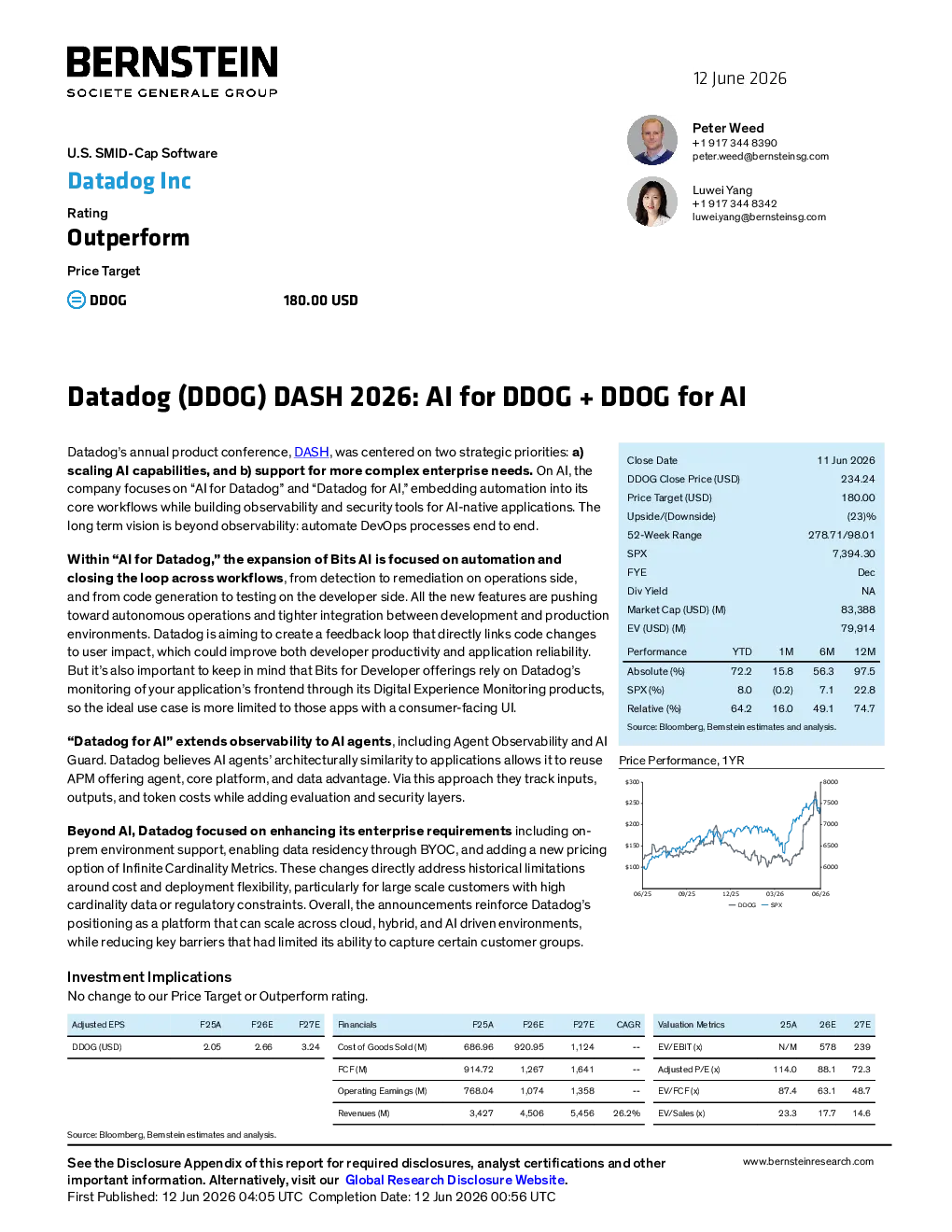
Peter Weed+1 917 344 8390peter.weed@bernsteinsg.com Price Target DDOG 180.00 USD Datadog (DDOG) DASH 2026: AI for DDOG + DDOG for AI Datadog’s annual product conference, DASH, was centered on two strategic priorities:a)scaling AI capabilities, and b) support for more complex enterprise needs.On AI, thecompany focuses on “AI for Datadog” and “Datadog for AI,” embedding automation into itscore workflows while building observability and security tools for AI-native applications. Thelong term vision is beyond observability: automate DevOps processes end to end. Within “AI for Datadog,” the expansion of Bits AI is focused on automation andclosing the loop across workflows, from detection to remediation on operations side,and from code generation to testing on the developer side. All the new features are pushingtoward autonomous operations and tighter integration between development and productionenvironments. Datadog is aiming to create a feedback loop that directly links code changesto user impact, which could improve both developer productivity and application reliability.But it’s also important to keep in mind that Bits for Developer offerings rely on Datadog’smonitoring of your application’s frontend through its Digital Experience Monitoring products,so the ideal use case is more limited to those apps with a consumer-facing UI. “Datadog for AI” extends observability to AI agents, including Agent Observability and AIGuard. Datadog believes AI agents’ architecturally similarity to applications allows it to reuseAPM offering agent, core platform, and data advantage. Via this approach they track inputs,outputs, and token costs while adding evaluation and security layers. Beyond AI, Datadog focused on enhancing its enterprise requirementsincluding on-prem environment support, enabling data residency through BYOC, and adding a new pricingoption of Infinite Cardinality Metrics. These changes directly address historical limitationsaround cost and deployment flexibility, particularly for large scale customers with highcardinality data or regulatory constraints. Overall, the announcements reinforce Datadog’spositioning as a platform that can scale across cloud, hybrid, and AI driven environments,while reducing key barriers that had limited its ability to capture certain customer groups. Investment Implications No change to our Price Target or Outperform rating. DETAILS At this year’s DASH conference focused on Datadog’s new product and feature releases focused primarily on two strategicareas: •The expansion of AI capabilities •Broader support for diverse deployment and pricing models Across both themes, the company is clearly positioning itself to extend beyond its traditional cloud observability leadership intoa more comprehensive platform that addresses emerging AI workloads and the evolving needs of large enterprises. AI STRATEGY: “AI FOR DATADOG” AND “DATADOG FOR AI” Datadog has categorized its AI strategy into two pillars: “AI for Datadog” that integrates AI into its platform and new products,and “Datadog for AI” that provides tooling to monitor and secure AI agents and AI systems themselves. AI FOR DATADOG: EXTENDING BITS AI ACROSS OPERATIONS AND DEVELOPMENT Within AI for Datadog, the company significantly expanded Bits AI, moving beyond operations workflows and increasinglyshifting left into developer workflows. On the operations side, the focus has been on closing the loop from incident detectionto automatic remediation. Bits AI already supported root cause investigation, but Datadog announced several new capabilitiesin preview, includingBits Detection, Bits Memory, and Bits Remediation. Together, these features aim to create a fullyautomated lifecycle spanning detection, investigation, and remediation. This same workflow structure has been extended to routine infrastructure management throughBits InfrastructureOperations. Rather than simply responding to incidents, the system is designed to proactively detect and resolve commonand repetitive infrastructure issues before they escalate. This represents a shift from reactive incident response to moreautonomous operations. On the developer side, Datadog mapped Bits AI capabilities to the standard workflow of code, deliver, and evaluate. Thecompany introducedBits Code, which generates code fixes;Bits Release, which creates validation plans for open pullrequests; andBits Testing, which generates synthetic tests for applications. These features are built on top of Datadog’sexisting digital experience monitoring portfolio and leverage Datadog’s access to the team’s source code, APM data, and RUMdata. By connecting code changes to downstream application impact, Datadog aims to provide developers with immediatefeedback on how their updates affect user experience. However, because the company’s visibility is heavily driven by frontendtelemetry, including RUM and session replay,these Bits for Developer capabilities are most effective for applications