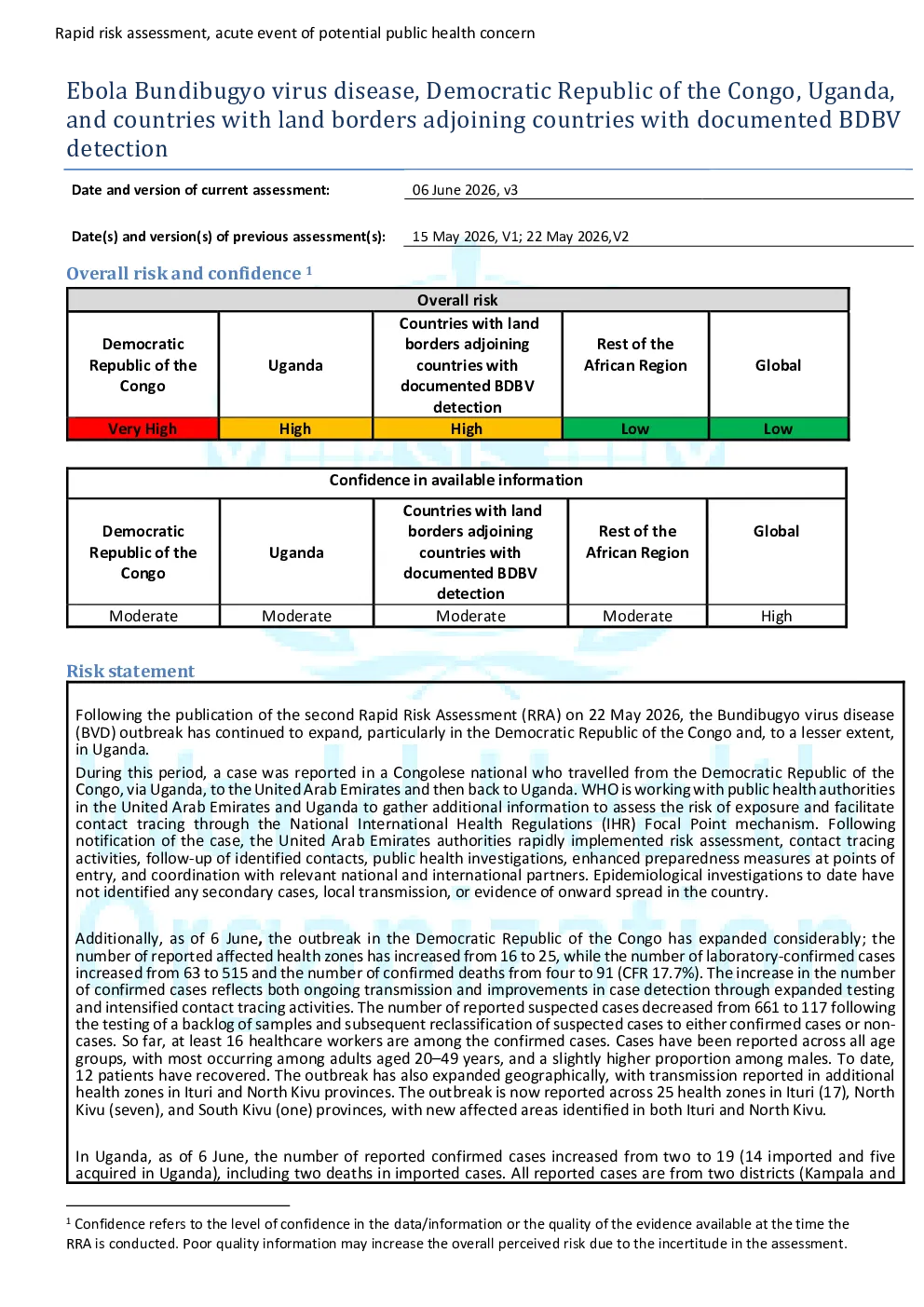
Dateandversionof current assessment: Date(s)andversion(s)of previous assessment(s):15 May 2026, V1; 22 May 2026,V2 Risk statement Following the publication of the second Rapid Risk Assessment (RRA) on 22 May 2026, the Bundibugyo virus disease(BVD)outbreak has continued to expand, particularly in the Democratic Republic of the Congo and, to a lesser extent,in Uganda. During this period,acasewas reportedin aCongolese national who travelled from the Democratic Republic of theCongo, viaUganda, to the United Arab Emirates and then back to Uganda. WHO is working with public health authoritiesin the United Arab Emiratesand Uganda to gather additional information to assess the risk of exposure and facilitatecontact tracing through the National International Health Regulations (IHR) Focal Point mechanism.Followingnotification of the case,theUnited Arab Emiratesauthorities rapidly implemented risk assessment, contact tracingactivities, follow-up of identified contacts, public health investigations, enhanced preparedness measures at points of Additionally, as of6June,the outbreak in theDemocratic Republic of the Congo has expanded considerably;thenumber ofreportedaffected health zones has increased from 16 to25, whilethe number oflaboratory-confirmed casesincreased from 63 to515andthe number ofconfirmed deaths from four to91(CFR 17.7%).The increase inthe numberofconfirmed cases reflects both ongoing transmission and improvements in case detection through expanded testingand intensified contact tracing activities.The number of reported suspected cases decreased from 661 to 117followingthe testing of a backlog of samples andsubsequent reclassification ofsuspectedcasesto either confirmed cases or non-cases.So far,at least16 healthcare workers are among the confirmed cases.Cases have been reported across all agegroups, with most occurring among adults aged 20–49 years, and a slightly higher proportion among males.To date, In Uganda,as of 6 June,the number of reported confirmed cases increased from twoto 19(14importedandfiveacquired in Uganda), including two deathsinimported cases. All reportedcasesarefromtwo districts(Kampalaand Rapidrisk assessment, acute event of potential public health concern Wakiso).Five healthcare workers are among theconfirmedcases, indicating transmission in healthcare settings.Todate, all cases in Uganda have been linked to importation from the Democratic Republic of the Congo or secondarycases linked to these; there has been no documented community transmission in Uganda. In light of the continued evolution of the outbreakand newly available information, including the increase inthenumber ofreported cases, geographic expansion, cross-border transmission to Uganda,and ongoing responseactivities, this RRA has been updated. Based on these developments and the WHOTemporary Recommendationsissuedby the WHO Director-General following the declaration of a Public Health Event of International Concern (PHEIC) forthe Ebola disease epidemic caused by Bundibugyo virus (BDBV)in the Democratic Republic of the Congo and Uganda,the risk for countries sharing land borders withcountries with documented BDBV detection,currentlytheDemocraticRepublic of the Congo and Uganda,has been separated out from the risk for other countries in the African Region: therisk in countries sharing land borders remains high, while the risk for other countriesin the African regionis assessed The risk intheDemocraticRepublic of the Congoremains assessed as very highdue to ongoing transmission and thecontinued expansion of the outbreak into new health zones, increasing the potential for further national and regionalspread. The key factors underpinning this assessment include: •The outbreak has continued to expand rapidly since the previous assessment.Between22Mayand6June2026, the number of confirmed cases increased more thaneightfoldfrom 63 to515cases, while the numberof health zoneswith confirmed cases hasincreased by56% (from 16 to 25), indicatingintensifiedtransmissionand geographicspread. out of 35.•According to the most up-to-date sub-national risk stratification analysis, which will be used to further informoperational response priorities, there are a total of 159 health zones currently deemed affected or at risk; thisclassifies the level of community transmission andunderscores the large geographic scale of response neededto control this outbreak.o25 health zones with confirmed cases, including 17 ‘hotspot’ health zonesand eight‘active’ healthzones2 o19 high-risk health zoneso115 at-risk health zones•Epidemiological links and the full chain of transmission are not yet clearly established, and the source of theoutbreak remains under investigation.•Retrospective investigations identified suspected viral haemorrhagic fever cases occurringback in March 2026,several weeks before outbreak confirmation, suggesting prolonged undetected transmission prior to May 2026and the establishment of multipledisconnected transmission ch