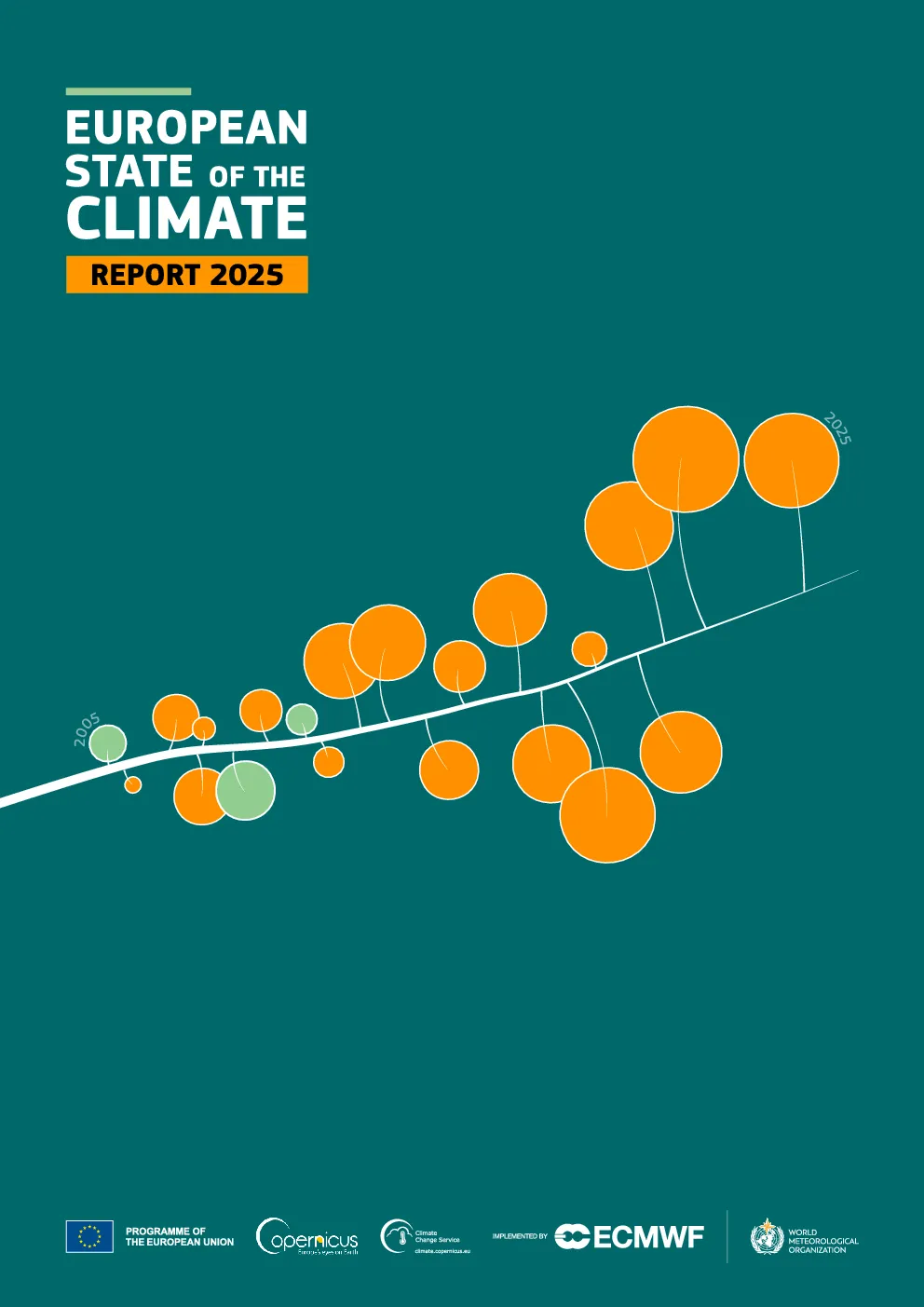
The data behind the art The cover art of the European State of the Climate 2025 provides an entry pointto a vast and multifaceted report. Vivid colours and simple shapes hint at scientificdata without overwhelming viewers, inviting closer engagement with the reportand the science behind it. Using ERA5 data, the visualisation depicts the annual temperature anomaly forEurope over the past 20 years. The data were first displayed as a scatterplot, whereeach dot corresponds to a year and its size is proportional to the magnitude ofthe anomaly. The chart was then gradually deconstructed: dots morph into leaves,while a trend line becomes a thinning branch symbolising the fragile equilibriumwe live in and the biodiversity loss we witness. Yellow and green indicate years withpositive and negative temperature anomalies, respectively. While communicatingthe warming trend across Europe, this symbolic organic form also hints at thebiodiversity themes explored in the report. © World Meteorological Organization and European Union, represented by the EuropeanCentre for Medium-Range Weather Forecasts (ECMWF), 2026. The right of publication in print, electronic and any other form and in any language is reserved byECMWF and WMO. Short extracts from this publication may be reproduced without authorisation,provided that the complete source is clearly indicated. Editorial correspondence and requests topublish, reproduce or translate this publication (articles) in part or in whole should be addressed to: ECMWF Communication Section – Copernicus Team European Centre for Medium-Range Weather Forecasts, ECMWFRobert-Schuman-Platz 3 - 53175 Bonn, Germanycopernicus-press@ecmwf.int Chair, Publications Board World Meteorological Organization (WMO) 7 bis avenue de la Paix - PO Box 2300 - CH-1211 Geneva 2, Switzerland+41 (0) 22 730 8403publications@wmo.int The designations employed and the presentation of material on the maps do not imply the expressionof any opinion whatsoever on the part of the C3S, ECMWF, or the Secretariats of WMO or the UnitedNations concerning the legal status of any country, territory or area or of its authorities, or concerningthe delimitation of its frontiers or boundaries. The depiction and use of boundaries, geographic namesand related data on maps and in lists, tables, documents and databases herein are not warranted tobe error-free and do not imply official endorsement or acceptance. The mention of specific companiesor products does not imply that they are endorsed or recommended in preference to others of a similarnature which are not mentioned or advertised. Published 29 April 2026 Welcome to the European Stateof the Climate (ESOTC) 2025 This annual flagship report is published by the Copernicus Climate Change Service (C3S) at the European Centrefor Medium-Range Weather Forecasts (ECMWF) and the World Meteorological Organization (WMO). ECMWFis a research institute and 24/7 operational service producing global weather predictions, and implementsC3S, which provides climate monitoring and forecasting for the globe, Europe and the Arctic, on behalf of theEuropean Commission. The WMO is the UN authoritative organisation that collates, monitors and predictsweather, climate and water resources, and provides related services at national, regional and global scalesthrough its 193 Members, the national meteorological and hydrological services. The ESOTC provides descriptions and analyses of climate conditions in Europe in theprevious year, covering variables from across the Earth system, key events and theirimpacts, and a discussion of climate policy and action with a focus on biodiversity. Italso provides updates to the long-term evolution of key Climate Indicators. The reportis the result of a collaborative effort involving around 100 scientists, and colleaguesacross Europe and the rest of the world. Together they analysed around 45 datasets,reported on about 45 different climate variables or indices, and reviewed, designedand published the ESOTC 2025. Globally, 2025 was the third-warmest year on record.1Each of the past 11 yearshas been among the 11 warmest on record, and the past three years were the threewarmest. The current level of global warming is estimated to be around 1.4°C abovethe pre-industrial level. If warming continues at the current rate, the Paris Agreement’slimit of 1.5°C for long-term global warming could be reached by the end of thisdecade, more than a decade sooner than predicted when the Agreement was signed. Atmospheric concentrations of the greenhouse gases carbon dioxide and methanecontinued to increase. Since the 1980s, Europe has been warming twice as fast as the global average,making it the fastest-warming continent on Earth. Heatwaves are becoming more frequent and severe. Glaciers in all European regionscontinue to melt. Changes in precipitation patterns, including an increase in theintensity of the most extreme events, have been observed. In 2025, annual temperatures