您的浏览器禁用了JavaScript(一种计算机语言,用以实现您与网页的交互),请解除该禁用,或者联系我们。 [落基山研究所]:动员私人资本减少新兴市场废物中的甲烷排放 - 发现报告

动员私人资本减少新兴市场废物中的甲烷排放

公用事业 2026-05-29 落基山研究所 徐雨泽
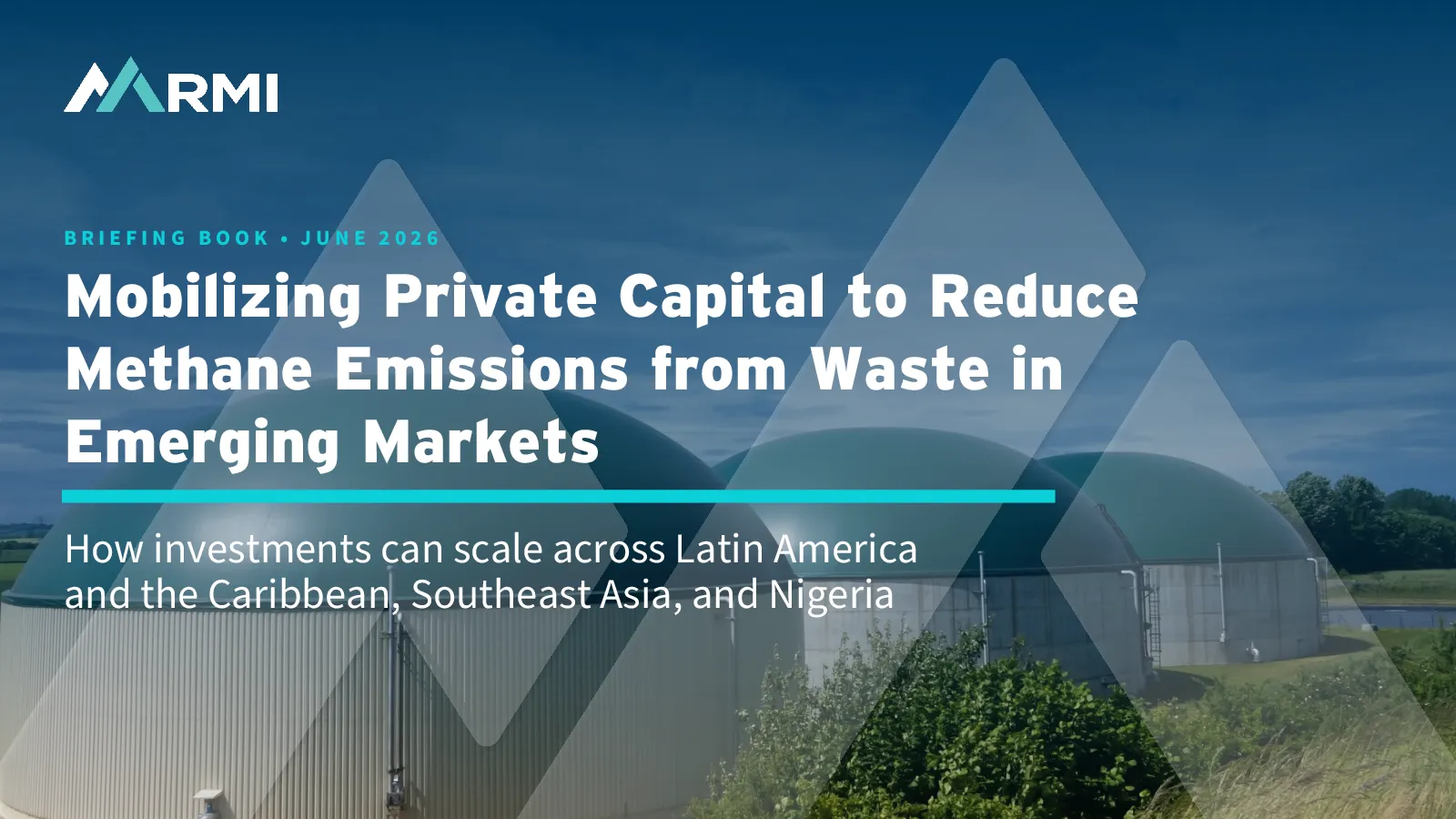
报告封面

B R I E F I N GB O O K•J U N E 2 0 2 6 Mobilizing Private Capital to ReduceMethane Emissions from Waste inEmerging Markets How investments can scale across Latin Americaand the Caribbean, Southeast Asia, and Nigeria Authors and Acknowledgements Copyrights and Citation Authors Shravan Bhat, EbunAyandele, Yuchen Wu, Jyoti Bodas, Tom Frankiewicz,Mobilizing Private Capital to Reduce Methane Emissions from Waste in EmergingMarkets: How Investments Can Scale Across Latin America and the Caribbean,Southeast Asia, and Nigeria, RMI, 2026,https://rmi.org/insight/mobilizing-private-capital-to-reduce-methane-emissions-from-waste-in-emerging-markets/. EbunAyandeleShravan BhatJyoti BodasTom FrankiewiczYuchen Wu Authors listed alphabetically. All authors from RMIunlessotherwise noted. AllphotosfromiStockunlessotherwisenoted. Contributors Hannah Barton, RMIBenjamin Bartle, RMINabil Bennouna, RMILila HolzmanVictoria Helms Acknowledgments The authors would like to thank the Global Methane Hub (GMH) for itsgenerous funding support, which made this report possible. The authors alsothank the individuals, financial institutions, and other organizations whoseinsights and feedback through stakeholder consultations informed this work,including Jiao Tang, Catalytic Finance Foundation; Felipe Rojas,ImplementaSur; Aditi Ramola, International Solid Waste Association (ISWA);the United Nations Economic Commission for Latin America and theCaribbean, and others. Contacts Tom Frankiewicz,tfrankiewicz@rmi.orgShravan Bhat,sbhat@rmi.org RMI–Energy. Transformed. About Us Rocky Mountain Institute (RMI) is an independent, nonpartisan nonprofit founded in 1982 thattransforms global energy systems through market-driven solutions to secure a prosperous, resilient,clean energy future for all. In collaboration with businesses, policymakers, funders, communities, andother partners, RMI drives investment to scale clean energy solutions, reduce energy waste, and boostaccess to affordable clean energy in ways that enhance security, strengthen the economy, and improvepeople’s livelihoods. RMI is active in over 50 countries. The Global Methane Hub organizes and unites governments, industry leaders, scientists, and nonprofitorganizations across the globe to minimize methane pollution through technology and common-sensepublic policies and regulations. The Hub has raised over $500 million in pooled funds from more than20 of the largest climate philanthropies to accelerate methane mitigation across theglobe.Visitwww.globalmethanehub.orgto learn more about organizations that support thecommitment. Table of Contents 5122443516578889496 Executive Summary and Key InsightsBackground and ContextWaste Methane 101Methane Abatement Finance LandscapeInvestment Archetypes, Risks, and MitigantsRegional Focus: Latin AmericaRegional Focus:SoutheastAsiaCountry Deep Dive:NigeriaConclusionAppendices Executive Summaryand Key Insights Executive Summary Thisbriefing book is prepared for private FIs interested in exploring sustainable energyinvestments in emerging markets and municipal leaders looking to more successfullyengage those institutions. It describes the current waste methane ecosystem, outlinesthe diverse benefits of waste methane investments, and explores key methanemitigation technologies including AD, LFGTE, and black soldier fly (BSF). Across thesetechnologies, we prioritize AD and LFGTE investments because they are better suited toprivate finance deployment at scale. The waste sector is a major and under-addressed source of methane emissions,accounting for approximately 20% of human-caused methane globally. Mature andproven technologies like anaerobic digestion (AD) and landfill gas to energy (LFGTE) arereadily available and widely deployed in developed markets although adoption inemerging economies has been slow. Many project developers in these markets cite difficulties accessing capital. Despitedemand for capital,lack of credible bankable projectslimits its supply. Only $6.1billion was invested in waste methane mitigation in 2021/22, well below the $20 millioninvestment need. Most projects fail to meet the investment criteria for capital providerslike revenue certainty, risk allocation, and scale, often resulting from poor feedstockquality, weak policy and regulatory frameworks, and operational challenges. Our analysis indicates a sizeable investment opportunity for private FIs in Latin Americaand Southeast Asia to support and capitalize waste methane mitigation. Across Brazil,Chile, Colombia, and Mexico, which represent 75% of regional solid waste methaneemissions, an annual investment of $2.3 billion and $7.3 billion is needed by 2030 and2050respectively. Across Indonesia, the Philippines, Vietnam, Thailand, and Malaysia,which collectively accounts for 95% of the region’s solid waste methane emissions, $1billion and $3 billion in annual investment is needed by 2030 and 2050, respectively. To bridge the project readiness and investor