全球经济驱动因素:人形机器人对宏观经济的重要性
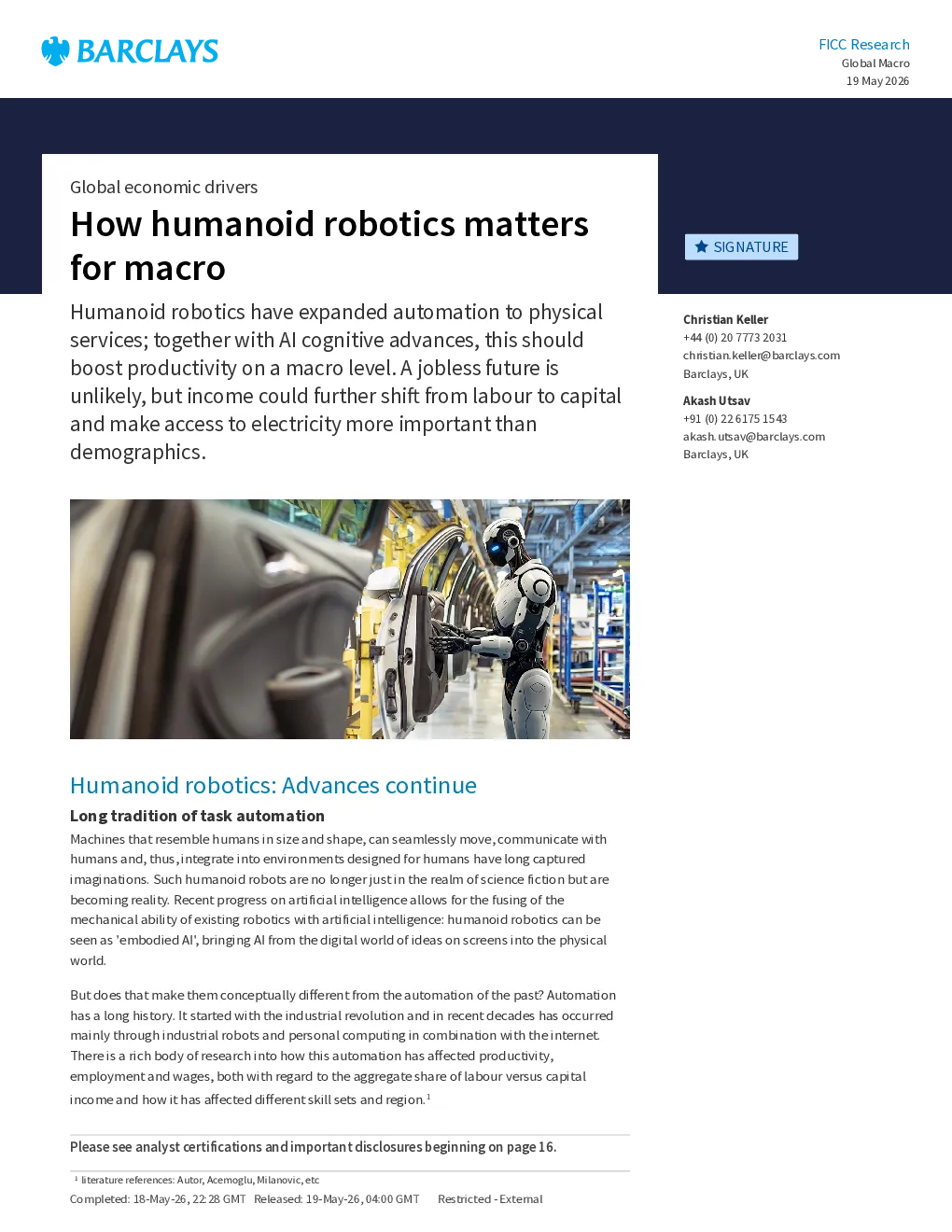
How humanoid robotics mattersfor macro SIGNATURE Humanoid robotics have expanded automation to physicalservices; together with AI cognitive advances, this shouldboost productivity on a macro level. A jobless future isunlikely, but income could furthershiftfrom labour to capital Christian Keller+44 (0) 20 7773 2031christian.keller@barclays.comBarclays, UK Akash Utsav+91 (0) 22 6175 1543akash.utsav@barclays.comBarclays, UK Humanoid robotics: Advances continue Long tradition of task automation Machines that resemble humans in size and shape, can seamlessly move, communicate withhumans and, thus, integrate into environments designed for humans have long capturedimaginations. Such humanoid robots are no longer just in the realm of science fiction but arebecoming reality. Recent progress on artificial intelligence allows for the fusing of the But does that make them conceptuallydifferentfrom the automation of the past? Automationhas a long history. It started with the industrial revolution and in recent decades has occurredmainly through industrial robots and personal computing in combination with the internet.There is a rich body of research into how this automation hasaffectedproductivity, More recently, generative AI, predominantly in the form of large language models (LLMs), hasdramatically expanded automation to cognitive tasks and has exposed services considered'high-skill' (ie, requiring higher education), which thus far had been lessaffectedby automation.Such high-skill cognitive work had in past decades typically also seen better trends in Cognitive meets physical: From tasks to occupations However, even this new automation through gen AI has something in common with theprevious forms: it remains largely task specific. Current automation through LLMs still focuseson cognitive micro-tasks (eg, coding), the waysoftwarehelped with word processing oraccounting tasks and large factor robots performed certain task in auto manufacturing. Humanoid robots join the cognitive with the physical. They could introduce an AI-enabledphysical generality, exposing not only more individual physical tasks to automation, but alsobeing able to perform various heterogeneous tasks combined. They could be broadly adaptableacross a wide range of functions, instead of just optimising single tasks (as traditional robots),thus serving in many industries. Being able to move between environments designed for In sum, humanoid robots might not only broaden the universe of tasks that can be automatedbut also be able to collapse previous task boundaries. This could enable ashiftfrom from taskto occupation-wide substitution. Put in the terms of economic theory: by merging cognitive and Hello productivity, bye bye Baumol and bottlenecks From micro- to macro-level productivity gains Exposure, adoption anddiffusion:From task, to sector, to economy Paul Krugman famously stated that 'productivity isn't everything, but in the long run, it isalmost everything'. Hence, the fundamental question with every new technology is how toestimate its potential macro-level (ie, economy-wide) productivity gains. Initially, a newtechnology typically shows large productivity gains in certain tasks, but it is far from clear that Approaching this task, the first set of question is: what are the observed productivity gains fromthe new technology in certain tasks; how many tasks in a sector are exposed to the newtechnology; and to what extent and how quickly will the technology be adopted in the relevant task-specific productivity gains * exposure * adoption rate = sector's productivity gain As a next step, the economy-wide productivity gains should be the sum of the sectoral gainsweighted by the share each sector has in the economy's output (ie, its share in GDP): sectoral productivity gains * sectoral weights in GDP = GDP-wide productivity gain This provides a first-order approximation of a positive microeconomic productivity shock on theaggregate economy, known as the Hulten’s theorem (ie, formulated by economist Charles R.Hulten in 1978). It shows that under perfect competition andefficientallocation of resources, FIGURE 3. Micro-level productivity gains in specific task do not automatically result in macro-levelproductivity gains for the aggregate economy. Note: Step 1. is inspired by Acemoglu (2024), adapted to our sector-level framework. Step 2. builds on the multi-sector model in Baqaee and Farhi (2019).Source: OECD (November 2024)In-elasticities, frictions, reallocation: How growth is lost 1 | 18 May 2026Such estimates of productivity gains based on Hulten's theorem provide a first approximation.However, they depend on several crucial conditions, including no frictions and perfect Restricted - Externalcompetition that allowsefficientresource allocation. Theseoftendo not reflect the economicreality, complicating any extrapolation from sectoral productivity gains to economy-wide gains. As an entire economy adjusts to sectoral produ