您的浏览器禁用了JavaScript(一种计算机语言,用以实现您与网页的交互),请解除该禁用,或者联系我们。 [美国银行]:研究所就业报告:2026年4月 - 发现报告

研究所就业报告:2026年4月

信息技术 2026-05-01 美国银行 李辰
报告封面

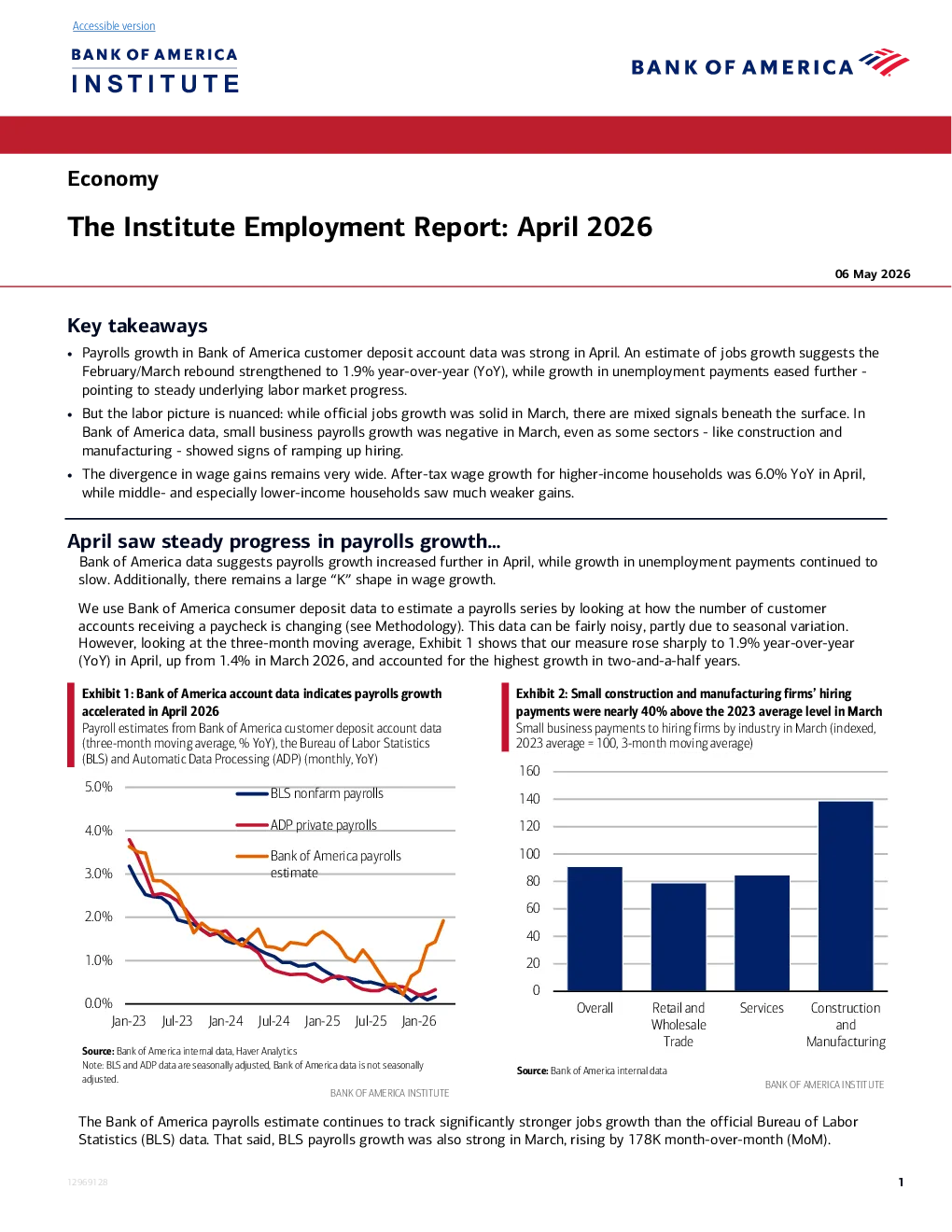
The Institute Employment Report: April 2026 06 May 2026 Key takeaways •Payrolls growth in Bank of America customer deposit account data was strong in April. An estimate of jobs growth suggests theFebruary/March rebound strengthened to 1.9% year-over-year (YoY), while growth in unemployment payments eased further - But the labor picture is nuanced: while official jobs growth was solid in March, there are mixed signals beneath the surface. InBank of America data, small business payrolls growth was negative in March, even as some sectors - like construction and The divergence in wage gains remains very wide. After-tax wage growth for higher-income households was 6.0% YoY in April,while middle- and especially lower-income households saw much weaker gains. April saw steady progress in payrolls growth… Bank of America data suggests payrolls growth increased further in April, while growth in unemployment payments continued toslow. Additionally, there remains a large“K”shape in wage growth. We use Bank of America consumer deposit data to estimate a payrolls series by looking at how the number of customeraccounts receiving a paycheck is changing (see Methodology). This data can be fairly noisy, partly due to seasonal variation.However, looking at the three-month moving average,Exhibit 1shows that our measure rose sharply to 1.9% year-over-year Exhibit2:Small construction and manufacturing firms’ hiringpayments were nearly 40% above the 2023 average level in March Payroll estimates from Bank of America customer deposit account data(three-month moving average, % YoY), the Bureau of Labor Statistics(BLS) and Automatic Data Processing (ADP) (monthly, YoY) Small business payments to hiring firms by industry in March (indexed,2023 average = 100, 3-month moving average) The Bank of America payrolls estimate continues to track significantly stronger jobs growth than the official Bureau of LaborStatistics (BLS) data. That said, BLS payrolls growth was also strong in March, rising by 178K month-over-month (MoM). It remains to be seen whether the recent increase in oil prices and the associated pass-through to transport costs will weigh onemployment growth going forward. Bank of America data indicates that small business payrolls growth was negative in March,marking three consecutive months of declines. But the overall employment situation is nuanced–with signs that small firms inconstruction and manufacturing were ramping up hiring as of March 2026 (Exhibit 2). For more, read publication:Small Business Exhibit3:Unemployment payment growth continued todeclineinApril Exhibit4:InApril, higher-income households’ after-tax wagegrowth rose to 6.0% YoY, while lower-income households’ wage Number of households receiving unemployment payments (three-monthmoving average, YoY%, not seasonally adjusted (NSA)) and ContinuingClaims (three-month moving average, YoY%, seasonally adjusted (SA)) After-tax wage and salary growth by household income terciles, based onBank of America aggregated consumer deposit account data (three-month moving average, YoY%, SA) Alongside rising jobs growth, Bank of America data on unemployment payments into customer accounts continues to showeasing growth. In April, unemployment payments growth dropped to 7.4% YoY (Exhibit 3). BLS Continuing Claims data has also Higher-income households have experienced much stronger after-tax wage growthThere remains a significant gap in after-tax wage growth between income groups (Exhibit 4). In April, higher-income households saw their after-tax wage growth rise to 6.0% YoY–the highest rate we’ve observed since August 2021. In fact, even within thiscohort there is a divergence, with after-tax wage growth for the highest 5% of households by income stronger than that of the Middle- and lower-income households also saw increases in their after-tax wage growth in April, to 2.3% YoY and 1.5% YoY,respectively. But the gap between these cohorts and higher-income households remains at its widest level since our data seriesbegan in 2015. MethodologySelected Bank of America transaction data is used to inform the macroeconomic views expressed in this report and should be considered in the context of other economic indicators and publicly available information. In certain instances, the data mayprovide directional and/or predictive value. The data used is not comprehensive; it is based onaggregated and anonymized Any payments data represents aggregated spend from US Retail, Preferred, Small Business and Wealth Management clients witha deposit account or credit card. Aggregated spend include total credit card, debit card, ACH, wires, bill pay, business/peer-to- AnySmall Businesspayments data represents aggregate spend from Small Business clients with a deposit account or a SmallBusiness credit card. Payroll payments data include channels such as ACH (automated clearing house), bill pay, checks and wire.Bank of America per Small Business client data represents acti